Stamp Duty Calculator UK (SDLT, LBTT & LTT)
Calculate your stamp duty instantly. Use this SDLT calculator for England and Northern Ireland, or switch region for LBTT in Scotland and LTT in Wales.
Property Details
Enter the full purchase price of the property (max £25,000,000)
Reviewed by

Julie White
ACASDLT Expert since 1999Stamp Duty Land Tax Specialist
ACA and Tax Adviser with a career spanning nearly four decades, specialising in SDLT planning and advisory work since 1999.
Results
Reviewed by
Julie White
ACASDLT Expert since 1999Stamp Duty Land Tax Specialist
ACA and Tax Adviser with a career spanning nearly four decades, specialising in SDLT planning and advisory work since 1999.
Disclaimer: This tool does not constitute financial advice. We do not recommend taking actions based solely on these results. The calculator makes assumptions and results may be inaccurate due to changes in government policy, interest rates, or personal circumstances. You use this information at your own risk. We can't guarantee to be perfect, so do note you use the information at your own risk and we can't accept liability if things go wrong. For official guidance, visit Gov UK.
Stamp duty is the progressive transfer tax paid by UK property buyers. England and Northern Ireland charge Stamp Duty Land Tax (SDLT), Scotland charges Land and Buildings Transaction Tax (LBTT), and Wales charges Land Transaction Tax (LTT). You pay 0% on the first slice of the price, then higher rates on each subsequent band.
Current 2026 thresholds: SDLT starts at 2% above £125,000 (0% for first-time buyers under £300,000). Scotland's LBTT nil-rate band is £145,000; Wales's LTT nil-rate band is £225,000. Additional-property buyers pay a 5% surcharge in England, 8% ADS in Scotland. Non-UK residents pay a further 2% on top.
Our calculator applies these 2026 bands automatically across all four nations, including first-time buyer relief, the additional-property surcharge, and the non-resident surcharge.
What our Stamp Duty Calculator handles
Every UK stamp duty rule, surcharge and relief is built into the calculator above. Updated for 2026 rates across all four nations.
All 4 UK nations
SDLT for England & NI, LBTT for Scotland, LTT for Wales
First-time buyer relief
0% SDLT up to £300,000 (England), £175k threshold (Scotland)
Second home & buy-to-let
5% surcharge in England, 8% ADS in Scotland, higher LTT in Wales
Non-UK resident surcharge
Extra 2% on top of standard SDLT for overseas buyers
2026 rates built in
Current bands and thresholds applied automatically
No registration required
Instant results, no email signup, no payment, no limits
What is Stamp Duty?
Stamp duty is a tax paid by property buyers in the UK when purchasing residential or commercial property above certain thresholds. In England and Northern Ireland, it is called Stamp Duty Land Tax (SDLT) and is administered by HMRC. Scotland has its own system called Land and Buildings Transaction Tax (LBTT), managed by Revenue Scotland, while Wales charges Land Transaction Tax (LTT), administered by the Welsh Revenue Authority.
Stamp duty is a progressive tax, meaning you only pay each rate on the portion of the property price that falls within each band, not on the entire purchase price. The buyer is legally responsible for paying and filing a return within 14 days of completion. Solicitors or conveyancers typically handle the filing on the buyer's behalf.
Several reliefs and exemptions exist, including first-time buyer relief (no SDLT up to £300,000 in England), reduced rates for shared ownership purchases, and exemptions for properties transferred between spouses during divorce. Additional surcharges apply for second homes (5%), buy-to-let properties (5%), and non-UK residents (2%).
14 days to file
After completion
Progressive bands
Pay per portion
Reliefs available
FTB, shared ownership
3 UK tax systems
SDLT, LBTT, LTT
How your stamp duty is worked out
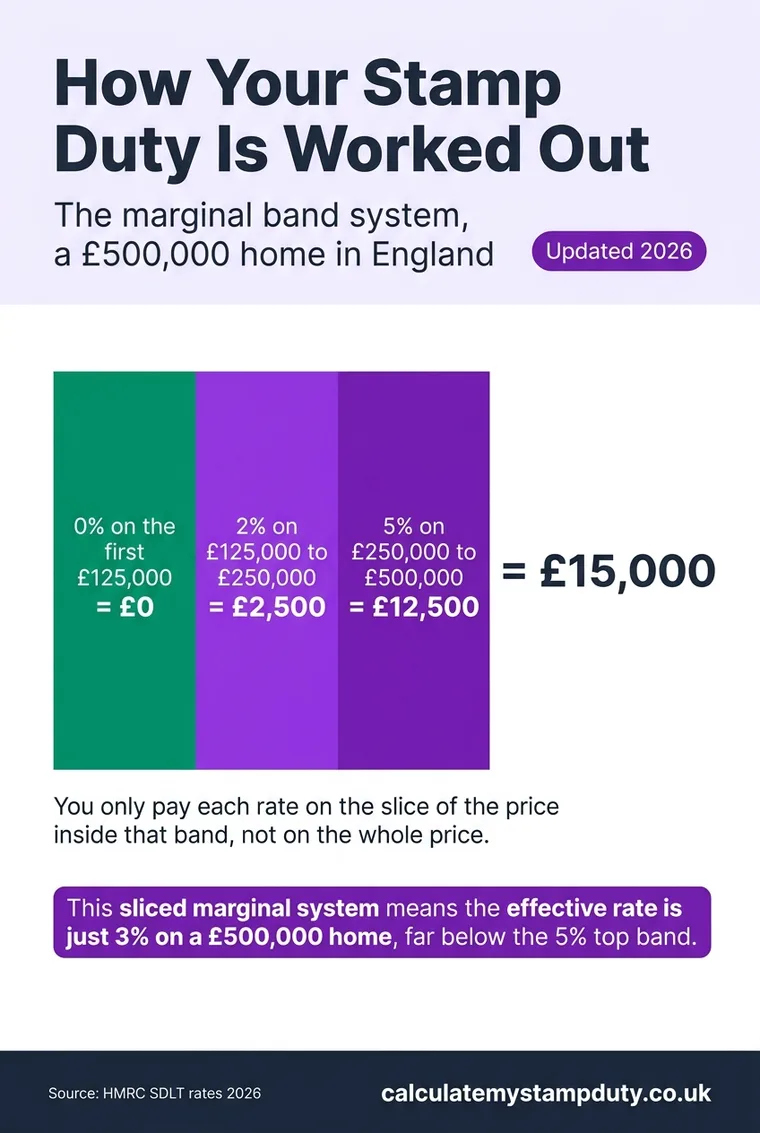
Stamp duty is charged in slices, not as a single flat percentage. You pay each rate only on the portion of the purchase price that falls inside that band, never on the whole amount.
On a £500,000 home in England that works out at £15,000: nothing on the first £125,000, 2% on the next £125,000, then 5% on the remainder. That is an effective rate of just 3%. The full England and Northern Ireland ladder runs 0% to £125,000, 2% to £250,000, 5% to £925,000, 10% to £1.5 million, then 12% on anything above.
Because of this banded system, most buyers owe far less than the headline rate for their price bracket would suggest. Scotland and Wales slice the price the same way, just from different starting points: LBTT begins at £145,000, or £175,000 for first-time buyers, and LTT begins at £225,000.
Current UK Stamp Duty Rates 2026
The UK has three separate property transaction tax systems. Rates shown are for standard residential purchases. Surcharges apply for additional properties and non-UK residents.
England & Northern Ireland
Stamp Duty Land Tax (SDLT)
| Band | Rate |
|---|---|
| £0 to £125,000 | 0% |
| £125,000 to £250,000 | 2% |
| £250,000 to £925,000 | 5% |
| £925,000 to £1,500,000 | 10% |
| £1,500,000+ | 12% |
First-time buyers: 0% up to £300,000 (properties up to £500,000)
Additional properties: +5% surcharge
Non-UK residents: +2% surcharge
Scotland
Land & Buildings Transaction Tax (LBTT)
| Band | Rate |
|---|---|
| £0 to £145,000 | 0% |
| £145,000 to £250,000 | 2% |
| £250,000 to £325,000 | 5% |
| £325,000 to £750,000 | 10% |
| £750,000+ | 12% |
First-time buyers: 0% up to £175,000
Additional Dwelling Supplement: 8%
Wales
Land Transaction Tax (LTT)
| Band | Rate |
|---|---|
| £0 to £225,000 | 0% |
| £225,000 to £400,000 | 6% |
| £400,000 to £750,000 | 8% |
| £750,000 to £1,500,000 | 10% |
| £1,500,000+ | 12% |
No first-time buyer relief in Wales
Separate higher residential rate bands for additional properties (from 5%)
Stamp duty rates by buyer type
Three people buying the same house can owe very different amounts. A standard buyer and an additional property buyer use the same band boundaries, so those two can be read across directly. First-time buyer relief uses its own thresholds and is shown separately below.
| Portion of purchase price | Standard buyer | Additional property |
|---|---|---|
| Up to £125,000 | 0% | 5% |
| £125,000 to £250,000 | 2% | 7% |
| £250,000 to £925,000 | 5% | 10% |
| £925,000 to £1,500,000 | 10% | 15% |
| Over £1,500,000 | 12% | 17% |
The additional property column is the standard rate plus the 5% surcharge, which applies once the price reaches £40,000. Non-UK residents add a further 2% on top of whichever column applies. Scotland charges LBTT and Wales charges LTT on entirely separate band tables.
First-time buyer rates
First-time buyer relief does not sit on the standard band boundaries. It has its own two bands, and it is lost entirely if the price is above £500,000.
| Portion of purchase price | First-time buyer rate |
|---|---|
| Up to £300,000 | 0% |
| £300,000 to £500,000 | 5% |
| Any purchase above £500,000 | No relief, standard rates apply |
The cliff edge is absolute rather than tapered. A first-time buyer paying £500,000 owes £10,000, but at £500,001 the relief is lost completely and the bill jumps to £15,000. Every buyer on a joint purchase must be a first-time buyer for the relief to apply at all.
How the calculation works, band by band
Stamp duty is charged in slices. Each rate applies only to the portion of the price inside that band, never to the whole amount. The three examples below take the same £300,000 property and show the full working for each buyer type.
Standard buyer
£300,000 purchase in England or Northern Ireland
| Band | Rate | Taxed on | Tax |
|---|---|---|---|
| Up to £125,000 | 0% | £125,000 | £0 |
| £125,000 to £250,000 | 2% | £125,000 | £2,500 |
| £250,000 to £925,000 | 5% | £50,000 | £2,500 |
| Total stamp duty | £5,000 | ||
| Effective rate on the whole price | 1.7% | ||
Someone moving home, or buying who does not already own another residential property.
First-time buyer
£300,000 purchase in England or Northern Ireland
| Band | Rate | Taxed on | Tax |
|---|---|---|---|
| Up to £300,000 | 0% | £300,000 | £0 |
| Total stamp duty | £0 | ||
| Effective rate on the whole price | 0.0% | ||
No one on the purchase has ever owned a residential property anywhere in the world.
Additional property
£300,000 purchase in England or Northern Ireland
| Band | Rate | Taxed on | Tax |
|---|---|---|---|
| Up to £125,000 | 5% | £125,000 | £6,250 |
| £125,000 to £250,000 | 7% | £125,000 | £8,750 |
| £250,000 to £925,000 | 10% | £50,000 | £5,000 |
| Total stamp duty | £20,000 | ||
| Effective rate on the whole price | 6.7% | ||
A second home, holiday home or buy-to-let, where you will own two or more properties at completion.
Your own figure depends on the exact price and your circumstances. Enter them in the calculator at the top of this page, or see the full stamp duty rates for 2026 including Scotland and Wales.
Sources
Rates and thresholds on this page are taken from the following primary sources and were last checked on 2 August 2026.
- HMRC: Stamp Duty Land Tax residential property rates (current SDLT bands for England and Northern Ireland)
- HMRC SDLT Manual, SDLTM09730 (higher rates for additional dwellings)
- Finance Act 2003, Schedule 4ZA (statutory basis for the additional dwelling surcharge)
- Revenue Scotland: Land and Buildings Transaction Tax (LBTT bands and the Additional Dwelling Supplement)
- Welsh Revenue Authority: Land Transaction Tax rates and bands (LTT bands for Wales)
Get your stamp duty right before you exchange
An annexe, extra land, an old home you have not sold yet or a possible refund can all change the figure. An independent SDLT specialist confirms yours.
What clients say
How much stamp duty will you pay?
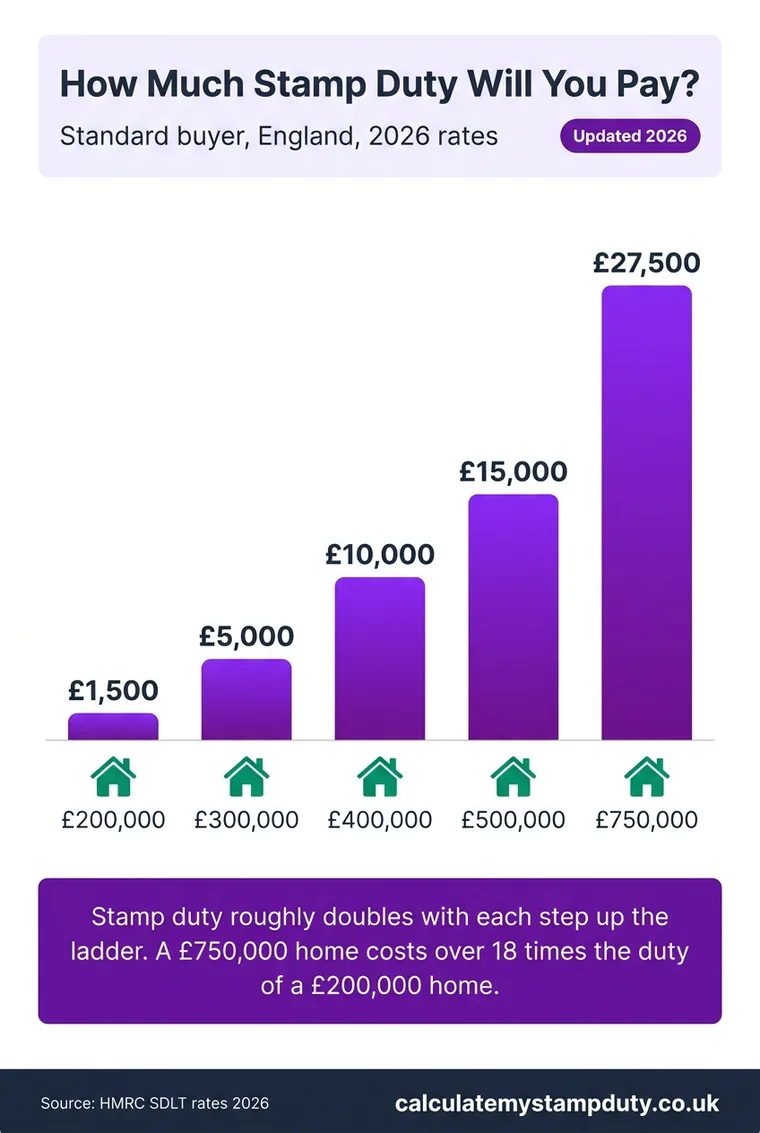
Your stamp duty bill rises steeply as the purchase price climbs. A standard buyer in England pays £1,500 on a £200,000 home, £5,000 at £300,000, £15,000 at £500,000, and £27,500 at £750,000. See the full stamp duty by property price breakdown for every price point and buyer type.
Buyer type changes the figure too. First-time buyers pay nothing up to £300,000 and 5% on the slice from £300,001 to £500,000, while second-home and buy-to-let buyers add a 5% surcharge on every band in England and Northern Ireland, up from 3% on 31 October 2024, or an 8% Additional Dwelling Supplement in Scotland. Two people buying the same house can owe very different amounts.
Enter your own price and buyer type in the calculator at the top of the page for an exact, band-by-band figure.
Our Most Popular Calculators
Quick, accurate tools to help you understand your stamp duty commitments
- Most Popular
Stamp Duty Calculator
Calculate SDLT on any property price using 2026 progressive tax bands for England & Northern Ireland
Calculate stamp duty now - Popular
First-Time Buyer
No SDLT up to £300,000 on properties up to £500,000. Check eligibility and calculate your savings
First time buyer stamp duty calculator Second Home
Calculate stamp duty with the 5% additional property surcharge (in force since 31 October 2024)
Second home stamp duty calculatorBuy-to-Let
SDLT for investment properties including the 5% additional property surcharge for landlords
Calculate buy-to-let SDLTNon-Resident Buyer
Calculate the additional 2% overseas buyer surcharge on top of standard or additional property rates
Calculate non-resident SDLTCost of Buying
Total property purchase costs including stamp duty, legal fees, surveys, and mortgage charges
Calculate total buying costs
Stamp Duty by Buyer Type
Your stamp duty bill depends on whether you are a first-time buyer, home mover, or purchasing an additional property. Each buyer type has different thresholds, reliefs, and surcharges.
First-Time Buyer
No SDLT up to £300,000
On properties up to £500,000. Save up to £5,000 compared to standard rates.
First time buyer stamp duty calculatorHome Mover
0% up to £125,000
Standard progressive rates apply. Selling your only home? No surcharge applies.
Calculate home mover stamp dutySecond Home
5% surcharge on entire price
Additional property surcharge of 5% (raised from 3% on 31 October 2024). Refund possible if you sell your old home within 3 years.
Calculate second home stamp dutyBuy-to-Let
5% surcharge for landlords
Same additional property surcharge as second homes. Applies even if this is your first property purchase.
Calculate buy-to-let stamp dutyNon-UK Resident
Additional 2% surcharge
Charged on top of standard rates (or on top of the 5% additional property surcharge if buying a second home).
Calculate non-resident stamp duty
Learn How Stamp Duty Really Works
Expert guides to help you navigate the complexities of UK stamp duty
- FTB Relief8 min read
First-Time Buyer Guide
Complete guide to FTB stamp duty relief, eligibility criteria, and how to claim your savings
Read Guide - Surcharge Rules6 min read
Second Home Stamp Duty
Understand the 5% surcharge, replacement main residence rules, and refund eligibility
Read Guide - Tax Bands7 min read
How Stamp Duty is Calculated
Learn how the progressive tax bands work and understand your calculation
Read Guide
April 2025 Stamp Duty Changes
From 1 April 2025, the temporary SDLT thresholds introduced in September 2022 reverted to their previous levels. (The additional property surcharge had already increased from 3% to 5% on 31 October 2024.)
| Change | Before April 2025 | From April 2025 |
|---|---|---|
| Standard nil-rate band | £250,000 | £125,000 |
| First-time buyer nil-rate band | £425,000 | £300,000 |
| FTB relief property limit | £625,000 | £500,000 |
These changes mean most buyers now pay more stamp duty. A first-time buyer purchasing at £400,000, for example, pays £5,000 under the current rates compared to £0 under the temporary thresholds.
Read full analysis of April 2025 changesCompare Stamp Duty Scenarios
See how different buyer types and regions affect your stamp duty bill
- FTBvsSTD
First-Time vs Standard
See how much you save with first-time buyer relief
Compare Now - SDLTvsLBTT
England vs Scotland
Compare SDLT and LBTT rates side by side
Compare Now - RESvsBTL
Standard vs Buy-to-Let
Understand the 5% surcharge impact on your costs
Compare Now - OLDvsNEW
Pre vs Post April 2025
See how the April 2025 changes affected your stamp duty bill
Compare Now - LTDvsPER
Company vs Personal
Compare tax treatment of owning property personally vs through a company
Compare Now
Where your moving money goes
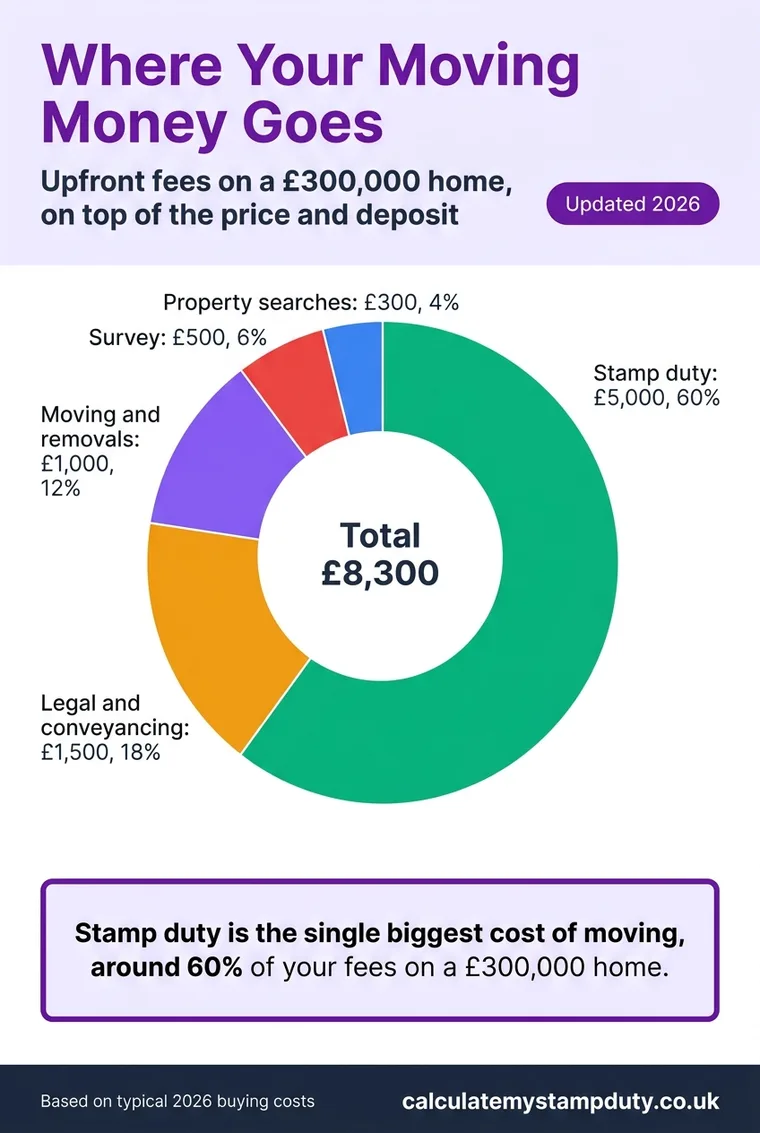
Stamp duty is usually the single biggest upfront cost of moving. On a typical £300,000 purchase it works out at around 60% of your fees, ahead of legal work, surveys, property searches and removals.
These costs sit on top of your deposit and fall due around completion, so it pays to budget for them early rather than treat them as an afterthought. Stamp duty carries the tightest deadline: in England and Northern Ireland the SDLT return and payment are due within 14 days of completion, and missing it brings an automatic £100 penalty, rising to £200 once you are more than three months late.
Our cost-of-buying calculator totals stamp duty, fees and mortgage together so you can see the full cash you need.
Interactive Tools, Guides & Downloads
Everything you need to assess, plan and compare your stamp duty in one place.
Frequently Asked Questions
Quick answers to common stamp duty questions with current 2026 rates and thresholds
How much stamp duty will I pay?
Stamp duty depends on the property price, your buyer status, and the UK region. In England, you pay 0% on the first £125,000, then 2% up to £250,000, 5% up to £925,000, 10% up to £1.5 million, and 12% above that. Use our SDLT calculator above for an instant, personalised estimate.
How stamp duty is calculatedDo first-time buyers pay stamp duty?
First-time buyers in England and Northern Ireland pay no stamp duty on properties up to £300,000, and 5% on the portion between £300,001 and £500,000. If the property costs more than £500,000, standard rates apply in full. Scotland offers a higher nil-rate threshold of £175,000 for FTBs. Wales has no first-time buyer relief.
First-time buyer stamp duty guideWhat is the additional property surcharge?
If you are buying a second home, buy-to-let, or any additional residential property in England or Northern Ireland, you pay a 5% surcharge on top of the standard SDLT rates (increased from 3% on 31 October 2024). Scotland charges 8% Additional Dwelling Supplement (ADS) and Wales uses separate higher residential rates.
Second home stamp duty guideWhen do I need to pay stamp duty?
You must file an SDLT return and pay the tax within 14 days of completion (the date you legally become the owner). Late filing incurs automatic penalties: £100 if up to 3 months late, £200 if later. Interest is also charged on unpaid tax. Your solicitor or conveyancer usually handles the filing.
SDLT filing and payment guideIs stamp duty different in Scotland and Wales?
Yes. Scotland uses Land and Buildings Transaction Tax (LBTT) with a nil-rate band of £145,000 (£175,000 for first-time buyers) and different rate bands. Wales charges Land Transaction Tax (LTT) with a nil-rate band of £225,000 and no first-time buyer relief. Each system is administered by a separate tax authority.
Compare regional ratesCan I claim a stamp duty refund?
You may claim a refund of the additional property surcharge if you sell your previous main residence within 3 years of buying your new home. Refund claims must be made within 12 months of the sale of the old property, or within 12 months of the filing date, whichever is later. HMRC processes most refund claims within 15 working days.
Stamp duty refund guide