UK Stamp Duty Rates 2026: Bands, Thresholds & Surcharges
The current stamp duty rates, bands and thresholds for 2026 across the UK. In England and Northern Ireland (SDLT) you pay 0% up to £125,000, then 2%, 5%, 10% and 12%, with a 5% additional-property surcharge. Scotland (LBTT) and Wales (LTT) set their own bands. Full rate tables, thresholds and worked examples for each nation are below.
Stamp Duty Rates & Thresholds 2026 at a Glance
Stamp duty is charged in bands: you pay each rate only on the portion of the price that falls within that band. These are the 2026 rates and thresholds now in force across the UK.
England & NI (SDLT)
- £0 to £125,000: 0%
- £125,001 to £250,000: 2%
- £250,001 to £925,000: 5%
- £925,001 to £1.5m: 10%
- Over £1.5m: 12%
Scotland (LBTT)
- £0 to £145,000: 0%
- £145,001 to £250,000: 2%
- £250,001 to £325,000: 5%
- £325,001 to £750,000: 10%
- Over £750,000: 12%
Wales (LTT)
- £0 to £225,000: 0%
- £225,001 to £400,000: 6%
- £400,001 to £750,000: 7.5%
- £750,001 to £1.5m: 10%
- Over £1.5m: 12%
Key thresholds and surcharges
- First-time buyers (England): 0% up to £300,000, then 5% to £500,000 (no relief above £500,000).
- Additional property / second home (England): +5% surcharge on every band, applying from £40,000.
- Non-UK residents (England): +2% surcharge on top of the applicable rate.
- Scotland ADS: 8% additional dwelling supplement. Wales: separate higher residential bands for additional property.
Your bill depends on the exact price and buyer type. Use the SDLT calculator for a precise, band-by-band figure.
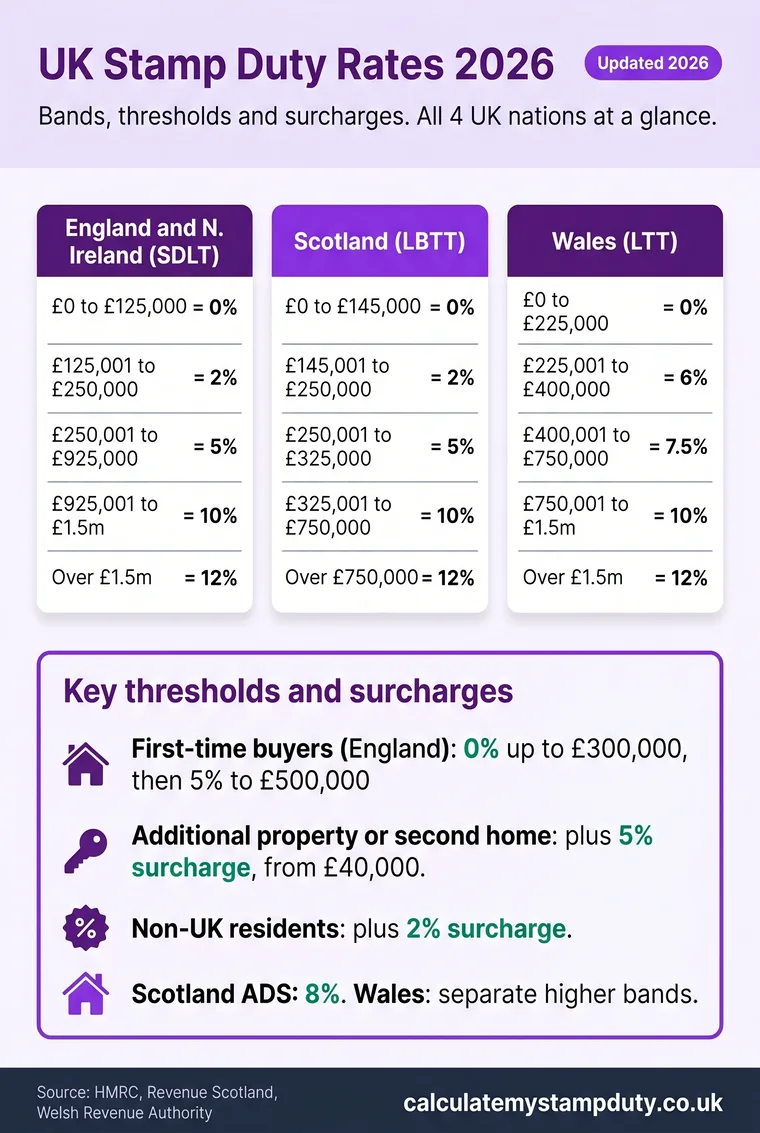
2026 stamp duty rates in one image
Every UK rate band and threshold in a single view: England and Northern Ireland (SDLT), Scotland (LBTT) and Wales (LTT) side by side, so you can compare what each nation charges at a glance.
It also captures the headline extras, first-time buyer relief up to £300,000, the 5% additional-property surcharge and the 2% non-resident surcharge.
These are the rates in force for 2026, after the April 2025 threshold changes, and they apply whether you are buying a home to live in, a second property or a buy-to-let investment.
What Changed Across the UK Between October 2024 and April 2025
Three of the four UK nations adjusted property transfer tax in the 2024 to 2025 window. England and Northern Ireland reverted nil-rate thresholds in April 2025 after the temporary relief expired. Scotland raised its Additional Dwelling Supplement in December 2024. Wales introduced separate higher residential bands the same month. The points below summarise the England/NI changes; nation-specific timelines live on each dedicated page.
For a side-by-side view of England's before/after, see our pre vs post April 2025 comparison.
Nil-Rate Threshold Reduced
The standard nil-rate band dropped from £250,000 back to £125,000.
Buyers pay more stamp duty on properties between £125,001 and £250,000.
First-Time Buyer Threshold Reduced
FTB relief threshold dropped from £425,000 to £300,000.
First-time buyers pay more on properties priced £300,001 to £425,000.
Additional Property Surcharge Increased (October 2024)
The surcharge for second homes and buy-to-lets increased from 3% to 5% on 31 October 2024 (Autumn Budget 2024). Already in force when the April 2025 threshold changes took effect.
Additional property buyers pay significantly more across all price bands.
FTB Maximum Price Reduced
First-time buyer relief maximum property price dropped from £625,000 to £500,000.
FTB relief no longer available for properties over £500,000.
England & Northern Ireland (SDLT) at a Glance
The headline numbers for England and Northern Ireland: nil-rate band of £125,000, top rate of 12% above £1.5 million, first-time buyer relief up to £300,000 (capped at £500,000 properties), and a 5% surcharge on additional properties. Non-residents pay a further 2% on top. See the full England SDLT band tables below for step-by-step worked examples at £250k, £350k, £500k and £750k, FTB savings illustrations and the residency test.
Standard Rates
| Band | Rate |
|---|---|
| £0 - £125,000 | 0% |
| £125,001 - £250,000 | 2% |
| £250,001 - £925,000 | 5% |
| £925,001 - £1,500,000 | 10% |
| Over £1,500,000 | 12% |
First-Time Buyer Rates
| Band | Rate |
|---|---|
| £0 - £300,000 | 0% |
| £300,001 - £500,000 | 5% |
Only for properties up to £500,000
Additional Property (+5%)
| Band | Rate |
|---|---|
| £0 - £125,000 | 5% |
| £125,001 - £250,000 | 7% |
| £250,001 - £925,000 | 10% |
| £925,001 - £1,500,000 | 15% |
| Over £1,500,000 | 17% |
Non-UK residents pay an additional 2% surcharge on all bands.
England SDLT Combined Rate Table (All Buyer Types)
The table below consolidates every England and Northern Ireland SDLT band into a single view, so you can read across to compare what a standard buyer, first-time buyer and additional property buyer each pay on the same portion of the purchase price. SDLT operates on a sliced (marginal) basis: each rate only applies to the portion of the price falling within that band, not to the whole purchase price.
| Property Value Band | Standard | First-Time Buyer | Additional Property |
|---|---|---|---|
| £0 to £125,000 | 0% | 0% | 5% |
| £125,001 to £250,000 | 2% | 0% | 7% |
| £250,001 to £300,000 | 5% | 0% | 10% |
| £300,001 to £500,000 | 5% | 5% | 10% |
| £500,001 to £925,000 | 5% | Standard rates apply | 10% |
| £925,001 to £1,500,000 | 10% | Standard rates apply | 15% |
| Over £1,500,000 | 12% | Standard rates apply | 17% |
First-time buyer relief only applies to properties priced up to £500,000. Non-UK residents pay an additional 2% surcharge on top of all rates shown above.
Key Facts
- No SDLT on first £125,000 of any standard purchase
- Rates are marginal: each band applies only to the portion within it
- SDLT is paid by the buyer, not the seller
- Due within 14 days of completion
Standard Buyer Quick Estimates
- £200,000 property£1,500
- £300,000 property£5,000
- £400,000 property£10,000
- £500,000 property£15,000
- £750,000 property£27,500
England SDLT Worked Examples
The following examples show step-by-step band calculations at four common property prices for each buyer type. For personalised figures, use our England SDLT calculator. We also have full breakdowns at 20 price points from £250k to £2m with regional comparisons.
£250,000 Property
Standard Buyer
0% on £125,000 = £0
2% on £125,000 (up to £250,000) = £2,500
Total: £2,500
First-Time Buyer
0% on £250,000 (below £300k threshold) = £0
Total: £0
Saving vs standard: £2,500
Additional Property
5% on £125,000 = £6,250
7% on £125,000 (up to £250,000) = £8,750
Total: £15,000
£350,000 Property
Standard Buyer
0% on £125,000 = £0
2% on £125,000 = £2,500
5% on £100,000 (£250k to £350k) = £5,000
Total: £7,500
First-Time Buyer
0% on £300,000 = £0
5% on £50,000 (£300k to £350k) = £2,500
Total: £2,500
Saving vs standard: £5,000
Additional Property
5% on £125,000 = £6,250
7% on £125,000 = £8,750
10% on £100,000 = £10,000
Total: £25,000
£500,000 Property
Standard Buyer
0% on £125,000 = £0
2% on £125,000 = £2,500
5% on £250,000 (£250k to £500k) = £12,500
Total: £15,000
First-Time Buyer
0% on £300,000 = £0
5% on £200,000 (£300k to £500k) = £10,000
Total: £10,000
Saving vs standard: £5,000
Additional Property
5% on £125,000 = £6,250
7% on £125,000 = £8,750
10% on £250,000 = £25,000
Total: £40,000
£750,000 Property
Standard Buyer
0% on £125,000 = £0
2% on £125,000 = £2,500
5% on £500,000 (£250k to £750k) = £25,000
Total: £27,500
First-Time Buyer
Property exceeds £500,000: standard rates apply in full with no FTB relief.
Total: £27,500
Additional Property
5% on £125,000 = £6,250
7% on £125,000 = £8,750
10% on £500,000 = £50,000
Total: £65,000
England First-Time Buyer Relief in Detail
First-time buyers purchasing a property priced at or below £500,000 benefit from a higher nil-rate threshold of £300,000. This means no SDLT is due on the first £300,000, and the 5% rate applies only to the portion between £300,001 and £500,000. If the purchase price exceeds £500,000, the standard rates apply in full with no relief.
First-Time Buyer Savings vs Standard Rates
- £300,000 propertySave £5,000
- £350,000 propertySave £5,000
- £400,000 propertySave £5,000
- £500,000 propertySave £5,000
Maximum saving is £5,000 at any property price between £300,000 and £500,000 (FTBs avoid 2% on £125,001 to £250,000 = £2,500, plus 5% on £250,001 to £300,000 = £2,500, total £5,000).
Who qualifies?
All buyers named on the purchase must be first-time buyers, meaning none of them has ever owned a residential property anywhere in the world, including inherited property. Both partners in a couple must qualify for joint purchases to receive FTB relief. Inheriting does not itself create an SDLT charge, but it can cost you first-time buyer status and trigger the surcharge on a later purchase: see stamp duty on inherited property.
England Additional Property Surcharge (+5%) in Detail
A 5% surcharge applies to purchases of additional residential properties, including buy-to-let investments, second homes, and holiday homes. The surcharge is added to the standard SDLT rate at every band, meaning it effectively doubles the SDLT liability at the lower end and adds significantly at higher price points. The surcharge increased from 3% to 5% on 31 October 2024. To price a specific purchase with the surcharge already applied, use our second home stamp duty calculator, which handles buy-to-let, holiday home and any other additional property purchase under the same 5% rules.
Additional Property Estimates
- £200,000 property£11,500(vs £1,500 standard)
- £350,000 property£25,000(vs £7,500 standard)
- £500,000 property£40,000(vs £15,000 standard)
- £750,000 property£65,000(vs £27,500 standard)
Refund available
If you buy a new main residence before selling your previous one, you pay the higher rates. You can claim a refund of the 5% surcharge if you sell the previous property within 36 months of the new purchase.
Non-Resident Surcharge (+2%) and the Residency Test
Non-UK residents pay an additional 2% SDLT surcharge on top of the applicable residential rates. This surcharge was introduced in April 2021 and applies to buyers who are not present in the UK for at least 183 days in the 12-month period before the purchase date.
| Scenario | UK Resident Rate | Non-Resident Rate |
|---|---|---|
| Standard buyer (main home) | 0 to 12% | 2 to 14% |
| Additional property buyer | 5 to 17% | 7 to 19% |
| First-time buyer (up to £500k) | 0 to 5% | 2 to 7% |
Residency Test
You are treated as a UK resident for SDLT purposes if you were present in the UK for at least 183 days in the continuous 12-month period ending on the effective date of the transaction. If multiple buyers are involved, all must meet the UK residency test to avoid the surcharge.
The non-resident surcharge is applied before other reliefs are calculated. It can be refunded if you subsequently become UK resident within 2 years of the transaction.
When England SDLT Applies
SDLT applies based on the location of the property being purchased, not the location of the buyer. If you are buying a property in England or Northern Ireland, SDLT applies regardless of where you live. The tax is administered by HMRC and must be reported and paid within 14 days of the completion date. Scotland replaced SDLT with Land and Buildings Transaction Tax (LBTT) in April 2015, and Wales replaced it with Land Transaction Tax (LTT) in April 2018. Northern Ireland continues to use SDLT under the same rates as England.
SDLT applies to:
- Freehold residential property purchases over £40,000
- Leasehold residential property purchases
- Transfers of equity where a mortgage is involved
- Mixed-use property (commercial rates apply)
England SDLT Payment Deadlines and Penalties
SDLT must be paid and an SDLT return filed with HMRC within 14 days of the effective date of the transaction (usually the completion date). This deadline was reduced from 30 days in March 2019. Missing the deadline results in automatic late filing penalties and interest charges on the unpaid tax.
| Late Period | Penalty |
|---|---|
| Up to 3 months late | £100 fixed penalty |
| 3 to 12 months late | £200 fixed penalty |
| Over 12 months late | 5 to 100% of tax due (deliberate cases higher) |
| All late payments | Interest at HMRC rate on unpaid amount |
Your conveyancing solicitor will usually handle the SDLT return and payment on your behalf. For full details on SDLT filing requirements, see our guide to SDLT filing and payment guide.
Annexe, land or an old home not sold yet?
These are the purchases where a standard calculator can get your stamp duty wrong. Get it checked before you exchange.
England SDLT Frequently Asked Questions
How much stamp duty on a £300,000 house in England?
A standard buyer pays £5,000 SDLT on a £300,000 property (0% on £125,000 = £0, plus 2% on £125,000 = £2,500, plus 5% on £50,000 = £2,500, totalling £5,000). A first-time buyer pays £0 because the entire price falls within the £300,000 nil-rate threshold. An additional property buyer pays £20,000 (5% on £125,000 = £6,250, plus 7% on £125,000 = £8,750, plus 10% on £50,000 = £5,000, totalling £20,000). Use our calculator for the precise figure.
Do first-time buyers pay stamp duty in England?
First-time buyers in England pay no SDLT on properties priced up to £300,000. For properties between £300,001 and £500,000, they pay 5% only on the portion above £300,000. For properties above £500,000, the standard rates apply in full with no first-time buyer relief. The maximum SDLT saving for a first-time buyer compared to a standard buyer is £5,000 (on any property between £300,000 and £500,000).
What is the additional property surcharge in England?
Buyers purchasing a second home, buy-to-let property, or any additional residential property in England pay a 5% surcharge on top of the standard SDLT rates at every band. This surcharge was increased from 3% to 5% on 31 October 2024 as part of the Autumn Budget measures. The surcharge can be reclaimed if you sell your previous main residence within 36 months of the new purchase. Our stamp duty calculator for second home purchases shows the surcharge broken down band by band.
Do non-residents pay extra stamp duty in England?
Yes. Non-UK residents purchasing residential property in England pay a 2% surcharge on top of the applicable SDLT rates. Residency is determined by presence in the UK for at least 183 days in the 12-month period before purchase. If a non-resident is also buying an additional property, both surcharges stack, resulting in rates up to 19% at the highest band. The non-resident surcharge can be refunded if you become UK resident within 2 years.
Current Scotland LBTT Rates
For full LBTT rate tables, ADS details, and worked examples, see our dedicated Scotland LBTT rates page.
Standard Rates
| Band | Rate |
|---|---|
| £0 - £145,000 | 0% |
| £145,001 - £250,000 | 2% |
| £250,001 - £325,000 | 5% |
| £325,001 - £750,000 | 10% |
| Over £750,000 | 12% |
FTB relief raises nil-rate to £175,000 (max saving £600)
With ADS (+8%)
| Band | Rate |
|---|---|
| £0 - £145,000 | 8% |
| £145,001 - £250,000 | 10% |
| £250,001 - £325,000 | 13% |
| £325,001 - £750,000 | 18% |
| Over £750,000 | 20% |
Additional Dwelling Supplement is 8% (increased from 6% in December 2024)
Current Wales LTT Rates
For full LTT rate tables and worked examples, see our dedicated Wales LTT rates page.
Standard Rates
| Band | Rate |
|---|---|
| £0 - £225,000 | 0% |
| £225,001 - £400,000 | 6% |
| £400,001 - £750,000 | 7.5% |
| £750,001 - £1,500,000 | 10% |
| Over £1,500,000 | 12% |
No specific FTB relief - all buyers use standard rates
Higher Residential Rates
| Band | Rate |
|---|---|
| £0 - £180,000 | 5% |
| £180,001 - £250,000 | 8.5% |
| £250,001 - £400,000 | 10% |
| £400,001 - £750,000 | 12.5% |
| £750,001 - £1,500,000 | 15% |
| Over £1,500,000 | 17% |
Separate rate bands for additional properties (from Dec 2024)
Which Nation Is Cheapest at Your Price Point?
The cheapest UK nation for stamp duty depends entirely on the property price. Below is what a standard buyer (non-FTB, main residence) would pay across the three regimes at three reference price points:
| Property Price | England SDLT | Scotland LBTT | Wales LTT |
|---|---|---|---|
| £200,000 | £1,500 | £1,100 | £0 |
| £300,000 | £5,000 | £4,600 | £4,500 |
| £500,000 | £15,000 | £23,350 | £18,000 |
Key insight: Wales typically offers the lowest rates for properties under £400,000 due to its £225,000 nil-rate band. Scotland is competitive for properties under £325,000. England becomes cheaper above £325,000 due to lower rates in higher bands.
UK 4-Nation Feature Comparison
| Feature | England & NI | Scotland | Wales |
|---|---|---|---|
| Tax Name | SDLT | LBTT | LTT |
| Nil-Rate Threshold | £125,000 | £145,000 | £225,000 |
| Additional Property Rate | 5% | 8% | Separate bands |
| FTB Relief | Up to £5,000 | Up to £600 | None |
| Refund Period | 36 months | 36 months | 36 months |
Frequently Asked Questions About Stamp Duty Rates
What are the current stamp duty rates in the UK?
In England and Northern Ireland, the current SDLT rates range from 0% (up to £125,000) to 12% (over £1.5 million). Scotland uses LBTT with rates from 0% (up to £145,000) to 12% (over £750,000). Wales uses LTT with 0% up to £225,000 and 12% over £1.5 million. First-time buyer relief and additional property surcharges vary by region.
When did stamp duty rates last change?
England saw two recent rate changes. On 31 October 2024, the additional property surcharge increased from 3% to 5% and the corporate body flat rate rose from 15% to 17%. On 1 April 2025, the standard nil-rate band reduced from £250,000 to £125,000 and the FTB nil-rate dropped from £425,000 (£625,000 cap) to £300,000 (£500,000 cap). Scotland's ADS increased from 6% to 8% on 5 December 2024. Wales adopted separate higher residential rate bands on 11 December 2024.
Are stamp duty rates going up in 2026?
No new stamp duty rates have been announced for 2026, and the rates that took effect on 1 April 2025 remain in place. The next Budget is on Wednesday 28 October 2026, and on 27 July 2026 the Prime Minister ruled out changing or scrapping stamp duty at it, saying "that won't be happening". That rules it out for this Budget rather than permanently, so treat the April 2025 rates as the current baseline rather than a settled long-term position.
Which UK nation is cheapest for stamp duty?
There is no single answer: it depends on the property price. Wales (LTT) is cheapest below roughly £225,000 because of its £225k nil-rate band. Scotland (LBTT) is competitive below £325,000. England & NI (SDLT) become the cheapest of the three for standard buyers above £325,000 and especially above £750,000, because of lower top-band rates. First-time buyers see the largest relief in England (up to £5,000), then Scotland (up to £600); Wales has no FTB relief. For step-by-step calculations on a single nation, follow the linked nation pages above.
What is the highest stamp duty rate?
The highest standard residential SDLT rate in England is 12% on the portion of property value over £1,500,000. For additional properties, the effective rate is 17% (12% + 5% surcharge). Non-UK residents can pay up to 19% (12% + 5% additional property + 2% non-resident). Companies buying residential property over £500,000 pay a flat 17% corporate rate.
What are the stamp duty rates for 2025-26?
The 2025-26 tax year rates (1 April 2025 to 31 March 2026) are the same as the current 2026 rates shown on this page. The standard nil-rate band is £125,000, with rates rising to 12% above £1.5 million. First-time buyers pay 0% up to £300,000 on properties up to £500,000. The additional property surcharge is 5%.
What are the current SDLT rates in England?
England uses Stamp Duty Land Tax (SDLT) with rates of 0% (up to £125,000), 2% (£125,001-£250,000), 5% (£250,001-£925,000), 10% (£925,001-£1,500,000), and 12% (over £1,500,000). See the full England SDLT tables below for worked examples and FTB calculations.
What are the stamp duty thresholds for 2026?
The England SDLT nil-rate threshold is £125,000 for standard buyers and £300,000 for first-time buyers (on properties up to £500,000). The additional-property surcharge applies from £40,000. Scotland LBTT starts at £145,000 and Wales LTT at £225,000.
What are the current LBTT rates in Scotland?
Scotland uses Land and Buildings Transaction Tax (LBTT) with rates of 0% (up to £145,000), 2% (£145,001-£250,000), 5% (£250,001-£325,000), 10% (£325,001-£750,000), and 12% (over £750,000). The Additional Dwelling Supplement is 8%. See our detailed Scotland LBTT rates page.
What are the current LTT rates in Wales?
Wales uses Land Transaction Tax (LTT) with rates of 0% (up to £225,000), 6% (£225,001-£400,000), 7.5% (£400,001-£750,000), 10% (£750,001-£1,500,000), and 12% (over £1,500,000). Wales has no first-time buyer relief but has the highest nil-rate band. See our detailed Wales LTT rates page.
Calculate Your Stamp Duty
Use our calculator to get an instant estimate based on these rates.
Open the Stamp Duty CalculatorReviewed by

Julie White
ACASDLT Expert since 1999Stamp Duty Land Tax Specialist
ACA and Tax Adviser with a career spanning nearly four decades, specialising in SDLT planning and advisory work since 1999.