Stamp Duty Refund: Can You Claim It Back?
HMRC refunded £501 million of second-home stamp duty in England and Northern Ireland in 2024-25. Here is who can claim, the deadlines that decide it, what HMRC needs from you, and how long payment takes.
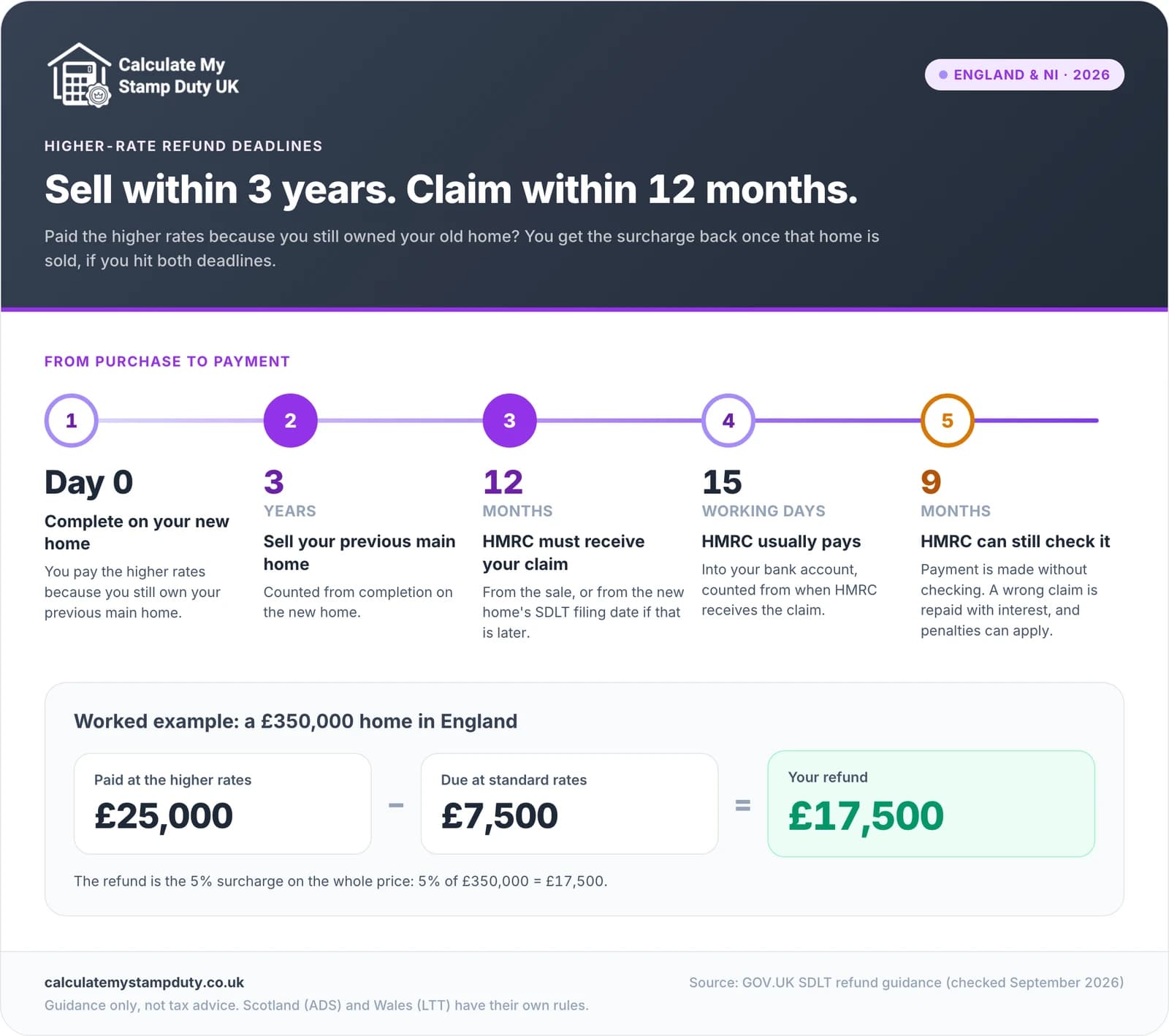
Quick Answer: Yes, if you paid the 5% surcharge on a new home and sold your previous main home within 3 years. HMRC must receive your claim within 12 months of the sale (or of the new home's SDLT filing date, if later) and usually pays within 15 working days.
Key Takeaways
- HMRC refunded £501 million of the second-home surcharge on 26,700 purchases in 2024-25 (England and Northern Ireland), about £18,800 each on average
- To get the surcharge back, sell your previous main home within 3 years of buying the new one. HMRC must receive your claim within 12 months of that sale, or of the new home's SDLT filing date if later
- HMRC says it usually pays within 15 working days of receiving a claim. It pays before checking, and has up to 9 months to open a compliance check
- Other refunds: the 2% non-resident surcharge (claim within 2 years), a missed relief (amend within 12 months of the filing date, after which it is generally lost), and a calculation error or the wrong rates (overpayment relief, up to 4 years after completion)
- You need your Unique Transaction Reference Number (UTRN), the dates and prices of both properties, the tax paid and your bank details
- If an agent claims for you and the claim is wrong, you repay the refund with interest, plus any penalty
- "Uninhabitable" and chattels claims rarely work after the event: a home needing repair is still residential, and HMRC wants evidence from the time that chattels were negotiated separately, such as a price for them in the contract
Stamp Duty Refunds in Numbers
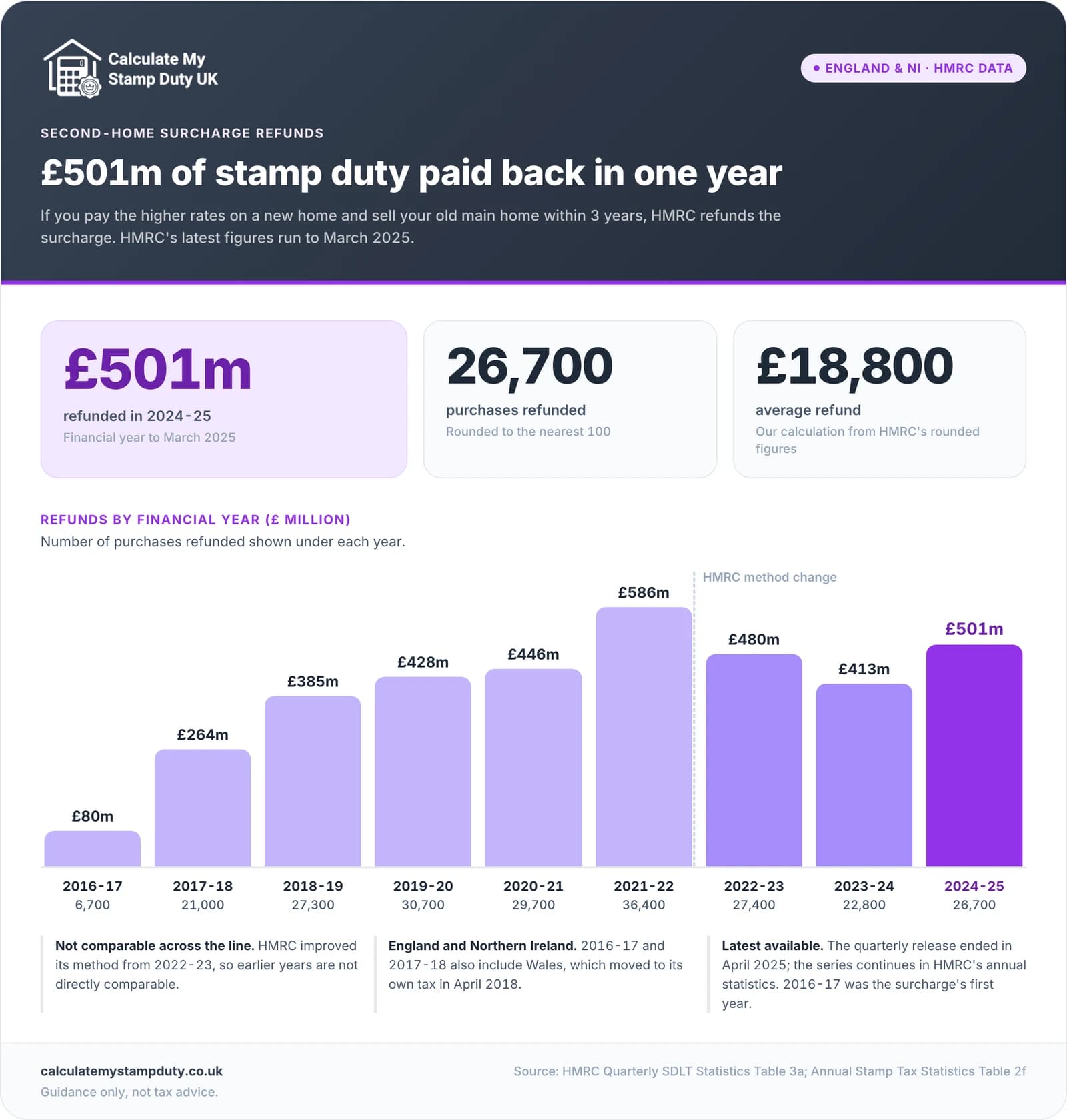
The second-home surcharge refund is the one most buyers claim, and HMRC's own figures show how common it is. In 2024-25 HMRC refunded £501 million of the higher rates on 26,700 purchases in England and Northern Ireland. That works out at about £18,800 per refund (our calculation from HMRC's rounded figures).
| Financial year | Refunded | Purchases refunded |
|---|---|---|
| 2016-17 | £80m | 6,700 |
| 2017-18 | £264m | 21,000 |
| 2018-19 | £385m | 27,300 |
| 2019-20 | £428m | 30,700 |
| 2020-21 | £446m | 29,700 |
| 2021-22 | £586m | 36,400 |
| 2022-23 | £480m | 27,400 |
| 2023-24 | £413m | 22,800 |
| 2024-25 | £501m | 26,700 |
Source: HMRC Quarterly Stamp Duty Land Tax Statistics, Table 3a. Counts are rounded to the nearest 100 and amounts to the nearest £1 million. HMRC changed its method from 2022-23, so earlier years are not directly comparable. 2016-17 and 2017-18 also include Wales, which moved to Land Transaction Tax in April 2018. The quarterly publication ended in April 2025. The same series continues in HMRC's Annual Stamp Tax Statistics (March 2026, Table 2f), whose latest figures also run to March 2025.
Can You Claim Stamp Duty Back?
Yes, in the situations HMRC lists. According to GOV.UK, you may get a refund if:
- you paid the higher rates on a new main home and have since sold your previous main home
- you paid the non-UK resident surcharge and now count as UK resident for SDLT
- you were entitled to a relief or exemption you did not claim on the original return
- you paid residential rates when the non-residential rates applied
- you made a mistake working out the tax on the original return
- you worked out the right tax but paid HMRC too much by mistake
Refunds are never automatic. You have to claim, and each route has its own deadline.
Common situations, answered
| Your situation | Can you claim? | Deadline (England and NI) |
|---|---|---|
| You bought a new home while still owning your old one, then sold the old main home | Yes, the whole surcharge, if the sale was within 3 years | HMRC must receive the claim within 12 months of the sale, or of the new home's filing date if later |
| You sold a second home, buy-to-let or holiday let that was never your main home | No. Only selling your previous main residence triggers the refund | Not applicable |
| You still own your old home and let it out instead of selling | Not yet. The refund needs a sale | Sale within 3 years of buying the new home |
| You paid the 2% non-resident surcharge, then spent 183 days in the UK in a qualifying 365-day period | Yes, the 2% surcharge | Within 2 years of completion |
| You missed first-time buyer relief or another relief | Yes, but only by amending the return in time | Within 12 months of the filing date. After that a missed relief is generally lost (FA 2003 Schedule 10 paragraph 34A, Case A) |
| The tax was miscalculated or the wrong rates were used | Yes, the overpayment | Amend within 12 months of the filing date; after that, overpayment relief up to 4 years after completion, with exclusions |
| The property needed renovation when you bought it | Almost never. A home needing repair is still residential (Mudan v HMRC, Court of Appeal 2025) | See the uninhabitable property guide |
| Carpets, curtains and white goods were included but not deducted from the price | Rarely. Only with evidence from the conveyancing at the time that they were negotiated separately, such as a price for them in the contract | As for any overpayment. See chattels below |
| You paid SDLT early (on substantial performance) and the contract was later rescinded, annulled or not carried into effect | Yes, to the extent the contract was not carried out | By amending the return for the contract (FA 2003 s44(9)) |
Second-home surcharge refund: eligibility checklist
If all of these apply, the refund is the surcharge itself: 5% of the price, or 3% if you exchanged contracts before 31 October 2024. On a £350,000 home bought today that is £17,500. Check your own figure with the stamp duty refund calculator.
Refund Types: Detailed Eligibility & Time Limits
The five refund types have very different rules and deadlines. Below is the detailed eligibility for each, with cross-links to the dedicated guides where the topic gets deeper treatment.
Time Limits by Region (Higher-Rate Refund)
| Region | Sell previous home within | Claim refund within |
|---|---|---|
| England & Northern Ireland (SDLT) | 3 years | HMRC must receive it within 12 months of the sale, or of the SDLT filing date if later. Usually paid within 15 working days |
| Scotland (LBTT and ADS) | 36 months (from 1 Apr 2024; 18 months before) | Amend the LBTT return within its 12-month amendment period, otherwise a repayment claim within 5 years of the return's due date. ADS refund details |
| Wales (LTT) | 3 years | Amend the LTT return within 12 months of the filing date, otherwise a refund claim, usually within 4 years of the purchase. The Welsh Revenue Authority says processing takes 15 to 20 working days |
1. Second-Home Surcharge Refund (most common)
Most people call this the second home stamp duty refund. If you bought a new home while still owning your previous main residence, you paid the 5% surcharge (8% ADS in Scotland, the higher residential bands in Wales). You can claim the surcharge back once you sell the old home, as long as the sale is within 3 years and your claim is in time. It is only available when the home you sell was your main residence. Selling a buy-to-let or holiday home does not qualify. See the refund deadlines for the timeline and the replacement of main residence rules for the underlying law.
2. Non-Resident Surcharge Refund
If you were treated as a non-UK resident when you bought a property and paid the 2% non-resident surcharge, you can reclaim it if you meet the UK residence test for this surcharge. That test requires at least 183 days in the UK in any continuous 365-day period that begins no more than 364 days before the effective date of the transaction and ends no more than 365 days after it, so the qualifying window spans time on both sides of the purchase and does not simply start on the purchase date. HMRC counts arrival and departure days. The claim must be made within 2 years of the effective date of the transaction (normally the completion date), not 2 years from the date you became UK resident. Keep flight records, hotel bookings and utility bills as evidence.
3. Uninhabitable Property Refund
A building that is not suitable for use as a dwelling is taxed at the non-residential rates (0% up to £150,000, 2% to £250,000, 5% above), which can be much lower. The bar is high. In Mudan v HMRC (Court of Appeal, 2025) the court confirmed that a home needing repair is still residential if it keeps the fundamental characteristics of a dwelling, and that "suitable for use as a dwelling" does not mean ready to move into. Previous use as a home counts against the claim. A new boiler, rewiring or damp proofing is not enough. See the uninhabitable property stamp duty refund guide for the cases that have won and lost, and HMRC's example of what a failed claim costs.
4. Overpayment Refund
You can claim a refund where you overpaid SDLT because of a calculation error, the wrong rates, or a relief you did not claim, such as first-time buyer relief or Multiple Dwellings Relief (transactions before 1 June 2024). Within 12 months of the filing date you amend the return. After that, overpayment relief under Schedule 10 paragraph 34 FA 2003 can cover a calculation error or the wrong rates, up to four years after the effective date of the transaction (paragraph 34B(1)). It does not rescue a missed relief: Case A in paragraph 34A excludes an overpayment caused by failing to make a claim, so a relief not claimed within the amendment window is generally lost. If you paid SDLT on a contract that was substantially performed and it was later rescinded, annulled or not carried out, the tax is repayable to that extent by amending the return made for the contract (FA 2003 s44(9)). See the refund deadlines for what happens once a deadline has passed.
5. Chattels Not Deducted From the Price
SDLT is charged on land and buildings, not on moveable items. Under FA 2003 Schedule 4 paragraph 4 the price must be split on a just and reasonable basis, and HMRC's manual (SDLTM04010) accepts carpets, curtains and blinds, free-standing furniture, white goods that are not fully integrated, removable electric and gas fires, and light shades as chattels. Fitted kitchens, Agas, bathroom suites, central heating and alarm systems are not.
The catch is evidence. HMRC says that in most cases no apportionment for chattels is appropriate, and that a deduction only stands if you can show contemporaneous evidence from the conveyancing that the chattels were separately negotiated, for example expressly identified and priced in the sale contract. Its words: "Simply showing that there were some chattels in the property when it was sold would not be considered sufficient evidence." Values must be second-hand open market values, not what the items cost new. Because the saving is only the tax on that value, a genuine chattels refund is usually small: £2,000 of chattels on a purchase where the top slice is taxed at 5% saves £100.
6. Special Circumstances
- Divorce or separation: Property transfers made in connection with divorce, dissolution, annulment or judicial separation are SDLT-exempt under FA 2003 Schedule 3 paragraph 3 (or 3A for civil partners), whether made under a court order or by an agreement in contemplation of those proceedings. If SDLT was paid in error, a refund applies. See the divorce property transfer guide.
- Defective title: If the purchase is unwound due to title defects discovered after completion, SDLT becomes refundable.
- Compulsory purchase: If a property is later compulsorily purchased by a public authority, the original SDLT may be reclaimable under compulsory purchase relief.
For step-by-step examples of how the refund figures work out at different property prices, see the refund calculation examples. If your claim is rejected, see the refund rejection appeals guide.
Refund Deadlines and What If You Miss Them
Two separate deadlines govern the higher-rate refund, and they work differently. Both are conditions of entitlement set by statute (Schedule 4ZA Finance Act 2003), not penalty deadlines, so the “reasonable excuse” rules that can excuse a late filing penalty do not apply here. In England and Northern Ireland, apart from the narrow exceptional-circumstances rule below, miss either deadline and the right to the refund is lost.
Deadline 1: Sell your old home within 3 years
Counted from completion on your new home. Scotland uses 36 months for transactions on or after 1 April 2024 (18 months for earlier ones). Sell later and, unless exceptional circumstances apply, the refund never arises.
Deadline 2: HMRC must receive your claim within 12 months
By the later of 12 months after the sale and 12 months after the filing date of the new home's SDLT return (for sales on or after 29 October 2018). It is the date HMRC receives the claim that counts, not the date you send it.
Took longer than 3 years to sell? Exceptional circumstances
GOV.UK allows a late refund if you bought the new home on or after 1 January 2017, exceptional circumstances stopped you selling the old one, and you have now sold it without further delay once the obstacle ended. HMRC means events that usually affect large groups of people, such as government restrictions or action by a public authority that prevents the sale. Not finding a buyer at your price, delays agreeing terms and a chain collapsing do not count. You apply by letter to BT Stamp Duty Land Tax, HM Revenue and Customs, BX9 1HD, explaining why you could not sell within 3 years, and the law requires the application within 12 months of the sale (FA 2003 Schedule 4ZA paragraph 3(7B)).
If You Think You Have Missed the Deadline
Do not assume the refund is gone without checking two things first:
- Verify the exact dates. Get the completion statements for both properties. Off-by-one errors and using exchange dates instead of completion dates are common, and you may be inside the window after all.
- Check for a separate overpayment. If the SDLT was wrong for another reason (a calculation error or the wrong rates), overpayment relief may apply on its own timeline, subject to the four-year limit and the exclusions set out below.
Overpayment relief: a separate four-year window, with exclusions
Overpayment relief sits in Schedule 10 paragraph 34 Finance Act 2003, not Schedule 11A. Schedule 11A is only the machinery for making a claim outside a return. Paragraph 34B(1) sets the deadline: a claim may not be made more than four years after the effective date of the transaction, which is normally completion (or the date of substantial performance if that came first), not the date the return was filed. It is a separate regime for SDLT that was genuinely miscalculated (wrong rate, missed relief, wrong classification), and it is not a back-door for a higher-rate refund once the 12-month or 36-month deadline has passed. Paragraph 34A is what stands in the way: it lists seven cases, A to G, in which HMRC is not liable to give effect to a claim. Case B applies where you can still put the position right by other means, such as amending the return. Case C applies where you could have used those other means within a period that has now expired and you knew, or ought reasonably to have known, before it expired that the relief was available. A missed higher-rate refund deadline is exactly the situation Case C is written for. The Upper Tribunal has read these exclusions narrowly, in BTR Core Fund JPUT v HMRC [2026] UKUT 27 (TCC) and HMRC v Candy [2026] UKUT 282 (TCC), so a refusal citing one of them is not always the last word.
If a solicitor handled both your purchase and your later sale and failed to flag the refund, causing you to miss the deadline, the lost refund may be recoverable as a professional negligence claim against them rather than from HMRC. The stakes are usually tens of thousands of pounds, so specialist SDLT advice is worthwhile. Check the exact figure with the stamp duty refund calculator.
Documents You Will Need
Having all documents ready before you start your claim will significantly speed up processing. Missing information is the single most common cause of delayed or rejected claims.
| Document | Why Needed | Where to Find It |
|---|---|---|
| UTRN (Unique Transaction Reference Number) | Identifies your original SDLT return | SDLT5 certificate from original purchase |
| Completion statement (new purchase) | Shows purchase price and completion date | From your conveyancer at purchase |
| Completion statement (old home sale) | Proves disposal within time limit | From your conveyancer at sale |
| Bank account details | HMRC pays refund by bank transfer | Your bank statements |
| Original SDLT return (form SDLT1) | Reference for the amendment | Your conveyancer or HMRC records |
| Evidence of SDLT paid | Confirms the original payment amount | Completion statement or bank records |
Find Your UTRN
The UTRN is 11 characters: 9 numbers followed by 2 characters, for example 123456789MC. It is on the paper return or the electronic SDLT5 certificate from your original purchase. If you cannot find it, ask your conveyancer. You cannot complete the refund form without it.
How to Claim: Online or by Post
For the second-home surcharge refund, HMRC has an online form and a paper form, SDLT16. Other refunds (a missed relief, the wrong rates, a calculation error) are claimed by amending the return within 12 months of the filing date, or by a written overpayment relief claim after that. HMRC does not publish different processing times for online and postal claims. Its stated time is the same: usually within 15 working days of receiving the claim.
Online (recommended)
- Start from GOV.UK's apply for a refund of the higher rates page and sign in (you can create sign-in details there)
- You cannot save a part-completed form, so gather everything first
- A claim received on time is what matters, and online arrives straight away
By post (form SDLT16)
- !Fill in SDLT16 online, print it and post it to the address on the form
- !Allow for postage: HMRC must receive it within the 12-month window
- Our SDLT16 form guide and claim letter template walks through each box
Step-by-Step Claim Process
Follow these steps to submit your higher rate refund claim. For the amendment process (overpayments), see the SDLT return amendment guide.
Confirm Your Eligibility and Deadline
Check that your old home's sale completed within 3 years of your new purchase, and that HMRC will receive the claim within 12 months of that sale (or of the new home's filing date, if later). Scotland uses 36 months for transactions on or after 1 April 2024 (18 months before). See the refund deadlines for the detail.
Gather All Required Documents
Collect your UTRN, completion statements for both properties, your bank details, and any other supporting evidence listed in the documents table above. Make copies of everything before submitting.
Calculate Your Refund Amount
Work out the refund you are claiming: the 5% surcharge on your full purchase price. See our refund calculation examples for worked examples. Use our stamp duty refund calculator for the exact figure.
Open HMRC's Refund Form
Start from the GOV.UK page for a refund of the higher rates and sign in. If you do not have sign-in details, you can create them as you go. The form cannot be saved part-way, so have everything from step 2 in front of you.
Complete the Refund Form
Fill in HMRC's online form (or SDLT16 by post) with your details, the new home's effective date and UTRN, the old home's sale date, address and buyer, the tax you paid, the refund you are claiming and the bank account to pay it into. Every buyer on the purchase must be included.
Record Your Submission Reference
On submission, HMRC will provide a confirmation reference. Keep this reference safe. It is your proof that you submitted within the deadline, which matters if HMRC later queries the timing.
Wait for Payment
HMRC says it usually pays within 15 working days of receiving the claim. It may write to you by post if it needs more information, so reply promptly.
Receive Your Refund, and Keep Your Records
The money goes to the account on the claim. Being paid does not mean HMRC has agreed the refund is due: it pays without checking and has up to 9 months to open a compliance check. Keep your completion statements and evidence of main residence: the law requires SDLT records to be kept for 6 years from the effective date (FA 2003 Schedule 10 paragraph 9).
Sold your old home after paying the 5% surcharge?
If you sold it within 3 years, the surcharge can usually be reclaimed. A specialist checks your case and makes the HMRC claim.
What Your Solicitor Does
Many solicitors routinely handle stamp duty refund claims on behalf of their clients, particularly conveyancers who handled both the purchase and the subsequent sale. However, their involvement is not automatic and there is often an additional charge for this service.
What a solicitor will typically do
- Retrieve your original SDLT5 certificate and UTRN from their file
- Prepare the amendment to your SDLT return with correct figures
- Submit the claim through HMRC's agent services
- Monitor the claim and respond to HMRC queries
- Confirm receipt of the refund to you
Solicitor Fees for Refund Claims
Some conveyancers submit the claim as part of the sale, others charge a separate fee. Ask for the fee in writing before they start. A straightforward second-home surcharge claim is a single online form, so many buyers file it themselves.
How Long Does a Stamp Duty Refund Take?
Usually within 15 working days of HMRC receiving your claim. That is HMRC's own statement on GOV.UK: it will usually pay directly into your bank account within 15 working days. The clock starts when HMRC receives the claim, not when you post it, and it counts working days only, so three calendar weeks is a fair expectation. HMRC does not publish how often it meets that, or separate times for online and postal claims.
| Tax and authority | Stated processing time | Check window after payment |
|---|---|---|
| SDLT (HMRC), England and NI | Usually within 15 working days of receipt | Up to 9 months for a compliance check |
| LBTT and ADS (Revenue Scotland) | Aims for 10 days once it has all the information | See the ADS refund guide |
| LTT (Welsh Revenue Authority) | 15 to 20 working days, longer if it needs more information | 12 months to open an enquiry |
What slows a refund down
- HMRC needs more information. It writes by post, so the delay includes the time letters take each way.
- A missing detail on an amendment. For a postal amendment, GOV.UK warns that if you do not send all the information and documents, HMRC may reject it as invalid.
- Not every buyer is on the claim. All purchasers must be included.
- Wrong bank details. The payment goes where the form says.
What Happens After Submission
HMRC pays first and checks later. In its own words, "to process refunds quickly, we will make the payment without checking eligibility", so a payment is not a sign that the claim has been accepted. HMRC has up to 9 months to open a compliance check on your amended return or claim.
If the refund is paid
The money arrives in the account on the claim, usually within 15 working days. Keep your records for at least 6 years from the purchase, as the law requires. If a check finds the claim was wrong, you repay it in full with interest, and a penalty may apply.
If HMRC requests more information
HMRC may write to you requesting additional evidence. Respond as quickly as possible with the requested documentation. Delays in responding will extend the processing time. Any evidence you send should be clearly labelled with your UTRN.
If HMRC rejects your claim
You have the right to appeal a rejected claim. See if HMRC rejects your claim below for the full process, including internal reviews and tribunal appeals.
If HMRC Rejects Your Claim: Review and Appeals
HMRC must give reasons for rejecting a refund claim. The most common are a missed deadline, HMRC not accepting that the property you sold was your main residence, insufficient evidence, or an administrative error such as a wrong UTRN. Read the rejection letter carefully: it sets out the reason and your appeal rights, including the deadline to request a review (usually 30 days).
Step 1: Ask for an internal review (free)
An internal review is carried out by an HMRC officer who was not involved in the original decision. It is free and you should always use it before going to a tribunal. Request it in writing within 30 days of the rejection, quote your UTRN and case reference, set out why the decision is wrong, and attach supporting evidence. HMRC normally completes the review within 45 days and can uphold, vary, or cancel the original decision.
Step 2: Appeal to the First-tier Tax Tribunal
If the review upholds the rejection, you have 30 days to appeal to the First-tier Tax Tribunal (Tax Chamber), an independent court that is not part of HMRC. Most SDLT refund cases fall in the basic track, which usually carries no filing fee and little costs risk. The Tribunal can decide factual disputes (such as dates or main residence status) but it cannot override a clear statutory deadline.
Evidence decides most appeals
The burden of proof is on you. For a main residence dispute, gather contemporaneous evidence: electoral roll registration, utility bills, council tax and bank statements at the old address, and completion statements and Land Registry records for the dates. Appeals with a genuine factual or evidence dispute have the best prospects; appeals against a clear, undisputed deadline miss rarely succeed.
How to Track Your Claim
HMRC does not provide an online tracking system for stamp duty refund claims in the same way as self-assessment refunds. You can check the status by:
- Logging into your HMRC online account and checking the SDLT section
- Contacting HMRC's SDLT helpline (0300 200 3510) and quoting your UTRN and submission reference
- Asking your solicitor or agent if they submitted on your behalf
HMRC's stated time is 15 working days from receipt. If that has passed with no payment and no letter, it is reasonable to follow up. Allow extra time for postage if you sent SDLT16 by post.
Rogue Repayment Agents: HMRC's Warning
If a claim is genuinely due, you can make it yourself directly, at no cost. No agent is required, and no fee is necessary. HMRC states this explicitly.
On 31 July 2025 HMRC issued a public warning about agents who cold-approach recent buyers offering to reclaim SDLT on a "no win, no fee" basis. The most common pitch is that a property was uninhabitable at the point of purchase and should therefore have been taxed at non-residential rates. HMRC's position is that this argument almost always fails, and the buyer, not the agent, carries the liability when it does.
The law is firmly against that pitch. In Mudan & Anor v HMRC [2025] EWCA Civ 799, the Court of Appeal confirmed that a dwelling in need of repair is still chargeable at residential rates, and that a repayment claim resting on a property's condition alone will not succeed. Being suitable for use as a dwelling is not the same as being ready for immediate occupation. The tests the tribunal applied were whether the building retains the fundamental characteristics of a dwelling, whether it is structurally sound, and whether it was previously used as a dwelling.
One case has since gone the other way on its facts. In Oakwood Great Oak Ltd v HMRC [2026] UKFTT 01138 (TC), released 5 August 2026, the First-tier Tribunal allowed an appeal where a house had stood empty for three to four years with substantial structural defects and asbestos throughout that made occupation unsafe. That is not a change in the law, and a First-tier decision binds nobody. It shows that the argument can still be won, but only on genuinely extreme facts, and it is the opposite of the "your house needed work, claim a refund" pitch. See the uninhabitable property SDLT guide for what the tribunal actually weighed.
What going wrong actually costs: HMRC's worked example
A buyer purchased a London house for £1,100,000 and his solicitor correctly filed SDLT of £53,750 at residential rates. The house needed a new boiler, rewiring and damp proofing, so he could not move in immediately. A repayment agent wrote to him claiming the repairs justified a refund.
- Refund claimed and paid: £9,250
- Agent's fee at 30%: £2,775
- Amount the buyer actually received: £6,475
- HMRC compliance check concluded the property was residential
- Amount the buyer had to repay: £9,250, plus interest and a penalty
He was left out of pocket. The agent refused to cover the interest and penalty, then stopped answering his emails and calls. Because SDLT is a self-assessed tax, the responsibility for an inaccurate claim sits with the taxpayer, never with the agent who submitted it.
Refund firms must now be registered with HMRC
Since 18 May 2026, anyone paid to deal with HMRC about someone else's tax affairs has had to register with HMRC as a tax adviser, through an agent services account. HMRC counts sending claims as dealing with it, so a firm you pay to submit a stamp duty refund claim for you is covered. For most firms the window to apply ran from 18 May to 18 August 2026. Firms that already held a Self Assessment or Corporation Tax agent code have until 18 November 2026.
A firm that keeps dealing with HMRC while unregistered first gets a formal compliance notice, then a £5,000 penalty for each further interaction. HMRC can ban repeat offenders and publish their names. Two cautions, though. HMRC says registration “is not a form of regulation and does not reflect your competency”, so a registered firm can still file a claim that fails. And if it does, the liability is still yours.
Warning signs
- An unsolicited letter, call or email shortly after your purchase completes
- A "no win, no fee" offer with a percentage fee, commonly around 30%
- An argument that your property was uninhabitable, derelict or in disrepair and so is non-residential
- A claim that the work is risk-free, or any reluctance to explain who is liable if HMRC rejects it
- Pressure to sign a deed of assignment giving the agent control of your repayment
- A firm that will not confirm in writing that it is registered with HMRC as a tax adviser
None of this means valid refunds are rare. The stamp duty refund calculator will tell you whether you have a genuine claim, and the step-by-step process above shows how to file it yourself. Where a legitimate claim exists, the most common ground is a replacement of main residence within 36 months, not the condition of the property.
Common Mistakes That Delay Claims
Wrong or Missing UTRN
The UTRN must exactly match the one on your original SDLT5 certificate. Even a single character wrong will cause HMRC to reject or delay the claim.
Completion Date Errors
Using exchange dates instead of completion dates is a frequent error. HMRC checks both dates against its own records. Ensure both completion statements show the actual completion dates.
Claiming for the Wrong Property
Ensure the property you sold matches the one identified as your previous main residence. HMRC may query if the sold property address does not appear in its records as your main residence.
Missing Supporting Evidence
Submitting a claim without completion statements leads to automatic requests for more information, adding weeks to the process. Include all supporting evidence from the start.
Claiming After the 12-Month Deadline
HMRC must receive the claim within 12 months of the sale, or of the new home's filing date if later, and that is as strict as the 3-year sale deadline. A posted form that arrives a day late is out of time. See the refund deadlines if you have missed this window.
Claim Checklist
Use this checklist before submitting your refund claim to reduce the risk of delays.
Frequently Asked Questions
How long does a stamp duty refund take?
HMRC says it usually pays within 15 working days of receiving your claim, straight into your bank account. Count from the day HMRC receives it and count working days only, so about three weeks in practice. It can take longer if HMRC writes to you for more information. In Wales the Welsh Revenue Authority quotes 15 to 20 working days, and Revenue Scotland aims for 10 days once it has everything it needs.
Can I submit the claim myself or do I need a solicitor?
You can submit the claim yourself through HMRC's online service. A solicitor is not required. However, if the claim is complex or you are uncomfortable with the process, a conveyancer or tax adviser can submit on your behalf for a fee. For straightforward cases, self-submission is entirely workable if you have all the documents.
What if I cannot find my SDLT5 certificate?
Ask the conveyancer who handled your purchase: the UTRN is on the SDLT5 certificate and the return they filed, so it should be on their file. Start early, because you cannot complete the form without it and the 12-month window keeps running.
How will HMRC pay the refund?
By bank transfer to the account on your claim. HMRC pays the refund to you unless you give permission for it to go to someone else, such as your solicitor or agent. Double-check the account number and sort code, because the payment goes wherever the form says.
What if my claim is rejected? Can I appeal?
Yes. If HMRC rejects your claim, you have the right to request an internal review and, if that fails, to appeal to the First-tier Tax Tribunal. See our dedicated page on refund rejection appeals for the full process and what evidence to gather.
Can I claim stamp duty back on a second home?
Yes, if the "second home" is the new home you moved into and you then sold your previous main home within 3 years. That is the second home stamp duty refund, and it returns the whole surcharge (5%, or 3% if you exchanged contracts before 31 October 2024). No, if the property you bought is a holiday home or buy-to-let you never live in as your main home, or if the one you sold was never your main residence. Scotland uses 36 months for transactions on or after 1 April 2024.
What evidence do I need for a stamp duty refund?
For higher rate refunds: proof of sale of your previous property (completion statement or sale contract), your SDLT5 certificate from the new purchase, and bank details for the refund payment. For overpayment refunds: documentation showing the error (original SDLT return, revised calculations, evidence of relief entitlement). HMRC may request additional evidence such as mortgage statements or utility bills proving the new property became your main residence.
Is there a deadline for stamp duty refund claims?
Yes. For the second-home surcharge refund in England and Northern Ireland, HMRC must receive your claim by the later of 12 months after the sale and 12 months after the new home's SDLT filing date. For the non-resident surcharge it is 2 years from completion. A missed relief has to be claimed by amending the return within 12 months of the filing date. For overpayment relief it is four years from the effective date of the transaction, and the claim can still be refused under the exclusions in Schedule 10 paragraph 34A. In Scotland you amend the LBTT return within 12 months or make a repayment claim within 5 years of the return's due date. Miss the deadline that applies and the right to claim is lost, even for large amounts.
Ready to Calculate Your Refund?
Use our stamp duty refund calculator to confirm the surcharge you paid and the exact amount you can claim back.
Calculate My RefundReviewed by

Julie White
ACASDLT Expert since 1999Stamp Duty Land Tax Specialist
ACA and Tax Adviser with a career spanning nearly four decades, specialising in SDLT planning and advisory work since 1999.