Berkeley Wants Stamp Duty Capped at 1%. The Treasury Had Just Said No to Downsizers
On 11 September 2026 a major housebuilder asked for three stamp duty cuts and warned that buyers may wait for the Budget. Three days earlier, the Treasury had put in writing that it has no plans for a new downsizer relief. Here is what each side said, what a 1% cap would be worth, and why neither changes what you pay today.
What clients say
Key Takeaways
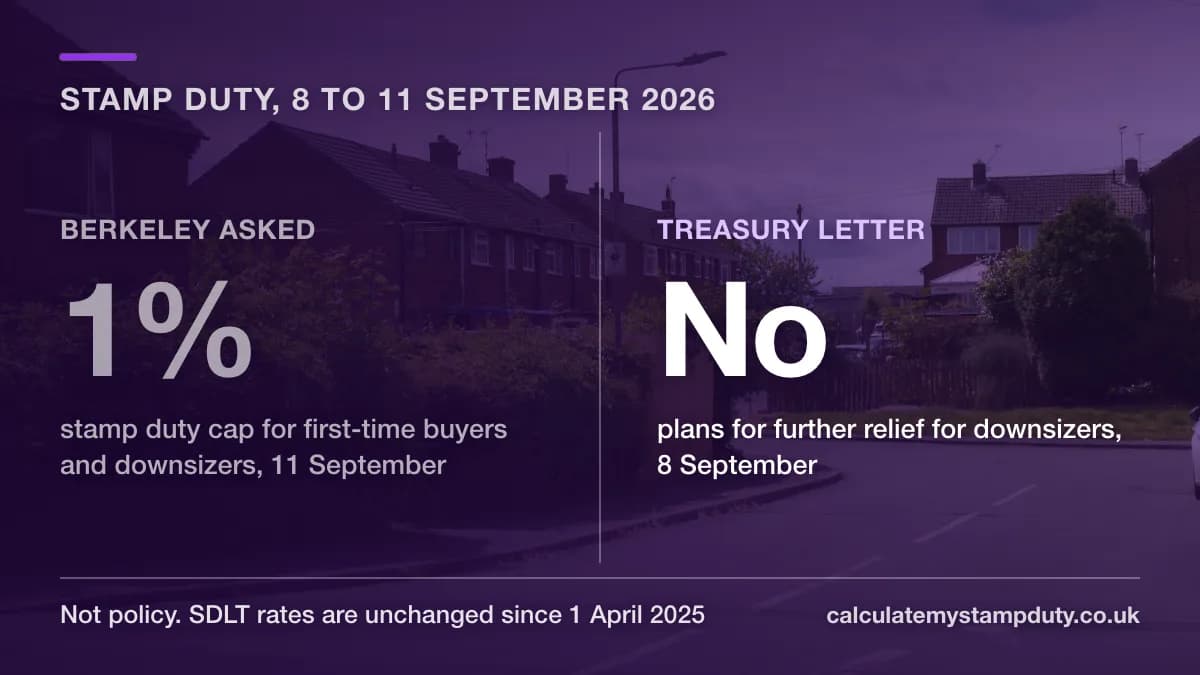
- On 11 September 2026 Berkeley Group asked the Government to cap stamp duty at 1% for first-time buyers and for downsizers, and to remove the 5% surcharge on additional properties
- In the same statement Berkeley said some buyers may defer transactions until after the Budget on 28 October 2026
- In a written response dated 8 September 2026, reported by Mortgage Soup on 10 September, the Treasury said the government had no plans to introduce further relief for people looking to downsize
- On 7 September 2026 Lloyds reported the average UK house price at £298,468 in August, the first annual fall since November 2023
- Berkeley did not say how a cap would work. If the bill could not exceed 1% of the price, a first-time buyer paying £500,000 would pay £5,000 instead of £10,000
- None of this is policy. The Prime Minister ruled out a stamp duty change at this Budget on 27 July 2026, and SDLT rates are unchanged from 1 April 2025
The Short Answer
Nothing has changed. A housebuilder has asked for stamp duty cuts, and the Treasury, in a separate letter, has turned down one of the same ideas. The rates for England and Northern Ireland are the ones set on 1 April 2025, and on 27 July 2026 the Prime Minister ruled out changing stamp duty at the Budget on 28 October.
The story matters for what it says about the weeks before the Budget, not for any change to your bill. A company that sells new homes says some of its buyers are waiting, and the Treasury has signalled in writing that at least one of the reliefs being asked for is not coming.
What Berkeley Asked For
Berkeley Group, which builds homes across London and southern England, published a trading update for its annual general meeting on 11 September 2026, covering 1 May to 31 August 2026. In it, the company put three proposals to the Government:
- Cap stamp duty at 1% for first-time buyers
- Cap stamp duty at 1% for downsizers
- Remove the 5% surcharge on additional properties, which Berkeley calls the investor surcharge
Its argument is that stamp duty has “become a binding constraint, now that interest rates have returned to more normal levels”. It also cites what it describes as a historical OBR estimate that every 1% cut in stamp duty may increase transactions by up to 6%. That is Berkeley's citation, not a new OBR forecast. The statement does not say how a cap would work, whether it means 1% of the price or a 1% rate on part of it, or how a downsizer would be defined.
On trading, Berkeley said it was receiving “good and stable levels of enquiries”, but that customers “without an immediate need to move and readily available liquidity remain more cautious to commit”. It added: “We are however mindful that some buyers may defer transactions until after the Budget at the end of October and any election uncertainty dissipates.”
Berkeley is not the first housebuilder to ask. On 11 August 2026 Bellway called for an immediate stamp duty cut alongside deposit support for first-time buyers, which we covered in what Burnham becoming Prime Minister means for stamp duty. Both requests come from companies that sell new homes, so they are best read as industry proposals rather than signs of government thinking.
What the Treasury Had Already Said
Three days before Berkeley's statement, the Treasury had answered a costed proposal for a downsizer relief. Joel Hagan, founder of the property portal Frontdoor, had proposed a “Rightsizing Relief”: a capped exemption from stamp duty for owner-occupiers moving from a larger home to a smaller one. The Treasury replied in a written response dated 8 September 2026, reference TO2026/16136, which Mortgage Soup reported on 10 September.
According to that report, the Treasury said:
- most people looking to downsize are likely to have equity in their existing home
- they are already exempt from Capital Gains Tax on their main home through Private Residence Relief
- for most downsizers the stamp duty on the smaller home would be relatively small, and in many cases lower than their estate agent's fees
- another relief would be likely to carry a significant cost to the Exchequer, and the government has no plans to introduce further relief for people looking to downsize
The Treasury has not published the letter, so the points above are as reported rather than quoted from the original. Hagan disputes the costing, saying “The Treasury has costed this statically” and that it ignores the onward sales a downsizer's move sets off.
Whether the stamp duty on a smaller home is small depends heavily on the price. A home mover buying at £250,000 pays £2,500. At £400,000 the bill is £10,000, and at £500,000 it is £15,000. If you are planning a move, our guide to stamp duty when downsizing sets out what applies now, including the 36-month rule if you buy before you sell.
What a 1% Cap Would Mean in Pounds
Because Berkeley has not said how its cap would work, the figures below use the simplest reading: the bill could not be more than 1% of the price. They use the rates for England and Northern Ireland in force since 1 April 2025.
| Buyer and price | Stamp duty today | With a 1% cap | Difference |
|---|---|---|---|
| First-time buyer, £300,000 | £0 | £0 | None |
| First-time buyer, £400,000 | £5,000 | £4,000 | £1,000 |
| First-time buyer, £500,000 | £10,000 | £5,000 | £5,000 |
| Home mover or downsizer, £400,000 | £10,000 | £4,000 | £6,000 |
| Home mover or downsizer, £500,000 | £15,000 | £5,000 | £10,000 |
First-time buyers already pay nothing up to £300,000, so a cap would only help them above that price, and first-time buyer relief stops altogether above £500,000. If the cap also applied above that level, a first-time buyer paying £600,000, who pays £20,000 today, would pay £6,000.
The third proposal is worth more per purchase. Removing the 5% surcharge on a second home or buy-to-let bought at the Lloyds average price of £298,468 would cut the bill from £19,846 to £4,923, a saving of £14,923.
To see your own figure under today's rules, use the stamp duty calculator, or the second home stamp duty calculator if the surcharge applies to you.
The Market Behind the Ask
Berkeley's warning came in a week of soft housing data. On 7 September 2026 Lloyds reported that the average UK house price fell 0.2% in August to £298,468, from £299,153 in July. Prices were 0.4% lower than a year earlier, the first annual fall since November 2023. These are figures from the Lloyds index, which is measured differently from the official ONS house price index.
Andrew Asaam, Mortgages Director at Lloyds, described the same hesitancy Berkeley reported: “more are choosing to sit tight, with sellers reluctant to accept offers they feel are too low, while some buyers are waiting to see how conditions develop.” He also pointed out that average prices remain around 25% higher than at the end of 2019.
A fall that small does very little to stamp duty. A home mover buying at the new average price pays £4,923. A first-time buyer at that price pays nothing, as they would have a year ago at £299,569, because both prices are below the £300,000 threshold.
The Week in Dates
| Date | What happened | Status |
|---|---|---|
| 27 July 2026 | The Prime Minister rules out changing stamp duty at this year's Budget | Stated by the PM |
| 7 September 2026 | Lloyds reports the first annual house price fall since November 2023 | Published data |
| 8 September 2026 | Treasury letter says there are no plans for further relief for downsizers | Reported on 10 September |
| 11 September 2026 | Berkeley asks for 1% caps and an end to the 5% surcharge, and warns buyers may wait for the Budget | Industry proposal |
| 28 October 2026 | The Budget | Scheduled |
We track what the Budget does to stamp duty, with the date of every statement, in Autumn Budget 2026 and stamp duty. If you are deciding whether to hold off buying, should I wait for stamp duty changes works through the trade-off.
Frequently Asked Questions
What did Berkeley ask for on stamp duty?
On 11 September 2026 Berkeley Group asked the Government to cap stamp duty at 1% for first-time buyers, cap it at 1% for downsizers, and remove the 5% surcharge on additional properties. It is a proposal from a housebuilder, not government policy.
Did the Treasury reject a stamp duty break for downsizers?
Yes, according to a written response dated 8 September 2026 to a proposal from the property portal Frontdoor, reported by Mortgage Soup on 10 September. The Treasury said the government had no plans to introduce further relief for people looking to downsize.
Is a 1% stamp duty cap going to happen?
Nothing has been announced. On 27 July 2026 the Prime Minister ruled out changing stamp duty at the Budget on 28 October 2026, and stamp duty rates in England and Northern Ireland are unchanged from 1 April 2025.
How much would a 1% cap save a first-time buyer?
Berkeley has not said how a cap would work. If the bill could not exceed 1% of the price, a first-time buyer paying £500,000 would pay £5,000 instead of £10,000 today. First-time buyers already pay nothing on a purchase up to £300,000.
Sources
- Berkeley Group Holdings plc, Trading Update, 11 September 2026
- Treasury rules out stamp duty relief for homeowners downsizing, Mortgage Soup, 10 September 2026
- Lloyds House Price Index, August 2026, published 7 September 2026
- Burnham rules out scrapping stamp duty this year, Estate Agent Today, 27 July 2026
This article summarises published statements, official data and press reporting, and is not tax or financial advice. It is not affiliated with HMRC or GOV.UK.
Reviewed by

Julie White
ACASDLT Expert since 1999Stamp Duty Land Tax Specialist
ACA and Tax Adviser with a career spanning nearly four decades, specialising in SDLT planning and advisory work since 1999.