Autumn Budget 2026 and Stamp Duty: What Changes on 28 October
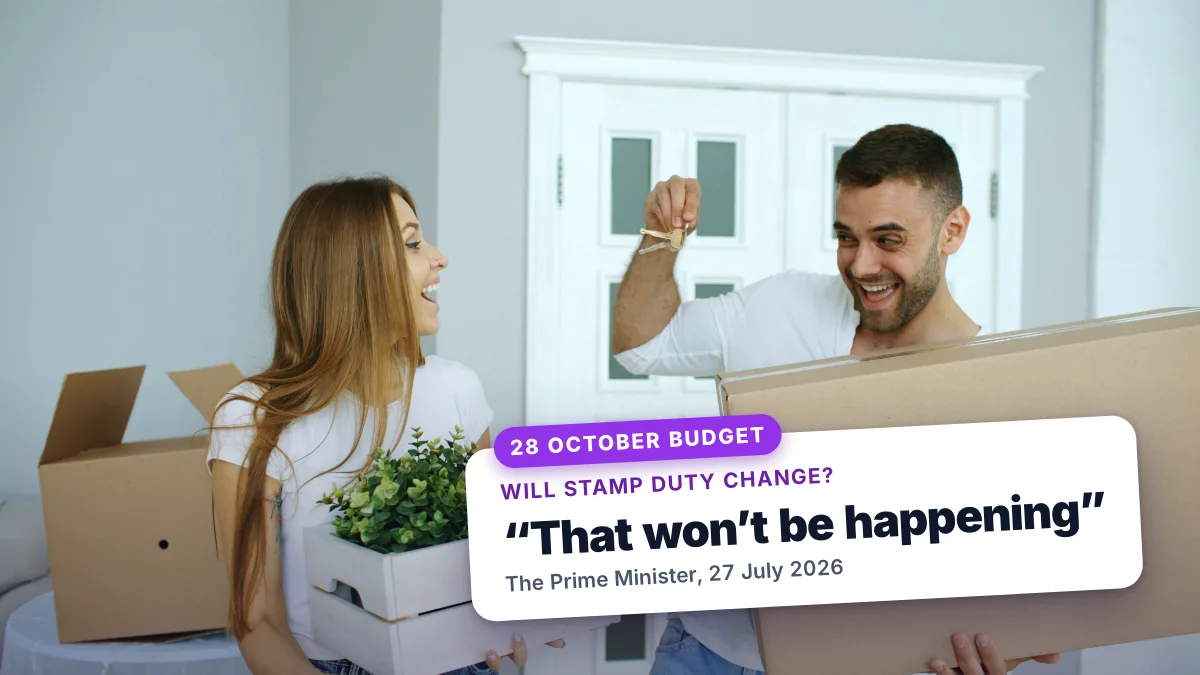
The Prime Minister has ruled out changing stamp duty at this Budget. The Chancellor will not rule out tax rises in general. Both things are true, and the gap between them is where most of the coverage goes wrong. Here is what is on the record, what is speculation, and what it means if you are buying now.
Key Takeaways
- The Budget is on Wednesday 28 October 2026. The Chancellor commissioned the OBR forecast for that date on 31 July 2026, and the OBR will publish its Economic and fiscal outlook the same day
- On 27 July 2026 the Prime Minister ruled out changing or scrapping stamp duty at this Budget, saying "That won't be happening"
- That statement covered this Budget, not the whole Parliament, so it is not a permanent commitment
- On 7 September 2026, in his first speech as Chancellor, John Healey declined to rule out tax rises generally, saying "If I respond to speculation now, that will only spawn more speculation"
- So stamp duty specifically has been ruled out for 28 October while property taxation generally has not, and press coverage often merges the two
- On 11 September 2026 Berkeley Group said some buyers may defer purchases until after the Budget and asked for 1% stamp duty caps. A Treasury letter dated 8 September had already said there are no plans for further relief for downsizers. Neither changes stamp duty
- On 24 September 2026 the Resolution Foundation asked the Chancellor to use this Budget to start a roadmap for replacing council tax and stamp duty on main homes with an annual property tax of 0.7% of value, and to leave stamp duty unchanged for the rest of this Parliament in the meantime
- On 22 September the Shadow Chancellor pledged to abolish stamp duty on homes, and on 27 September The i Paper reported a group of Labour MPs pressing to scrap it along with council tax. Neither is government policy
- On 16 October 2026 an independent housing committee chaired by Sir Vince Cable asked the Chancellor to bring back the Covid-era stamp duty holiday, with a £500,000 nil-rate threshold, or to exempt first-time buyers and downsizers. It is a lobbying call, and the Prime Minister has ruled out a stamp duty change at this Budget
- One property measure is already announced: the High Value Council Tax Surcharge on English homes worth £2m or more, from April 2028. It is an annual charge on owners, not a purchase tax, and it is not stamp duty
- On 26 September 2026 the government announced Your First Home, an equity loan scheme for first-time buyers of new-build homes in England, to be confirmed at the Budget. The announcement did not mention stamp duty
- SDLT rates and thresholds are unchanged from 1 April 2025 and nothing announced so far changes what you pay on a purchase completing today
The Short Answer
No change to stamp duty has been announced for the Budget on 28 October 2026, and the Prime Minister has specifically ruled one out. If you are buying a home now, the rates that apply are the ones set on 1 April 2025, and nothing said so far changes the figure on your return.
The reason the question keeps coming back is that two different things are being reported as one. Stamp duty has been ruled out for this Budget. Property taxation in the wider sense has not, and the Chancellor has pointedly declined to rule out tax rises. A headline about a property tax shake-up is not necessarily a headline about stamp duty.
Confirmed vs Speculation
Everything below is separated by whether it is on the record or not. Dates are the date the statement was made, so you can check the age of anything you read elsewhere.
| Item | Status | Source and date |
|---|---|---|
| Budget on Wednesday 28 October 2026 | Confirmed | OBR forecast commissioned by the Chancellor, 31 July 2026 |
| No change to stamp duty at this Budget | Stated by the PM | Andy Burnham, 27 July 2026 |
| High Value Council Tax Surcharge from April 2028 | Announced | Budget 2025, consultation closed 14 July 2026 |
| Wider tax rises at this Budget | Not ruled out | John Healey, 7 September 2026 |
| Stamp duty replaced by a land value tax | Speculation | No government proposal published |
| Stamp duty and council tax merged into one property tax | Speculation, and denied | Rejected by the PM, 27 July 2026 |
| Any change to SDLT rates or thresholds for buyers | Nothing announced | Rates unchanged since 1 April 2025 |
| 1% stamp duty caps for first-time buyers and downsizers, and no 5% surcharge | Industry proposal | Berkeley Group trading update, 11 September 2026 |
| New stamp duty relief for downsizers | No plans, says the Treasury | Treasury written response dated 8 September 2026, reported 10 September |
| Closing the six-dwelling rule, after the Providence House sale | Called for, not announced | MPs and peers, reported by the FT, 22 September 2026 |
| Independent review of council tax and residential stamp duty | Campaign proposal | Fairer Share Budget submission, 22 September 2026 |
| Replace council tax and stamp duty on main homes with a 0.7% annual property tax, and leave stamp duty unchanged for the rest of this Parliament first | Think tank proposal | Resolution Foundation, Home Economics, 24 September 2026 |
| Abolish stamp duty on your home | Opposition pledge | Shadow Chancellor Andrew Griffith, Daily Mail, 22 September 2026 |
| Scrap stamp duty and council tax for an annual proportional property tax | Backbench call | A group of Labour MPs, reported by The i Paper, 27 September 2026 |
| Return of the £500,000 stamp duty holiday, or exemptions for first-time buyers and downsizers | Committee proposal | Housing Policy and Delivery Oversight Committee, chaired by Sir Vince Cable, 16 October 2026 |
| Mansion tax threshold cut from £2m to £1.5m | Reported dropped, not confirmed | Floated by The Times, September 2026. The Financial Times reported on 13 October 2026 that the Chancellor has decided against it. An annual charge, not stamp duty |
The Date and How It Was Set
The Budget will be delivered on Wednesday 28 October 2026. The date is fixed by the Chancellor commissioning an economic and fiscal forecast from the Office for Budget Responsibility, which happened on 31 July 2026. The OBR has confirmed it will publish an updated Economic and fiscal outlook on the same day.
This is John Healey's first Budget as Chancellor and the first fiscal event of Andy Burnham's premiership, which began on 20 July 2026. That matters for how much weight to give pre-Budget speculation: a new Chancellor has no track record to read, so forecasters are working from the Prime Minister's past positions rather than from anything the Treasury has published.
What Has Actually Been Said
These are the statements doing most of the work in current coverage, each with its date, because the differences between them are the whole story.
Andy Burnham, Prime Minister, 27 July 2026
Asked whether stamp duty would be changed or abolished, the Prime Minister said a change “won't be happening”, adding: “It's just not the case that we are bringing forward plans on that scale at this moment in time.” This is the clearest statement available, and note the words “at this moment in time”. It rules out a change at the 28 October Budget. It does not rule out a later fiscal event.
John Healey, Chancellor, 7 September 2026
In his first speech as Chancellor, at the Manufacturing Technology Centre in Coventry, Healey pledged “fiscal discipline” and balancing the books “with a buffer to protect against uncertainty”. Asked repeatedly whether taxes could rise, he declined to say: “If I respond to speculation now, that will only spawn more speculation.” He did confirm one Budget measure with a property dimension, a roadmap to fiscal devolution including greater business rates retention for councils and a share of local income tax for mayoral strategic authorities from 2028. That is local government finance, not a purchase tax.
HM Treasury, written response dated 8 September 2026
Answering a proposal from Joel Hagan of the property portal Frontdoor for a capped “Rightsizing Relief” for downsizers, the Treasury said the government had no plans to introduce further relief for people looking to downsize. It argued that most downsizers have equity in their homes and already pay no Capital Gains Tax on their main residence, and that another relief would carry a significant cost. The Treasury has not published the letter, so this is as reported by Mortgage Soup on 10 September. It concerns one relief rather than stamp duty as a whole, but it points the same way as the Prime Minister's statement.
Berkeley Group, trading update, 11 September 2026
The housebuilder said “some buyers may defer transactions until after the Budget at the end of October and any election uncertainty dissipates”, and asked the Government to cap stamp duty at 1% for first-time buyers and for downsizers, and to remove the 5% surcharge on additional properties. That is an industry proposal, and it asks for one of the things the Treasury had declined three days earlier. We cover it in full in Berkeley wants stamp duty capped at 1%.
Resolution Foundation, Home Economics, 24 September 2026
The think tank wants council tax replaced with an annual property tax of 0.7% of a home's value, paid by occupiers with a rebate for poorer households, and stamp duty on main homes eventually abolished. It is not asking for that on 28 October. It asks the Chancellor to use this Budget to start building an up-to-date database of property values, which it says will take at least two years, and to set up a commission. In the meantime it says ministers should “commit to leaving Stamp Duty unchanged for the rest of this Parliament to steady the housing market”. It estimates stamp duty prevents around 100,000 house purchases a year, but warns that simply announcing abolition would “gum up the housing market” and leave a £15 billion hole in the public finances.
Andrew Griffith, Shadow Chancellor, 22 September 2026
Writing in the Daily Mail, he said that in his first budget as Chancellor “stamp duty on your home” would be abolished, alongside other tax cuts he said would be funded by cutting welfare spending and the cost of government. It is an opposition pledge and cannot take effect at this Budget.
Labour MPs, reported by The i Paper, 27 September 2026
A group of Labour MPs, mainly from the North of England, want stamp duty and council tax replaced by an annual proportional property tax. Jonathan Brash, the MP for Hartlepool, called council tax an “injustice built into a system that has not properly updated its valuations for 35 years”. Asked about the demands, a Treasury spokesperson said: “As has always been the case, decisions on tax are a matter for the Chancellor to set out at fiscal events, rather than routinely commenting on rumour, speculation or proposals.”
Housing Policy and Delivery Oversight Committee, 16 October 2026
Added 22 October 2026.
The committee is chaired by Sir Vince Cable and funded by the Family Building Society. Its members include the chief executives of the society, the Building Societies Association and the Home Builders Federation. Its preferred stamp duty option is to bring back the Covid-era holiday, which raised the nil-rate threshold to £500,000. The alternative it offers is to exempt first-time buyers and downsizers, which it accepts would be more complex to run. Cable said: “We have considered again Stamp Duty and urge the Chancellor to sweep away the Treasury's siloed view of revenue to consider the impact on the wider economy.” The committee says the holiday generated almost as much tax as it gave up, citing LSE London research commissioned by the society. That is the committee's claim, not an official estimate. It also wants the OBR to assess every Budget measure for its effect on housing. None of this is government policy. The downsizer option asks for the relief the Treasury said on 8 September it has no plans to introduce, and the Prime Minister has ruled out a stamp duty change at this Budget.
Gordon Brown, reported by The Telegraph, 3 September 2026
Speaking on The Rest Is Money podcast, the former Prime Minister argued against adding new property levies, saying: “The funny thing is that property is taxed quite heavily in Britain as part of a wealth tax. So I think you've got to look at a reform of existing taxes.” He has no role in setting this Budget, and the intervention is included here only because it is being widely quoted as though it signals government thinking. It does not.
The Property Measure That Is Confirmed
One property tax change is already announced, and it is routinely confused with stamp duty. The High Value Council Tax Surcharge was announced at the Budget in November 2025 and applies to residential properties in England worth £2 million or more, from April 2028. It is charged on owners rather than occupiers, sits on top of council tax, and starts at £2,500 a year, rising to £7,500 a year for properties valued above £5 million. Bands are based on updated valuations identifying properties worth £2m or more in 2026. The government estimates it will raise around £430 million a year from 2028-29, to support funding for local government services.
A consultation on the design ran from 19 May to 14 July 2026, covering who is liable in different ownership situations, proposed exemptions for student halls, military and diplomatic accommodation and social housing, and a deferral mechanism for owners without the income to pay each year. The outcome has not been published, and the government has said the main provisions will appear in a future Finance Bill. That makes it a live candidate for detail at the October Budget.
Updated 16 October 2026.
The threshold itself is reported to be staying at £2 million. In September The Times reported that the Chancellor was considering cutting it to £1.5 million. On 13 October 2026 the Financial Times reported that he has decided against that, after objections from London Labour MPs. The Treasury does not comment on Budget speculation, so this is a press report rather than a government statement, and the £1.5m threshold story stays open until 28 October.
A second housing measure was trailed on 26 September 2026. Your First Home is an equity loan scheme for first-time buyers of new-build homes in England, to be confirmed at the Budget: it is expected to support 2.5% deposits backed by 20% government equity loans with an initial interest-free period, with income and local price caps to be set out on 28 October. The announcement did not mention stamp duty, and a first-time buyer using it would still pay SDLT under the normal first-time buyer rules.
Why this is not stamp duty
Stamp duty is a one-off tax on a purchase. The surcharge is an annual charge on ownership. Someone who never moves will pay the surcharge every year and no stamp duty at all. If you see a headline about a “mansion tax” and you are budgeting for a purchase, it is almost certainly not about the tax you are about to pay. We cover it in detail in our guide to the annual surcharge and the consultation on how it will work.
The Rates as They Stand Today
These are the rates in force for England and Northern Ireland, unchanged since 1 April 2025 and unaffected by anything announced for October:
- 0% up to £125,000, then 2% to £250,000, 5% to £925,000, 10% to £1.5 million and 12% above that
- First-time buyers pay nothing up to £300,000, with relief available on purchases up to £500,000
- An additional property, such as a second home or buy to let, carries a 5% surcharge on every band from £40,000
- Non-UK residents pay a further 2% surcharge
Scotland and Wales set their own rates and are not affected by a UK Budget in the same way. See our 2026 stamp duty rates for the full tables, or work out your own figure with the stamp duty calculator.
Should You Delay Your Purchase?
On the evidence available, no. The Prime Minister has ruled out a stamp duty change at this Budget, so a buyer holding off until 29 October to see what happened would, on current information, be waiting for an announcement that is not coming.
There is also a structural reason not to wait even if you expect a cut eventually. Stamp duty changes are normally announced with a start date, and cuts have historically taken effect either immediately or several months later. A buyer who delays is taking a certain cost, which is the risk of losing the property and the price movement in the meantime, against an uncertain saving. The one case where timing genuinely matters is a change already legislated with a future start date, and there is no such change to SDLT on the books.
Updated 15 September 2026.
Some buyers are waiting anyway. On 7 September 2026 Lloyds reported the first annual fall in house prices since November 2023, with the average at £298,468 in August, and said “some buyers are waiting to see how conditions develop”. On 11 September Berkeley Group said some of its buyers “may defer transactions until after the Budget”. Neither changes the stamp duty position. The Prime Minister has ruled out a change at this Budget, and a Treasury letter dated 8 September, reported by Mortgage Soup, said there are no plans for further relief for downsizers. The 0.4% annual fall moves a home mover's stamp duty on an average-priced home by about £55, which is small next to the cost of losing a property you want.
Updated 27 September 2026.
If something were announced on 28 October, the record since 2014 shows how it would land. All four cuts to residential rates or thresholds in that time took effect on the day they were announced or the day after: 4 December 2014, 22 November 2017, 8 July 2020 and 23 September 2022. A buyer waiting for a cut cannot position for it in advance. The three new rises in that time, the 3% surcharge from April 2016, the non-resident surcharge from April 2021 and the increase to 5% on 31 October 2024, each spared buyers who had already exchanged contracts before the Budget that set them, subject to conditions on contracts later varied or assigned.
Even the Resolution Foundation, which wants stamp duty on main homes replaced in the long run, is asking for no change to it in this Parliament, “to steady the housing market”.
We work through the timing question properly in should I wait for stamp duty changes.
What Would Have to Happen for Rates to Change
Replacing stamp duty is not a single decision. It would need a replacement tax designed, consulted on and legislated, and stamp duty raises a substantial and reliable sum that the Treasury would have to find elsewhere. That is the practical reason the various reform proposals keep being discussed without being adopted, and why the Prime Minister was able to rule one out for this Budget without abandoning his long-standing interest in land value taxation.
The reform proposals on the table sets out each option and who is backing it, and what Burnham becoming Prime Minister means for stamp duty covers his own record in more detail.
Frequently Asked Questions
Will stamp duty change in the Budget 2026?
No change has been announced, and on 27 July 2026 the Prime Minister ruled out changing or scrapping stamp duty at this Budget, saying “That won't be happening”. That covered the Budget of 28 October 2026 specifically rather than the whole Parliament.
When is the Autumn Budget 2026?
Wednesday 28 October 2026. The Chancellor commissioned the OBR forecast for that date on 31 July 2026, and the OBR will publish its Economic and fiscal outlook the same day.
Is stamp duty being abolished?
Not at this Budget. Reports that stamp duty and council tax would be replaced with a single annual property tax were rejected by the Prime Minister on 27 July 2026. No government proposal to abolish stamp duty has been published.
Has the Chancellor ruled out tax rises at the Budget?
No. On 7 September 2026 John Healey declined to rule out further tax rises, saying “If I respond to speculation now, that will only spawn more speculation”. That is a statement about taxation generally. It does not reopen stamp duty, which the Prime Minister had already ruled out for this Budget.
Should I complete before the Budget?
There is no announced change to complete ahead of. Because no stamp duty change is expected on 28 October, there is no deadline to beat, and delaying a purchase to see the Budget means carrying the risk of losing the property for an uncertain benefit.
What did the Resolution Foundation propose for the Budget?
On 24 September 2026 it asked the Chancellor to use the Budget to start building an up-to-date database of property values, as the first step towards replacing council tax and stamp duty on main homes with an annual property tax of 0.7% of value. It also asked ministers to leave stamp duty unchanged for the rest of this Parliament. It is a think tank proposal, not government policy.
Does the mansion tax affect what I pay when I buy?
No. The High Value Council Tax Surcharge is an annual charge on owners of English homes worth £2 million or more from April 2028, paid alongside council tax. It is not a purchase tax and it does not change your stamp duty.
How This Page Will Be Updated
Pre-Budget reporting changes weekly and much of it is unsourced. This page is maintained on a simple rule: a claim moves from speculation to confirmed only when it is attributable to the government on a date, and every statement carries the date it was made so you can judge how current it is.
Updated 15 September 2026 with the Treasury's letter of 8 September on downsizer relief, Berkeley Group's trading update of 11 September, and the Lloyds House Price Index of 7 September.
Updated 23 September 2026 with two items. First, calls from MPs and peers on 22 September to close the six-dwelling rule, after reports that it applied to the £265m sale of Providence House. The Treasury can change that rule by order, and we explain it in the stamp duty rule behind Britain's biggest home sale. Second, the campaign group Fairer Share's Budget submission of 22 September, which asks the Treasury to commission an independent review of council tax and residential stamp duty, including replacing both with a proportional property tax modelled at 0.48% of current value. Neither is government policy.
Updated 29 September 2026 with the Your First Home announcement of 26 September and a corrected Prime Minister quote. Updated 27 September 2026 with the Resolution Foundation's Home Economics report of 24 September, the Shadow Chancellor's pledge of 22 September to abolish stamp duty on homes, the Labour MPs' calls reported by The i Paper on 27 September with the Treasury's response, and reports that the mansion tax threshold could fall to £1.5m. None of them is government policy. We also added how past stamp duty changes took effect, under Should You Delay. Labour's conference took place this week, with the Chancellor speaking on Monday 28 September and the Prime Minister on Tuesday 29 September; we will add anything either said about stamp duty, with its date, once confirmed from the official text.
Updated 16 October 2026 with the Financial Times report of 13 October that the Chancellor has decided against cutting the mansion tax threshold to £1.5m. It is a press report, not a government statement, and it does not affect stamp duty.
Updated 22 October 2026 with the Housing Policy and Delivery Oversight Committee's call of 16 October for a return of the £500,000 stamp duty holiday. It is a proposal, not policy. HMRC's receipts release of 21 October, the last before the Budget, put September 2026 SDLT at £1,302m, down 10.5% on a year earlier. We cover those figures in SDLT receipts in 2026.
It will be updated on 28 October 2026 with what the Budget actually did to stamp duty, including no change if that is the outcome. Until then, the answer to whether stamp duty is changing is the one at the top of this page.
Sources
- Chancellor's letter to the Treasury Select Committee on the Budget 2026 date, GOV.UK, 31 July 2026
- Fairer Share, Autumn 2026 Budget submission, 22 September 2026
- Autumn 2026 forecast date announced, Office for Budget Responsibility, 31 July 2026
- Burnham rules out scrapping stamp duty this year, Estate Agent Today, 27 July 2026
- Chancellor John Healey's keynote pre-Budget speech, LBC, 7 September 2026
- Budget plans to hit £1.5million-plus homes with Mansion Tax shelved, This is Money citing the Financial Times, 13 October 2026
- OBR should assess every Budget measure for its impact on housing, says committee chaired by Vince Cable, Mortgage Strategy, 16 October 2026
- Housing panel backs stamp duty holiday as 1.5 million homes target slips, Mortgage Introducer, 19 October 2026
- High Value Council Tax Surcharge (HVCTS), House of Commons Library, updated 2 September 2026
- High Value Council Tax Surcharge consultation, GOV.UK, 19 May to 14 July 2026
- Lloyds House Price Index, August 2026, published 7 September 2026
- Treasury rules out stamp duty relief for homeowners downsizing, Mortgage Soup, 10 September 2026
- Berkeley Group Holdings plc, Trading Update, 11 September 2026
- Home economics: how to put England's broken housing taxes on firmer foundations, Resolution Foundation, 24 September 2026
- Wealth, capital gains and property tax hikes: All the Budget demands Burnham faces, The i Paper, 27 September 2026
- Andrew Griffith, Shadow Chancellor, Daily Mail, 22 September 2026
- Labour conference 2026: What POLITICO reporters will be watching for, POLITICO, 27 September 2026
- Stamp duty land tax: reform of structure, rates and thresholds, HMRC guidance note, December 2014
- Stamp Duty Land Tax: relief for first time buyers, GOV.UK, 22 November 2017
- Stamp Duty Land Tax: temporary reduced rates, GOV.UK, 8 July 2020
- The Growth Plan 2022, HM Treasury, 23 September 2022
- Stamp Duty Land Tax: higher rates on purchases of additional residential properties, GOV.UK
- New rates of Stamp Duty Land Tax for non-UK residents from 1 April 2021, HMRC
- Stamp Duty Land Tax rates: 31 October 2024 to 31 March 2025, GOV.UK
This article summarises published statements, official documents and press reporting, and is not tax or financial advice. It is not affiliated with HMRC or GOV.UK.
Reviewed by

Julie White
ACAStamp duty specialist since 1999Stamp Duty Land Tax Specialist
ACA and Tax Adviser with a career spanning nearly four decades, specialising in stamp duty planning and advisory work since 1999.