Five Flats and a £265m Mansion: The Stamp Duty Rule Behind Britain's Biggest Home Sale
The most expensive house sale in the UK was reported to have been taxed as commercial property, because five small flats were bought in the same transaction. Here is the rule that makes that possible, what the two stamp duty bills would be, what both sides have said, and what could happen next.
Key Takeaways
- Providence House in Chelsea was reported in May 2026 to have sold for about £265m, the highest price paid for a home in the UK. The price has not yet appeared on the Land Registry
- Five small flats were sold in the same transaction. Under section 116(7) of the Finance Act 2003, six or more dwellings bought in a single transaction are treated as non-residential property
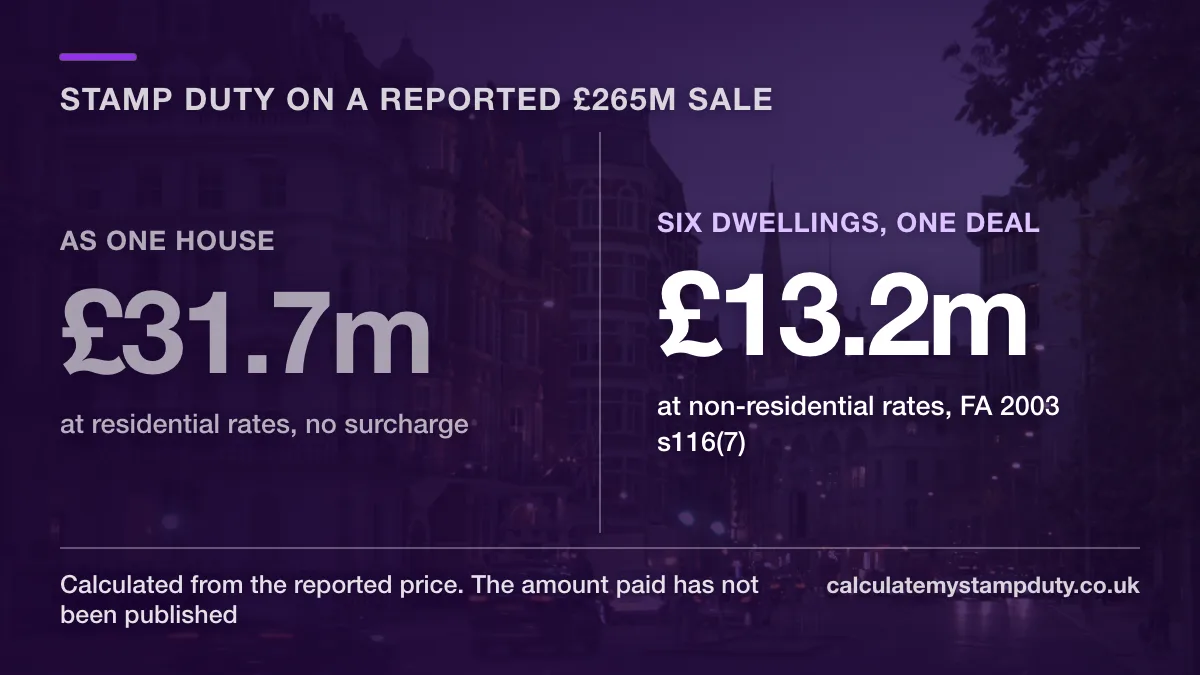
- On a £265m price, residential rates give a bill of £31,713,750. Non-residential rates give £13,239,500. The difference is about £18.5m
- If the buyer would have paid the 5% surcharge on the house alone, the bill on the £263.75m house would be £44,751,250 and the saving about £31.5m. A genuine mixed-use purchase reaches the same non-residential rates
- Those bills are calculated from the reported price. No record of the stamp duty actually paid has been published
- A source close to the buyer told The Times "the right amount of stamp duty was paid as required by law" and that the properties were only offered together. A spokesman for the seller said he would not be commenting
- Tax Policy Associates estimates HMRC has until around 26 February 2027 to open an enquiry. The Treasury can amend or repeal the rule by order, without a Finance Act
- The rule has not changed. For any buyer of six or more homes in one transaction, it still applies automatically
The Short Answer
When six or more separate dwellings are bought in one transaction, stamp duty treats all of them as non-residential property. The top rate is then 5% instead of 12%, and neither the 5% surcharge for additional homes nor the 2% surcharge for non-residents applies. That is the law as written, and it is not a relief that has to be claimed.
The Providence House sale has drawn attention because almost all of the price was for one house. Nobody has suggested any law was broken. The questions being asked are whether HMRC could argue the rule should not apply on these facts, and whether the Government will change the rule.
What Was Reported
On 22 September 2026, London Centric and Tax Policy Associates published an investigation into the sale of Providence House, a Chelsea mansion owned through Providence House LLP, a vehicle connected to the property developer Nick Candy. The Times and the Financial Times reported the story the same day. According to that reporting:
- The house was sold in May 2026 to Suneil Setiya, a co-founder of a trading firm. The sale has not yet been registered, so the buyer and price come from press reports, not a public record.
- The reported price varies: £265m in The Times, £270m according to Bloomberg, and more than £275m in the FT. Tax Policy Associates uses £265m as the lowest figure.
- Land Registry applications for the house and five flats carry priority times one second apart on 12 May 2026, which Tax Policy Associates reads as consistent with a single transaction.
- The LLP had acquired the house and three of the flats in November 2024. Two more flats were bought in April and June 2025, for £475,000 and £220,000.
Tax Policy Associates says it does not regard the earlier transfer into the LLP as avoidance. Its questions are about the 2026 sale.
How the Six-Dwelling Rule Works
The rule is section 116(7) of the Finance Act 2003. It says:
“Where six or more separate dwellings are the subject of a single transaction involving the transfer of a major interest in, or the grant of a lease over, them, then, for the purposes of this Part as it applies in relation to that transaction, those dwellings are treated as not being residential property.”
Three things follow from that wording:
- It is automatic. There is no election and no box to tick. If six or more dwellings are the subject of one transaction, the transaction is non-residential.
- The value split does not matter. The section counts dwellings. It says nothing about how the price is divided between them.
- The surcharges fall away. The 5% higher rate for additional dwellings and the 2% non-resident surcharge are both built on the residential rates, so they do not apply to a non-residential transaction.
The rule was meant for investors. Tim Stovold, head of tax at Moore Kingston Smith, told The Times it was “intended to be used by landlords acquiring portfolios of properties without the disincentive of large amounts of stamp duty being payable”. It became more valuable after 1 June 2024, when Multiple Dwellings Relief was abolished. For a bulk purchase, the six-dwelling rule is now the main way the tax differs from buying homes one at a time. Our guide to Multiple Dwellings Relief covers what changed.
The non-residential rates are 0% on the first £150,000, 2% on the next £100,000 and 5% on everything above £250,000. You can run any price through our commercial stamp duty calculator.
The Two Stamp Duty Bills
These are the bills on the reported £265m price, using the rates for England and Northern Ireland in force since 1 April 2025. They are our own arithmetic and match the figures Tax Policy Associates published. The Times rounded them to £31.8m and £13.25m.
| Basis | Stamp duty on £265m |
|---|---|
| Residential rates, no surcharge | £31,713,750 |
| Residential rates with the 5% additional-dwelling surcharge | £44,963,750 |
| Non-residential rates (six or more dwellings) | £13,239,500 |
The widely reported saving of about £18.5m is the gap between the first and third rows, £18,474,250. It assumes the buyer would not have paid either surcharge on the house alone, which Tax Policy Associates describes as a conservative assumption. At the FT's price of £275m the gap would be £19,174,250.
What these figures are not
They are calculations from a reported price, not the amount on the buyer's return. The price has not been registered and no one involved has published what was paid. The comparison also assumes the house would have been sold on its own at the same price, which cannot be known.
Three Routes Compared, With the Surcharge
The figures above assume no surcharge. A buyer who already owns a home would pay the 5% higher rate on a house bought alone, so the gap is wider. The tables below take that case and compare it with three routes: buying six or more dwellings together, buying the house with a genuine shop (a mixed-use purchase), and Multiple Dwellings Relief as it used to work.
Scenario A treats the reported £265m as £263.75m for the house plus five flats at £250,000 each. Scenarios B and C use five flats at £100,000 each. The shop is one genuine non-residential shop bought with the house for £100,000. Rates are those for England and Northern Ireland from 1 April 2025.
| Scenario | House value | Total with 5 flats | House only, with surcharge | Six-dwelling rule | MDR* | House + £100k shop |
|---|---|---|---|---|---|---|
| A | £263,750,000 | £265,000,000 | £44,751,250 | £13,239,500 | £44,532,500 | £13,182,000 |
| B | £26,500,000 | £27,000,000 | £4,418,750 | £1,339,500 | £4,072,500 | £1,319,500 |
| C | £2,650,000 | £3,150,000 | £364,250 | £147,000 | £255,000 | £127,000 |
The savings against buying the house alone, and the extra property each route needs:
| Scenario | Six-dwelling saving | MDR* saving | Mixed-use saving | Extra cost: 5 flats | Extra cost: 1 shop |
|---|---|---|---|---|---|
| A | £31,511,750 | £218,750 | £31,569,250 | £1,250,000 | £100,000 |
| B | £3,079,250 | £346,250 | £3,099,250 | £500,000 | £100,000 |
| C | £217,250 | £109,250 | £237,250 | £500,000 | £100,000 |
*MDR was abolished for most transactions from 1 June 2024. These MDR figures apply today's rates and the 5% surcharge as if the relief still existed. They are a comparator, not a route that is open now.
What the comparison shows:
- The six-dwelling rule can save a lot. In each example, five extra flats move the whole purchase onto the non-residential rates, well below a house bought alone at the higher rates.
- Mixed-use reaches the same rates for less. A genuine £100,000 shop also puts the purchase on the non-residential rates. The shop costs less than five flats, so the total price and the bill are lower in every example.
- The rate table is the same, the price is not. A shop is not treated more kindly than flats. Both routes use the same non-residential rates, and the mixed-use purchase simply has less total consideration.
- MDR depended on value. Averaging could keep each dwelling in lower bands, which helped at modest prices. Once the average value was high and the surcharge applied, the six-dwelling rule was far better.
Practical caution
The tax follows what is actually bought at completion. A shop must be genuine non-residential property. For the six-dwelling rule, each dwelling must be a separate dwelling and all must be bought in one transaction. Artificial packaging, unsupported splits of the price, or land that is really part of a home's garden or grounds may not get the intended treatment. Advice on the specific purchase and valuation evidence at the time are essential.
What Each Side Has Said
The buyer. A source close to Mr Setiya told The Times: “the right amount of stamp duty was paid as required by law. The properties were only available for purchase from the owner collectively, and Suneil's offer was accepted on that basis.” A person close to him told the FT that “The single transaction was not structured to minimise the stamp duty.”
The seller. A spokesman for Nick Candy told The Times: “Nick is out of the country at present, and he will not be commenting.”
Tax advisers. Ben Smith, a tax partner at Wilsons, told The Times the case “undoubtedly raises questions as to the effectiveness of the ‘six or more dwellings’ rule and will prompt further calls for stamp duty reform”. Tim Stovold said a transaction in which one property made up 99% of the value “was never anticipated in the rules”. Tax Policy Associates reports that most, but not all, of the stamp duty specialists it spoke to thought the arrangement looked artificial, and says it does not know for sure.
London Centric, which first reported the story, states there is nothing to suggest anyone broke any laws.
Can HMRC Challenge It?
HMRC normally has nine months from the filing date of a stamp duty return to open an enquiry. Assuming the transaction took effect on 12 May 2026 and the return was filed on time, Tax Policy Associates puts that deadline at around 26 February 2027. After that, HMRC would need grounds for a discovery assessment.
There is no public sign yet that HMRC has opened one. Neither HMRC nor the Treasury has commented on the case. The arguments open to HMRC, as Tax Policy Associates sets them out, include:
- reading the rule purposively, so that it does not reach a transaction that is in substance the purchase of one house
- the stamp duty anti-avoidance rule in section 75A, although Tax Policy Associates thinks it probably does not apply, because of how the Upper Tribunal read that section in HMRC v Ridgway [2024] UKUT 36 (TCC). At least one commenter on that article thinks HMRC's case under section 75A is stronger
- arguing that there were really two transactions, one for the house and one for the flats
Tax Policy Associates also says the arrangement may have been notifiable under the disclosure of tax avoidance schemes rules, calls that position “rather complex and unclear”, and says it does not know whether any disclosure was made.
The Times reports that the same house was also at the centre of a separate, earlier dispute with HMRC, over stamp duty paid when it was bought in 2012. That case, about overpayment relief, was decided by the Upper Tribunal in July 2026 and is covered in our landmark stamp duty cases.
Could the Rule Change?
It could, and more easily than most stamp duty rules. Section 116(8)(b) of the Finance Act 2003 allows the Treasury to amend or repeal subsection (7) by order, so no Finance Act would be needed.
According to the FT, MPs and peers called for action on 22 September. Baroness Hodge said she hoped “Treasury officials will immediately take action to close this loophole”, and Siobhain McDonagh said the Treasury should “immediately step in”. Liam Byrne said HMRC “must now take a second look at this transaction”.
No change has been announced. The Budget is on 28 October 2026, and we track anything it does to stamp duty in Autumn Budget 2026 and stamp duty. A change to this rule would be separate from the headline residential rates, which the Prime Minister ruled out changing at this Budget on 27 July 2026.
What It Means If You Are Buying
For almost every buyer, nothing. Buying one home, or one home with an annexe, is a residential purchase, and the rates you pay are the ones in our stamp duty rates for 2026.
The rule matters to investors buying a block or portfolio. Take six flats at £200,000 each, bought together for £1.2m by a buyer who already owns a home. At residential rates with the 5% surcharge the bill would be £123,750. Treated as non-residential, it is £49,500. Our portfolio stamp duty guide covers bulk purchases in more detail.
Whether something counts as a separate dwelling, and whether several purchases are one transaction, are questions of fact that HMRC does examine. If a purchase depends on this rule, get advice before exchange rather than after. This story is also a reminder that the Treasury can change the rule quickly if it decides to.
Frequently Asked Questions
What is the six-dwelling rule in stamp duty?
Under section 116(7) of the Finance Act 2003, when six or more separate dwellings are bought in a single transaction they are treated as non-residential property. Non-residential rates apply, with a top rate of 5%, and the residential surcharges do not.
How much stamp duty was paid on Providence House?
It has not been published. On the reported £265m price, non-residential rates give £13,239,500 and residential rates give £31,713,750, a difference of about £18.5m. Both are calculations, not figures from a return.
Was the Providence House stamp duty legal?
Nothing suggests any law was broken. A source close to the buyer says the correct amount of stamp duty was paid. HMRC can still open an enquiry, which Tax Policy Associates estimates it could do until around 26 February 2027.
Is the six-dwelling rule being abolished?
No change has been announced. The Treasury can amend or repeal the rule by order under section 116(8)(b) of the Finance Act 2003, and some MPs and peers have called for it to act.
Sources
- Nick Candy, Suneil Setiya, the UK's biggest house sale, and £18.5m of avoided stamp duty, Tax Policy Associates, 22 September 2026
- London Centric, 22 September 2026
- The Times, 22 September 2026
- Financial Times, 22 September 2026
- Finance Act 2003, section 116, legislation.gov.uk
- Finance Act 2003, section 55 (Table B, non-residential and mixed rates), legislation.gov.uk
- HMRC SDLT Manual SDLTM09840: higher rates and multiple dwellings relief
- SDLT: mixed-property purchases and MDR, consultation outcome, HM Treasury, 6 March 2024
- Stamp Duty Land Tax: non-residential and mixed rates, GOV.UK
- HMRC v Ridgway [2024] UKUT 36 (TCC), Upper Tribunal decision
This article reports published statements and press coverage and explains the law as it stands. It does not allege wrongdoing by anyone named, and it is not tax or financial advice. It is not affiliated with HMRC or GOV.UK.
Reviewed by

Julie White
ACASDLT Expert since 1999Stamp Duty Land Tax Specialist
ACA and Tax Adviser with a career spanning nearly four decades, specialising in SDLT planning and advisory work since 1999.