Mansion Tax Home Inspections: What the Valuation Powers Actually Allow
Reports this weekend said HMRC inspectors will enter homes to value them for the £2m surcharge, with fines for owners who refuse. The powers being described are real, but they predate the surcharge by more than a decade and carry conditions that the coverage has mostly left out.
Key Takeaways
- The Telegraph reported on 22 August 2026 that HMRC valuation officers will carry out internal inspections of homes to band properties for the High Value Council Tax Surcharge, widely called the mansion tax
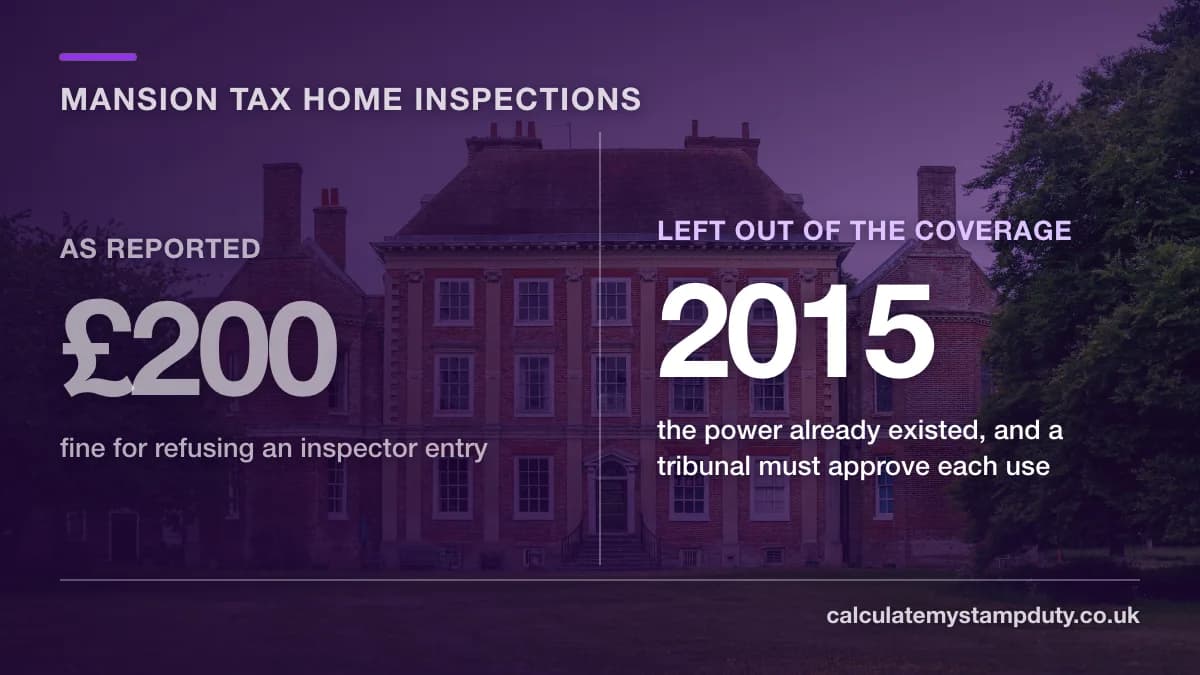
- The power of entry itself is not new. It sits in section 25A of the Local Government Finance Act 1992, inserted on 1 October 2015 by SI 2015/982, and applies to council tax valuation generally rather than to this surcharge specifically
- Section 25A requires the valuation officer to obtain First-tier Tribunal approval before the power is exercised, and to give at least three clear days' notice in writing. This condition has not featured in most of the coverage
- The £200 figure is the maximum fine for intentionally delaying or obstructing an officer exercising that power. It is level 1 on the standard scale
- The £500 figure is separate. It is the maximum fine under section 27 for failing to comply with an information notice within 21 days, and is level 2 on the standard scale
- Knowingly or recklessly supplying false information carries a higher penalty under section 27, up to level 3 and a term of imprisonment not exceeding three months
- HMRC has said most valuations will use publicly available data, third-party data and satellite imagery, with internal inspections where attributes can only be confirmed inside or a re-measurement is needed
- The surcharge applies to homes in England valued at £2m or more, takes effect from April 2028, and is charged at £2,500 to £7,500 a year depending on band
- Nothing in this story changes stamp duty. SDLT rates and thresholds are unchanged, and the surcharge is an annual council tax charge rather than a transaction tax
What Was Reported
On 22 August 2026 The Telegraph reported that HMRC valuation officers would be sent to homes in England to assess whether they fall within the High Value Council Tax Surcharge, the £2m charge announced at the Autumn Budget 2025 and commonly called the mansion tax. The story was picked up widely the following day, with headlines referring to a “council tax police” and to inspectors forcing entry.
The underlying facts came from written answers to parliamentary questions tabled by Conservative MPs. Ministers confirmed that internal inspections would form part of the valuation process, that officers would record details such as floor area, architectural style, number of storeys, rooms, bedrooms and bathrooms, and that penalties exist for owners who obstruct an officer or fail to provide information. Shadow Chancellor Mel Stride described the plans as a “sinister assault on civil liberties”, and Shadow Housing Secretary Sir James Cleverly characterised them as snooping. A government spokesperson said visits would be arranged in advance and conducted in line with a code of practice.
The reporting is accurate on the penalties and on the fact that internal inspections are envisaged. What it largely omits is where these powers come from and what has to happen before one is used. Both are a matter of public statute, so they can be checked directly.
The Surcharge Behind the Story
The High Value Council Tax Surcharge was announced by then Chancellor Rachel Reeves at the Autumn Budget 2025. It applies to homes in England valued at £2m or more at 2026 values, takes effect from April 2028, and is collected alongside council tax although the revenue goes to the Treasury rather than to local authorities. The bands are uprated annually with CPI. We covered the design in detail when the consultation closed on 14 July 2026.
| Property value (2026) | Annual surcharge |
|---|---|
| £2m to £2.5m | £2,500 |
| £2.5m to £3.5m | £3,500 |
| £3.5m to £5m | £5,000 |
| Over £5m | £7,500 |
The valuation problem is the reason inspections are in scope at all. Council tax bands in England still rest on values from 1991, so they cannot identify which homes are worth £2m today. A fresh valuation exercise is therefore required, and the Treasury has previously put a £150m cost on identifying the homes in scope.
On the naming. Several reports refer to the Valuation Office Agency. The VOA ceased to exist as a separate agency on 31 March 2026, and its functions moved into HMRC on 1 April 2026. The valuation function still operates and the statutory role of “listing officer” is unchanged, but it now sits inside HMRC, which is why some coverage says HMRC and some says VOA.
Where the Entry Power Comes From
The power being described is in section 25A of the Local Government Finance Act 1992, headed “Powers of entry: England”. It allows a listing officer, and any servant of the Crown authorised by that officer in writing, to enter, survey and value a dwelling where the officer needs to value it to carry out their functions.
Section 25A was inserted on 1 October 2015 by the Council Tax and Non-Domestic Rating (Powers of Entry: Safeguards) (England) Order 2015, SI 2015/982. It is a general council tax valuation power. It was not created by the Autumn Budget 2025, it is not part of the surcharge legislation, and it has been available for banding work for close to eleven years. Wales has its own equivalent at section 26.
A separate provision, section 27, lets a listing officer serve a notice requiring information about a property. That one dates from the 1992 Act itself. The distinction matters, because the two penalty figures quoted in the coverage attach to different provisions.
The Conditions Attached to It
Section 25A does not permit an officer to arrive unannounced or to force entry. Three conditions apply before the power can be exercised:
- Tribunal approval. The valuation officer must obtain the approval of the First-tier Tribunal before the power is exercised, and the tribunal must be satisfied that the officer needs to value the dwelling. This is the condition that has been largely absent from the coverage, and it is the reason the 2015 instrument is titled “Powers of Entry: Safeguards”.
- Written notice. At least three clear days' notice in writing must be given of the proposed exercise of the power. Saturdays, Sundays, Christmas Day, Good Friday and bank holidays do not count towards the three days.
- Proof of authority. A person authorised by the officer must produce their written authority if asked to.
Junior Treasury minister Dan Tomlinson said in a parliamentary answer that the valuation function would contact homeowners to arrange a visit, and the government has said visits would be pre-arranged and conducted under a code of practice. That is consistent with the statutory position rather than an additional concession.
Headlines describing inspectors forcing their way into homes do not match what section 25A provides. The practical picture is an arranged appointment, preceded by notice, which a tribunal has already agreed is necessary.
The £200 and £500 Figures
Both numbers reported are correct, but they are penalties for two different things, and neither is new.
| Conduct | Provision | Maximum penalty |
|---|---|---|
| Intentionally delaying or obstructing an officer exercising the power of entry | s.25A LGFA 1992 | Level 1, £200 |
| Failing to comply with an information notice within 21 days | s.27 LGFA 1992 | Level 2, £500 |
| Knowingly or recklessly supplying false information | s.27 LGFA 1992 | Level 3, and up to 3 months' imprisonment |
These are summary convictions, which means a magistrates' court would have to convict before any fine applied. The standard scale amounts are set nationally: level 1 is £200, level 2 is £500 and level 3 is £1,000.
How Homes Get Selected for a Visit
The stated approach is desk-based first. HMRC's valuation function has said it will use publicly available data, third-party data and satellite imagery, applying automated valuation models checked by professional valuers, to place homes into one of the four bands. That was the method set out in the consultation.
Internal inspections were described as required where “attributes can only be confirmed internally or a re-measurement is required”. In other words, they are the exception for cases the desk-based method cannot settle, not a routine step for every home. No figure has been published for how many inspections are expected.
Reporting also indicates that homes previously valued above £1.5m will be reassessed to establish whether they now reach £2m, which is why some owners below the threshold may still be contacted. On the number of homes affected, the OBR has estimated around 165,000 in scope, above the 120,000 originally forecast, though published estimates vary depending on the period being measured.
What This Means If Your Home Is Near £2m
Nothing is payable yet. The surcharge starts in April 2028, and the valuation exercise runs ahead of it. If you own a home that might be at or near £2m at 2026 values, the practical points are these:
- Correspondence about a valuation is not itself a bill, and does not confirm that a property is in scope.
- An information notice under section 27 carries a 21 day response window, so it is worth diarising the date rather than setting it aside.
- An inspection should be arranged in advance and preceded by written notice. If someone attends without either, the statutory conditions have not been met.
- Banding decisions can be challenged. The consultation covered an appeal route through the Valuation Tribunal, and the government has said thousands of appeals are anticipated.
- Deferral was consulted on for owners who are asset-rich and income-poor, with proposed income and capital thresholds. The final rules have not been published.
Because the final design is still being settled after the consultation, anything beyond the announced bands and start date should be treated as provisional until it appears in legislation.
How This Connects to Stamp Duty
The surcharge is an annual charge on ownership. Stamp duty is a one-off charge on purchase. They are separate taxes with separate rules, and this story changes nothing about SDLT: rates and thresholds remain as set in April 2025, as shown on our current rates page.
The two do interact at the top of the market, in two ways worth noting. A buyer purchasing at £2m already pays SDLT at the top residential rate on the slice above £1.5m, and from April 2028 would also face the annual surcharge on the same property. Separately, a Treasury disclosure indicated the surcharge is expected to reduce SDLT receipts by around £215m, because a charge on high-value homes dampens transactions in that band.
For what a purchase at these levels costs today, our calculator handles the full residential band structure including the additional property surcharge.
Annexe, land or an old home not sold yet?
These are the purchases where a standard calculator can get your stamp duty wrong. Get it checked before you exchange.
Frequently Asked Questions
Can an inspector force entry to my home?
Not under section 25A. The power allows an officer to enter, survey and value a dwelling, but only after the First-tier Tribunal has approved it and after at least three clear days' written notice. The government has also said visits will be arranged in advance. There is no provision for entry by force.
Are these new powers created by the mansion tax?
No. Section 25A was inserted on 1 October 2015 by SI 2015/982, and the information notice power in section 27 dates from the Local Government Finance Act 1992 itself. Both are general council tax valuation powers. What is new is the scale of the valuation exercise they are being applied to.
What is the fine if I refuse entry?
Intentionally delaying or obstructing an officer exercising the section 25A power is a summary offence carrying a fine of up to level 1 on the standard scale, which is £200. A separate penalty of up to level 2, £500, applies to failing to comply with an information notice under section 27.
Will every £2m home be inspected inside?
That is not what has been described. The stated method is desk-based valuation using public data, third-party data and satellite imagery, with internal inspections where attributes can only be confirmed internally or a re-measurement is needed. No projection of inspection numbers has been published.
Does this change what I pay in stamp duty?
No. Stamp duty rates and thresholds are unchanged. The High Value Council Tax Surcharge is an annual charge on ownership from April 2028 and does not alter the tax due on a purchase.
Does the surcharge apply in Scotland, Wales or Northern Ireland?
No. The announced surcharge applies to homes in England. Council tax is devolved, and section 25A is expressly the England provision, with Wales covered separately by section 26. Northern Ireland uses domestic rates rather than council tax.
Calculate Your Stamp Duty
The surcharge does not affect the tax due on a purchase. If you are buying, our calculator gives the SDLT on any price at current rates, including the additional property and non-resident surcharges.
Use Stamp Duty CalculatorSources
- Section 25A, Local Government Finance Act 1992 (Powers of entry: England), legislation.gov.uk
- Section 27, Local Government Finance Act 1992 (Information about properties), legislation.gov.uk
- The Council Tax and Non-Domestic Rating (Powers of Entry: Safeguards) (England) Order 2015, SI 2015/982
- VOA integration with HMRC, GOV.UK
- Burnham to send mansion tax police to your home, The Telegraph, 22 August 2026
- Ministers' parliamentary answers on internal inspections, Daily Express, 23 August 2026
- HMRC mansion tax inspectors to target homes for property valuations, City AM, 23 August 2026
This article summarises published legislation, ministerial statements and press reporting, and is not tax or legal advice. It is not affiliated with HMRC or GOV.UK.
Reviewed by

Julie White
ACAStamp duty specialist since 1999Stamp Duty Land Tax Specialist
ACA and Tax Adviser with a career spanning nearly four decades, specialising in stamp duty planning and advisory work since 1999.