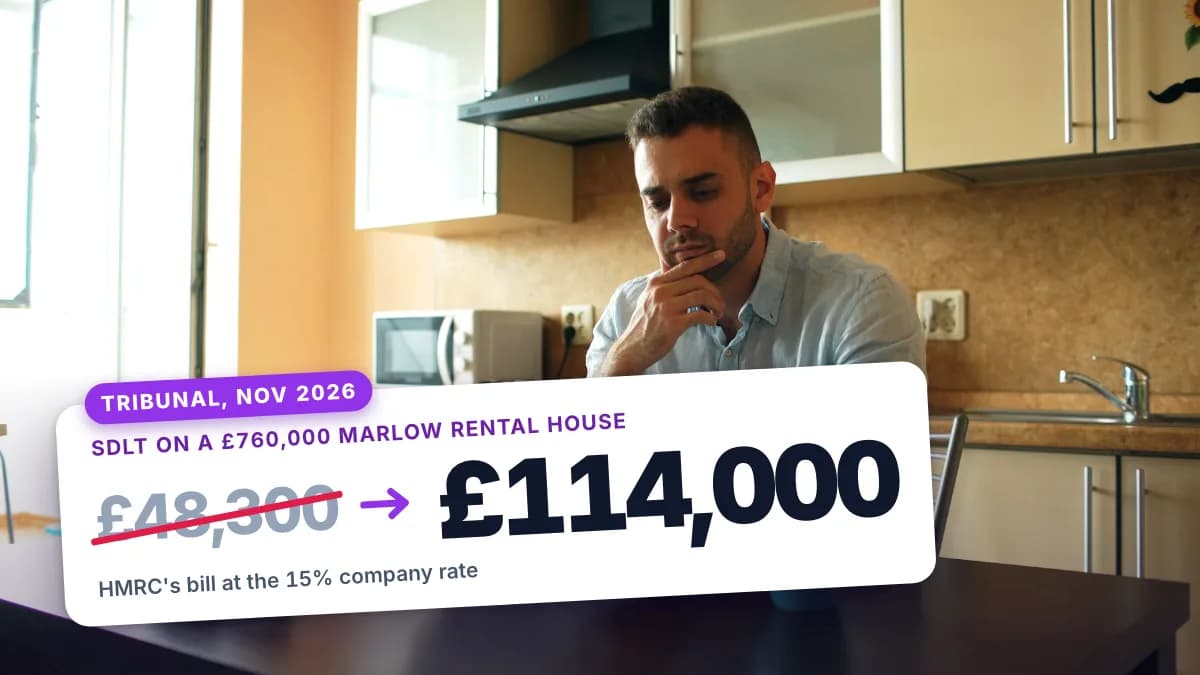
A Company Paid £48,300 Stamp Duty on a Marlow Rental House. HMRC Wanted £114,000 After Its Letters Went Unanswered
A company bought a £760,000 house in Marlow to let and paid stamp duty land tax at residential rates, claiming relief from the 15% rate that then applied to companies. HMRC's enquiry letters were missed, and it charged the full 15%. On 10 November 2026 the First-tier Tribunal let the company appeal five months late. Whether the relief applies is still to be decided.
Kaleidoscopes Group Limited v The Commissioners for HMRC [2026] UKFTT 1544 (TC), decision TC 10097, heard 30 October 2026, released 10 November 2026 (SDLT, England).
Key Takeaways
- Kaleidoscopes Group Ltd v HMRC [2026] UKFTT 1544 (TC), released 10 November 2026: the First-tier Tribunal gave a company permission to appeal late against a £65,700 SDLT closure notice and a £17,739 penalty
- The company bought a house in Marlow for £760,000 on 3 April 2024 as the first property in a planned rental portfolio. It paid £48,300, claiming property rental business relief from the then 15% company rate
- HMRC opened an enquiry on 18 November 2024. Its letters went unanswered, and on 9 April 2025 it charged the full 15%: £114,000, an extra £65,700
- The appeals were five months and two months late against a 30-day limit. The tribunal accepted that serious ill health of the sole director, and a family friend helping run the company who missed HMRC's letters, together explained the delay
- It found the company had a strong case on the relief and that HMRC had identified no weakness in it. Whether the relief applies has not been decided
- The company rate is now 17%. On the same £760,000 purchase today, a company pays £129,200 at 17% or £66,000 with the relief, on our calculator engine
- The relief can be withdrawn at any point in the three years after purchase, for example if a connected person moves in. A further return is then due within 30 days
What the Tribunal Decided
Kaleidoscopes Group Limited v HMRC [2026] UKFTT 1544 (TC) was heard by Tribunal Judge Ruthven Gemmell WS by remote video on 30 October 2026 and released on 10 November 2026. It deals only with whether the company could bring two appeals out of time. The tribunal granted permission for both (paragraph 103).
The company was incorporated on 23 January 2024 to invest in assets including rental property. On 3 April 2024 it bought a house in Marlow for £760,000 as the first property in a planned rental portfolio. It carried out improvements and instructed local estate agents to let the house (paragraphs 13 and 14). The letting was not successful and the company later sold the property (paragraph 46).
The company's solicitors filed the return and paid £48,300. They claimed relief under paragraph 5 of Schedule 4A to the Finance Act 2003, the relief for dwellings bought for a property rental business, which takes a company out of the flat company rate (paragraphs 9 and 10). The timeline after that:
- 18 November 2024: HMRC opened an enquiry and asked for documents. The letter also asked the company to say if any health or personal circumstances made it hard to deal with HMRC (paragraphs 16 and 17).
- 20 January 2025: with no reply, HMRC wrote that it was “unable to verify why SDLT was paid at a lower rate” and asked for a response by 20 February 2025 (paragraph 16).
- 9 April 2025: HMRC issued a closure notice charging an extra £65,700 (paragraph 19).
- 15 July 2025: HMRC issued a penalty notice for £17,739, which the decision records as made under Schedule 55 to the Finance Act 2009 (paragraphs 1 and 3).
- 3 August 2025: the director learned of the dispute and contacted HMRC and a tax adviser straight away (paragraphs 28 and 29).
- 30 September 2025: the appeals were lodged (paragraph 30).
The £65,700: How the Figures Work
In April 2024 a company buying a dwelling for more than £500,000 paid 15% of the whole price, unless a relief applied. With property rental business relief, HMRC's manual says the company pays the higher rates for additional dwellings instead (SDLTM09555). Those were 3 percentage points above the standard bands in force from 23 September 2022 to 30 October 2024. We ran both through our calculator engine:
| £760,000, effective date 3 April 2024 | SDLT |
|---|---|
| With the relief: 3% on the first £250,000 (£7,500) and 8% on the next £510,000 (£40,800) | £48,300 |
| Without the relief: 15% of £760,000 | £114,000 |
| Extra tax charged by the closure notice | £65,700 |
Both totals match the decision: £48,300 paid, and £114,000 after the closure notice (paragraph 41). The penalty of £17,739 comes on top. The company's adviser told the tribunal that £48,300 is what an individual would have paid at the time, and what a company would pay with the relief (paragraph 10). That is the figure for an individual buying an additional home. An individual buying an only home would have paid less.
A third figure HMRC could not explain. Correspondence of 11 June 2025 between the company's solicitors and HMRC's Birmingham stamp office suggested the correct figure was £58,300, £10,000 more than was paid. At the hearing HMRC could not explain where that figure came from, or why the solicitors' original calculation was missing, although the evidence showed it had been sent (paragraphs 8, 21 and 89). The tribunal described the position as “obfuscated” by the stamp office figure.
The Same Purchase Today: £129,200 or £66,000
The company rate is no longer 15%. It has been 17% since 31 October 2024, and the surcharge for additional dwellings rose from 3% to 5% on the same date (GOV.UK, SDLT: corporate bodies). The nil-rate band also fell back to £125,000 on 1 April 2025. Our calculator engine gives these figures for the same £760,000 dwelling bought by a company now:
| Company buying a £760,000 dwelling today | SDLT |
|---|---|
| No relief: 17% of £760,000 | £129,200 |
| With property rental business relief: 5% on the first £125,000 (£6,250), 7% on the next £125,000 (£8,750), 10% on the next £510,000 (£51,000) | £66,000 |
| Difference | £63,200 |
At or below £500,000 the flat rate does not apply, and a company pays the standard bands plus the 5% surcharge on any dwelling of £40,000 or more. Run your own price through the limited company stamp duty calculator, which shows both routes.
Contracts Signed Before 31 October 2024
A purchase that completed on or after 31 October 2024 still paid 15%, not 17%, if the contract was entered into before that date (Finance Act 2025, section 53(3)). That protection is lost if, on or after 31 October 2024, the contract was varied or its rights assigned, the purchase followed the exercise of an option or right of pre-emption, or a sub-sale or assignment let someone other than the original buyer call for the transfer (section 53(4)). The surcharge rise from 3% to 5% has the same cut-off and the same exceptions (SDLTM09845A).
Kaleidoscopes completed on 3 April 2024, before either change, so its case is decided on the 15% rate and the 3% surcharge.
How a Company Keeps the Residential Rates
Paragraph 5 of Schedule 4A switches off the flat rate where the dwelling is acquired exclusively for one or more listed purposes. For a buy-to-let company the main one is “exploitation as a source of rents or other receipts” in the course of a qualifying property rental business, meaning one run on a commercial basis and with a view to profit (SDLTM09555). Development or redevelopment for resale or letting, and a property trading business, are also on the list.
The occupation rule. A dwelling does not count as acquired exclusively for those purposes if it is intended that a non-qualifying individual will be allowed to occupy it (paragraph 5(2)). Paragraph 5A defines that group widely. It includes individuals connected with the company, such as a shareholder who controls it, their spouses or civil partners, and their brothers, sisters, ancestors and lineal descendants. HMRC's manual says withdrawal applies in all cases where a non-qualifying individual is allowed to occupy, “even where the individual pays a market rent to the owner” (SDLTM09660).
The three-year clawback. Paragraph 5G withdraws the relief if, at any time in the three years from the effective date, the dwelling is not held exclusively for a qualifying purpose, or a non-qualifying individual is allowed to occupy it. Where letting has not started yet, or has stopped, the company keeps the relief only if reasonable steps are being taken to carry out the purpose. HMRC's examples of reasonable steps are appointing a letting agent, redecorating, more substantial alterations and buying furniture. The steps must be ones that could be expected to lead to a letting: advertising a Knightsbridge flat in Newcastle, or at a rent it is unlikely to achieve, does not count (SDLTM09660). The purpose requirement is also suspended while an unforeseen change beyond the company's control makes the purpose unreasonable to carry out (paragraph 5G(4)).
If the relief is withdrawn, the company must deliver a further return within 30 days of the first day a condition was not met, and pay the tax by the same date (section 81(1A), (1B) and (2A) of the Finance Act 2003). Our guide to the 17% company rate covers the other reliefs.
In this case the company's adviser described the relief as relatively straightforward. The company said it could show receipts for the improvement works and its estate agents' attempts to let (paragraphs 45, 46 and 88). The decision does not say when the house was sold or test those facts against paragraph 5G. That is for the full hearing.
HMRC Letters and the 30-Day Appeal Window
SDLT is self-assessed. HMRC can open an enquiry into a return, ask for documents, and close it with a closure notice that amends the tax. The company in this case did not answer the enquiry letters, so HMRC closed the enquiry without the relief (paragraph 43). The appeal rules are in Part 7 of Schedule 10 to the Finance Act 2003:
- 30 days. Notice of appeal against a closure notice must be given in writing, within 30 days after the date it was issued, to the HMRC officer who issued it, and must state the grounds (paragraph 36). The tribunal applied the same 30-day limit to the penalty (paragraph 73 of the decision).
- The tax is still due. An appeal does not stop the tax being payable (paragraph 38). If you believe you are overcharged, you can apply to HMRC within 30 days to postpone payment, and refer it to the tribunal if HMRC does not agree (paragraph 39).
- Missing the deadline. HMRC must accept a late appeal if you ask in writing, it is satisfied you had a reasonable excuse, and you asked without unreasonable delay after the excuse ended. If HMRC does not agree, only the tribunal can give permission (paragraph 44).
HMRC argued that the company had several chances to avoid this. Its first letter invited the company to say if health or personal circumstances made it hard to deal with HMRC, the company could have asked for more time, and there was no protective appeal (paragraphs 56, 63 and 64). Our HMRC stamp duty contact guide lists how to reach the stamp duty team.
Why the Tribunal Let the Late Appeals In
The starting point is that permission to appeal late should not be granted unless the tribunal is satisfied it should be. It applied the three stages from Martland v HMRC [2018] UKUT 0178 (TCC): how long the delay was, why it happened, and a balance of all the circumstances, giving particular weight to time limits being respected (paragraph 71). HMRC relied on the Court of Appeal's 2026 decision in Medpro, which upheld that guidance (paragraphs 65 and 66).
- The delay. Five months on the closure notice and two months on the penalty were both serious and significant against a 30-day limit (paragraph 73).
- The reason. The company's sole director was seriously ill and, on medical advice, had stepped away from work. A family friend helping to run the company did not pass on HMRC's letters or recognise the deadlines. The tribunal found the cause was the combination of the two, “and not one or the other” (paragraph 83). The director had relied on solicitors to pay the right tax and did not know there was any doubt, so he had no reason to warn his helper to look out for HMRC (paragraphs 84 and 96).
- The balance. The tribunal called the reasons “adequate” bordering on “good” (paragraph 97), while recording that the director accepted the help he had arranged was inadequate (paragraph 99). It found the company had a strong case on the relief, and that HMRC “had not identified an apparent weakness” and seemed relatively unaware of the details of the claim (paragraphs 90 and 91). Refusing permission would have left the company unable to challenge £65,700 (paragraph 88).
The strength of the relief claim carried weight. Under Martland, the tribunal can take account of an obvious strength or weakness in the case, because losing the chance to argue a strong case is a greater prejudice. A company with a weak relief claim, or no medical evidence, may not get the same result.
What Happens Next
The appeals against the closure notice and the penalty can now go ahead. Whether paragraph 5 relief applies, and so whether the £65,700 and the penalty stand, has not been decided. Either party can apply for permission to appeal this decision, and the application must reach the tribunal within 56 days after the decision is sent to that party (paragraph 104). If it was sent on its release date, 10 November 2026, that window closes on 5 January 2027. As of 15 November 2026 no application by HMRC has been published.
First-tier Tribunal decisions bind no other tribunal. This one turns on its own facts, especially the medical evidence and the strength of the relief claim.
What It Means for Company Buyers
- Keep evidence of the letting purpose from day one. Instructions to letting agents, invoices for works and furniture, and marketing at a realistic rent are what HMRC's guidance treats as reasonable steps.
- Nobody connected to the company lives in it for three years. That includes shareholders who control it and their families, even if they pay a market rent.
- If plans change within three years, for example the company stops letting, decides to sell, or lets a relative move in, check whether a further return is due within 30 days.
- Make sure HMRC post reaches someone who acts on it. Enquiry letters go to the company. If the director is unavailable, someone needs authority to reply, ask for more time or tell HMRC about health problems.
- Appeal a closure notice within 30 days, in writing and with grounds, even if you are still gathering evidence. Apply to postpone the tax at the same time if you think it is wrong.
- If you have missed it, ask HMRC in writing to accept a late appeal as soon as the reason for the delay ends, then apply to the tribunal if it refuses.
More on buying through a company is in our SPV property purchase guide. Individual landlords never pay the company rate, and there is no separate relief for portfolio landlords: see professional landlord stamp duty relief.
Frequently Asked Questions
What did the tribunal decide in Kaleidoscopes Group v HMRC?
It gave the company permission to appeal late against an HMRC closure notice for £65,700 of extra stamp duty land tax and a £17,739 penalty. The appeals were five months and two months out of time. The decision, [2026] UKFTT 1544 (TC), was released on 10 November 2026. It did not decide whether the company qualifies for property rental business relief. That question goes to a later hearing.
Why did HMRC charge the company £114,000?
Because it applied the 15% rate that then applied to companies buying a dwelling for more than £500,000: 15% of £760,000 is £114,000. The company had paid £48,300 by claiming property rental business relief, which replaces the flat rate with the residential rates plus the surcharge for additional dwellings. HMRC opened an enquiry, received no reply to its letters, and closed the enquiry on 9 April 2025 without allowing the relief.
What would the same purchase cost a company today?
The company rate rose from 15% to 17% on 31 October 2024. On a £760,000 dwelling a company now pays £129,200 at 17%, or £66,000 if property rental business relief applies (the standard bands plus the 5% surcharge). That is a difference of £63,200.
What stops property rental business relief applying?
The dwelling must be acquired exclusively for a qualifying purpose, such as letting in the course of a commercial property rental business. Relief is not available if it is intended that a non-qualifying individual will be allowed to occupy it. That includes individuals connected with the company, such as a shareholder who controls it, and their spouses, civil partners, brothers, sisters, ancestors and lineal descendants. HMRC's manual says this applies even if they pay a market rent.
Can HMRC take the relief back after completion?
Yes. Under paragraph 5G of Schedule 4A to the Finance Act 2003, the relief is withdrawn if, at any time in the three years from the effective date, the dwelling stops being held exclusively for a qualifying purpose or a non-qualifying individual is allowed to occupy it. If letting has not started or has stopped, the company must be taking reasonable steps to let it. Where relief is withdrawn the company must file a further return within 30 days and pay the extra tax.
How long do you have to appeal an SDLT closure notice?
30 days from the date the closure notice is issued. The appeal must be in writing to the HMRC officer who issued it and must state the grounds. The tax stays payable unless you also apply to postpone it within 30 days. A late appeal needs HMRC's agreement, which it must give if there was a reasonable excuse and you asked without unreasonable delay, or the tribunal's permission.
Calculate Company Stamp Duty
Our limited company calculator shows the SDLT on a residential purchase by a company at the 17% rate and with a relief from it, for England and Northern Ireland. If HMRC has opened an enquiry into a relief claim, take specialist advice before the deadlines in its letters pass.
Use the Limited Company CalculatorSources
- Kaleidoscopes Group Limited v HMRC [2026] UKFTT 1544 (TC), TC 10097, Find Case Law
- Finance Act 2003, Schedule 4A (paragraphs 3, 5, 5A and 5G), legislation.gov.uk
- Finance Act 2003, Schedule 10 Part 7: reviews and appeals (paragraphs 36, 38, 39 and 44), legislation.gov.uk
- Finance Act 2003, section 81: further return where relief withdrawn, legislation.gov.uk
- Finance Act 2025, section 53: purchases by companies etc (15% to 17%, transitional rules), legislation.gov.uk
- SDLTM09845A: higher rates for additional dwellings, transitional rules and the change of rate, HMRC Stamp Duty Land Tax Manual
- SDLTM09555: property rental businesses, HMRC Stamp Duty Land Tax Manual
- SDLTM09660: withdrawal of relief under paragraph 5G, HMRC Stamp Duty Land Tax Manual
- Stamp Duty Land Tax: corporate bodies, GOV.UK
- Stamp Duty Land Tax rates: 23 September 2022 to 30 October 2024, GOV.UK
This article summarises a published tribunal decision and is not tax advice. It is not affiliated with HMRC or GOV.UK.
Reviewed by

Julie White
ACAStamp duty specialist since 1999Stamp Duty Land Tax Specialist
ACA and Tax Adviser with a career spanning nearly four decades, specialising in stamp duty planning and advisory work since 1999.