A Pool House With Its Own Kitchen, Shower and Drive Was Not a Separate Home. The Buyer Lost an £80,750 Stamp Duty Claim
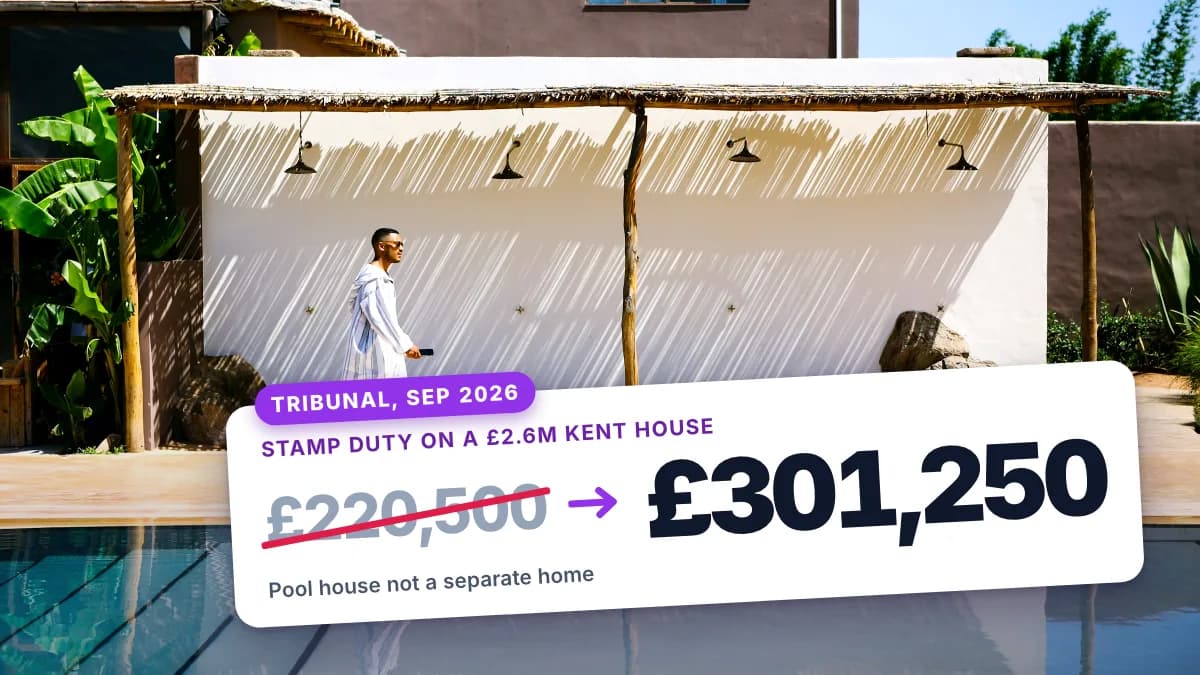
On 18 September 2026 the First-tier Tribunal ruled that a pool house in the grounds of a £2.6m country house near Tenterden in Kent was not a separate dwelling, so the buyer could not claim multiple dwellings relief. It had a kitchen, a shower room, its own driveway and lockable doors. What sank the claim was the swimming pool outside its French doors. The decision was first reported by The Times and was picked up across the national press this week.
Smith v HMRC [2026] UKFTT 01351 (TC), decision TC 10022, heard 2 July 2026, released 18 September 2026 (SDLT, England).
Key Takeaways
- Smith v HMRC [2026] UKFTT 01351 (TC), released 18 September 2026: the First-tier Tribunal held that a pool house at a £2.6m property near Tenterden, Kent, was not suitable for use as a single dwelling, so multiple dwellings relief (MDR) was not available. The buyer lost
- At stake was £80,750: SDLT of £301,250 on HMRC's view against £220,500 with MDR. Both figures match the higher rates for additional dwellings in force when the purchase completed on 14 December 2023
- The pool house passed the basic living needs test. It had a kitchen, a shower room, a WC and room for a single bed, and the tribunal rejected HMRC's argument that it was too small
- It failed on privacy and security. Sharing the pool would realistically mean the main house using the pool house's shower and toilet, and a main house that gave up the pool was not a realistic arrangement either
- Its own driveway, lockable doors and a distance of over 200 feet were not enough. Shared meters, postal address and council tax rating counted against it, but carried very limited weight
- MDR was abolished for transactions with an effective date on or after 1 June 2024, but the higher rates rules use the same "suitable for use as a single dwelling" words, so whether an annexe is a separate dwelling still matters
- The decision binds no other tribunal. The buyer had 56 days from when it was sent to him to apply for permission to appeal, and whether he has applied is not on the public record
What the Tribunal Decided
Multiple dwellings relief let a buyer of two or more dwellings in one transaction work out stamp duty land tax (SDLT) on the average price per dwelling, then multiply it back up, subject to a minimum of 1% of the total price. On a large house with an annexe it could cut the bill by tens of thousands of pounds. A building counted as a dwelling if it was “used or suitable for use as a single dwelling” (paragraph 7(2)(a) of Schedule 6B to the Finance Act 2003).
Smith v HMRC [2026] UKFTT 01351 (TC), decision TC 10022, was heard by video on 2 July 2026 by Tribunal Judge Rosa Pettifer and Tribunal Member Helen Myerscough, and released on 18 September 2026. The buyer paid £2,600,000 on 14 December 2023 for about three acres near Tenterden with an eight-bedroom main house, and filed his return on 18 December 2023. He later claimed MDR on the basis that the pool house was a second dwelling. HMRC rejected the claim in a closure notice dated 21 February 2025 (paragraphs 3, 4 and 25 to 27). The tribunal dismissed his appeal.
Both sides relied on the Upper Tribunal's test in Fiander and Brower v HMRC [2021] UKUT 0156 (TCC), at paragraph 48. A dwelling must provide facilities for basic domestic living needs, and those needs must be capable of being met “with a degree of privacy, self-sufficiency and security consistent with the concept of a single dwelling”. The test is objective. It looks at occupiers generally, not at a relative or a particular buyer, and at the property as it stood at completion.
What the Pool House Had
The pool house was a single-storey, timber-clad building with a pitched tiled roof. The tribunal's findings, as at completion:
| Feature | What the tribunal found | Paragraph |
|---|---|---|
| Rooms | Five: a main room, a plant room, a sauna room, a shower room, and a room with a lavatory and a sink | 29(4) |
| Kitchen | Sink, cupboards, worktops, space for a fridge and dishwasher, wiring for a large cooker, and an island with seating for at least three, taking about half of a main room of about 20.74m² | 30 |
| Sleeping and storage | Room for at least a single bed and a modest seating area. The sauna unit could be lifted out to leave a storage room | 31, 32 |
| Access | Its own lockable entrances, its own driveway through a gate from a public road, and its own parking | 29(5) |
| Services | Its own oil-fired underfloor heating, stop tap and fuse board. It shared the council tax rating, postal address, electricity meter and water meter, and the whole property was on one Land Registry title | 26, 29(5), 29(6) |
| Position | Over 200 feet from the main house, across a stream with a bridge. Its French doors open straight onto the tiled area around the swimming pool | 29(2), 29(3) |
| Use and description | Not used as a dwelling at completion and called the “pool house” in the sales brochure. The tribunal said neither was relevant to the test | 28, 29(3), 38 |
HMRC argued that the building was too small to live in, with the kitchen taking half the main room and nowhere to keep belongings. The tribunal disagreed on both points (paragraphs 39 and 40). It found that the pool house provided space for sleeping, a private toilet, washbasin and shower, and somewhere to prepare and eat food, so basic living needs were met: “a material factor pointing towards MDR being available” (paragraphs 41 and 42).
A correction to some coverage. One report described a “five-bedroom pool house”. The decision records five rooms, not five bedrooms: a main room, a plant room, a sauna room, a shower room, and a room with a lavatory and a sink (paragraph 29(4)). The only bed space it found was for a single bed in the main room (paragraph 31).
Why Privacy Decided It
The tribunal said a lack of privacy and security can outweigh every other factor, while agreeing with an earlier decision, Berrell and Thomas v HMRC [2025] UKFTT 01067 (TC), that privacy does not need to be absolute (paragraph 43). It accepted that the distance, the separate driveway and the lockable doors gave a degree of privacy consistent with a single dwelling (paragraph 45). It did not accept the buyer's point that trees hid the two buildings from each other, because the only photographs were taken when the trees were in leaf. The problem was the pool.
Because the test is objective, the tribunal asked on what realistic terms one household could live in the pool house while another lived in the main house (paragraph 48). The buyer's counsel put forward two arrangements, and the tribunal rejected both:
- The main house gives up the pool. That would solve the privacy problem, but the tribunal was not satisfied that occupiers of what it called an impressive property would realistically give up “a significant amenity” (paragraph 49).
- The pool is shared. Curtains or blinds could stop the two households seeing into each other (paragraph 50). But anyone from the main house would have to walk more than 200 feet each way in swimwear, or change in the open air, and “in reality any shared use of the pool would involve occupiers of the Main House using the facilities, at least the shower and toilet, of the Annexe”. That would suit only “a particular type of occupier (eg relatives or friends)”, not occupiers generally (paragraph 51).
Marketing material for other homes with shared pools did not help, because none was laid out like this one. Nor did an Airbnb listing: holiday lets are where “people may be prepared, in the context of privacy, to compromise more than they would be more generally” (paragraph 51).
The shared meters, address, council tax rating and single title counted against the claim, but the tribunal placed “very limited weight” on them, because bills can be apportioned and post arranged (paragraph 55). The pool house's own heating, stop tap and fuse board carried “some limited weight” the other way (paragraph 56). The conclusion: the pool house did not meet, “by reference to occupiers generally, basic living needs with a degree of privacy, self-sufficiency and security consistent with the concept of a single dwelling. We rely particularly on our findings in relation to privacy and security” (paragraph 57).
The £80,750: How the Figures Work
The decision gives the two totals but not the workings (paragraph 5). Both match the higher rates for additional dwellings in force on 14 December 2023, which were 3% above the standard rates. The decision does not say why the higher rates applied, so we have not assumed a reason. Our working:
- One dwelling, HMRC's view: 3% on the first £250,000 (£7,500), 8% on the next £675,000 (£54,000), 13% on the next £575,000 (£74,750), 15% on the remaining £1,100,000 (£165,000). Total £301,250.
- Two dwellings with MDR: £2,600,000 divided by two is £1,300,000. Tax on £1,300,000 is £7,500 plus £54,000 plus 13% on £375,000 (£48,750), which is £110,250. Multiplied by two: £220,500, above the 1% minimum of £26,000.
- Difference: £80,750.
At the standard rates then in force, without the 3% surcharge, a single £2.6m home would have cost £223,250. The surcharge has been 5% since 31 October 2024. To see today's figures on your price, use our stamp duty calculator.
What It Means for Annexes Now
MDR was abolished for transactions with an effective date on or after 1 June 2024. It still applies where contracts were exchanged on or before 6 March 2024 and were not varied, assigned or sub-sold after that date, whenever completion takes place. The usual way to add an MDR claim after filing was to amend the return within 12 months of the filing date, so for most purchases that window has closed. The transitional rules are in our multiple dwellings relief guide.
The question of whether an annexe is a separate dwelling has not gone away. The rules for the higher rates use the same words: a building counts as a dwelling if “it is used or suitable for use as a single dwelling” (paragraph 18(2)(a) of Schedule 4ZA to the Finance Act 2003). Buying a house with an annexe that is a separate dwelling can bring in the 5% higher rates even if you own nothing else, unless the annexe counts as subsidiary to the main house, and HMRC says first-time buyer relief is not due where a purchase consists of two or more dwellings (SDLTM29821). Our guide to granny annexe stamp duty covers both rules.
- A kitchen and a shower are not enough on their own. The tribunal looked at how two households could realistically live side by side, and a facility that one of them would need to use decided it.
- Labels do not decide it either way. Calling the building a pool house in the brochure, and never having lived in it, were irrelevant. So were the buyer's plans for it, because the test is objective.
- Separate meters and addresses carry little weight. Their absence counted only slightly against the pool house, and having its own heating and fuse board counted only slightly in its favour.
Smith was decided under the MDR rules and does not decide a higher rates case. It is a First-tier Tribunal decision on its own facts and binds no other tribunal, and the tribunal itself warned against piecing together principles from other first-tier annexe decisions with different facts (paragraph 35). The buyer had 56 days from when the decision was sent to him to apply for permission to appeal (paragraph 59). Whether he has applied is not on the public record.
If someone offers to reclaim stamp duty on a house with an annexe, check the dates and the test before you sign anything. SDLT is self-assessed, so if a claim is paid and later overturned, the tax is repaid with interest. For deadlines and the other routes, see Stamp Duty Refund: Can You Claim It Back?
Frequently Asked Questions
Can a pool house count as a separate dwelling for stamp duty?
It can, but only if it is suitable for use as a single dwelling, judged objectively for occupiers generally. Under the Upper Tribunal's test in Fiander and Brower, it must meet basic living needs with a degree of privacy, self-sufficiency and security consistent with a single dwelling. In Smith v HMRC, released on 18 September 2026, a pool house with a kitchen, shower room and its own driveway met the basic needs but failed on privacy, because sharing the pool would realistically mean the main house using its shower and toilet.
Why did the buyer lose when the pool house had a kitchen and a shower?
Because of the pool outside its doors. The tribunal asked on what realistic terms one household could live in the pool house and another in the main house. If the main house gave up the pool, privacy would be fine, but the tribunal did not accept that occupiers of the main house would realistically give up such a significant amenity. If the pool was shared, the main house would in reality use the pool house's shower and toilet, which only suits relatives or friends, not occupiers generally.
How much stamp duty was at stake in Smith v HMRC?
£80,750. On HMRC's view the SDLT on the £2.6m purchase was £301,250. With multiple dwellings relief it would have been £220,500. Both figures match the higher rates for additional dwellings in force when the purchase completed on 14 December 2023, which were 3% above the standard rates. The decision does not say why the higher rates applied.
Can I still claim multiple dwellings relief on a house with an annexe?
Only on older purchases. MDR was abolished for transactions with an effective date on or after 1 June 2024. It still applies where contracts were exchanged on or before 6 March 2024 and were not varied, assigned or sub-sold after that date. The usual way to add a claim after filing was to amend the return within 12 months of the filing date, so for most purchases that window has closed.
Does an annexe still matter for stamp duty now that MDR has gone?
Yes. The higher rates rules use the same words: a building counts as a dwelling if it is used or suitable for use as a single dwelling. Buying a house with an annexe that is a separate dwelling can bring in the 5% higher rates even if you own nothing else, unless the annexe is subsidiary to the main house, and HMRC says first-time buyer relief is not due where a purchase consists of two or more dwellings.
Can the buyer appeal the pool house decision?
He could apply for permission to appeal within 56 days of the decision being sent to him. Whether he has applied is not on the public record. Smith is a First-tier Tribunal decision on its own facts and binds no other tribunal.
Calculate Your Stamp Duty
Buying a house with an annexe? Our calculator works out SDLT for England and Northern Ireland, LBTT for Scotland and LTT for Wales, including the higher rates for additional dwellings, so you can see what is at stake if the annexe counts as a second home. If you think it might, take independent advice before you exchange.
Use Stamp Duty CalculatorSources
- John Smith v HMRC [2026] UKFTT 01351 (TC), TC 10022, Find Case Law
- Finance Act 2003, Schedule 4ZA, paragraph 18: what counts as a dwelling, legislation.gov.uk
- Stamp Duty Land Tax rates: 23 September 2022 to 30 October 2024, GOV.UK
- Your pool house is not a second home, judge rules, This is Money, 6 October 2026
This article summarises a published tribunal decision and is not tax advice. It is not affiliated with HMRC or GOV.UK.
Reviewed by

Julie White
ACAStamp duty specialist since 1999Stamp Duty Land Tax Specialist
ACA and Tax Adviser with a career spanning nearly four decades, specialising in stamp duty planning and advisory work since 1999.