
A £2.4m Asbestos House Was Not a Dwelling for Stamp Duty. A Scottish House Empty 12 Years Still Was
On 5 August 2026 the First-tier Tribunal ruled that a £2.4m house in Bushey Heath, empty for three to four years and with asbestos throughout, was not a dwelling, so non-residential stamp duty land tax rates applied. On 1 May 2026 Scotland's tax tribunal had ruled that a Selkirk house bought unseen at auction, last occupied in 2012, with dangerous wiring and lead in the water, still was one. Neither decision is new. Both are back in the news because the Chartered Institute of Taxation's Tax Adviser magazine set them side by side in its October 2026 issue.
Oakwood Great Oak Ltd v HMRC [2026] UKFTT 01138 (TC), released 5 August 2026 (SDLT, England). LMT Property Investors Ltd v Revenue Scotland [2026] FTSTC 3, released 1 May 2026 (LBTT, Scotland).
Key Takeaways
- Oakwood Great Oak Ltd v HMRC [2026] UKFTT 01138 (TC), decision TC 09979, released 5 August 2026: the First-tier Tribunal held that a £2.4m house in Bushey Heath was not suitable for use as a dwelling, so non-residential SDLT rates applied. The company won
- LMT Property Investors Ltd v Revenue Scotland [2026] FTSTC 3, released 1 May 2026: Scotland's tax tribunal held that a Selkirk house bought for £110,000 was still a dwelling, so the £8,800 Additional Dwelling Supplement (8%) stood. The company lost
- Both tribunals applied the Court of Appeal's test in Mudan & Anor v HMRC [2025] EWCA Civ 799: a building does not have to be ready to move into to be a dwelling, and the key question is whether a former home has lost its identity as one
- Oakwood crossed the line on the combined weight of three to four years' vacancy, substantial structural defects, asbestos in numerous locations that made the house unsafe, and remediation that would itself have stripped out the services. The tribunal said theoretical repairability is not the test
- LMT fell short because its defects were fixable with ordinary works: rewiring was "almost routine", the water could be used, the main roof was intact, and much of the stripping-out was the buyer's own choice
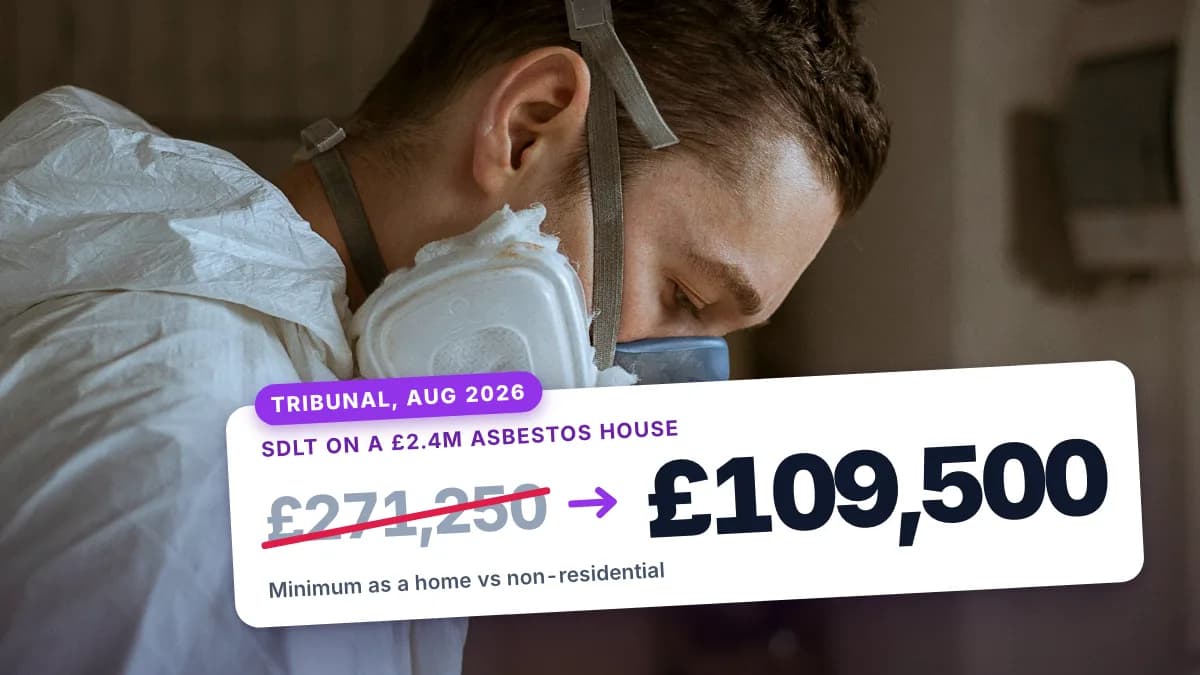
- The Oakwood decision does not state the tax at stake. Because the buyer was a company, residential rates on 29 November 2022 would have been at least £271,250 against £109,500 at non-residential rates, a gap of at least £161,750 on our working
- Neither decision binds any other tribunal. HMRC had 56 days to seek permission to appeal Oakwood, and whether it did is not on the public record. In LMT the tribunal also found it likely that AI had been used to prepare the appeal, after the company cited a case that does not exist
Two Run-Down Houses, Two Opposite Answers
Stamp duty land tax (SDLT), collected by HMRC in England and Northern Ireland, and land and buildings transaction tax (LBTT), collected by Revenue Scotland, are separate taxes. They share one definition. Residential property is a building “used or suitable for use as a dwelling”: section 116 of the Finance Act 2003 for SDLT, section 59 of the Land and Buildings Transaction Tax (Scotland) Act 2013 for LBTT. A building too far gone for that use is non-residential, and in Scotland it is outside the Additional Dwelling Supplement.
Oakwood Great Oak Ltd v HMRC [2026] UKFTT 01138 (TC), decision TC 09979, was heard by Tribunal Judge Stapenhurst and Mr L Howard and released on 5 August 2026. The company bought “Great Oak”, Prowse Avenue, Bushey Heath, a 1930s detached house with a 1960s extension, on 29 November 2022 for £2,400,000 and filed its return as non-residential. HMRC's closure notice of 22 December 2023 treated it as residential. The company had always planned to demolish the house and build two new ones, and it has since been demolished, but the tribunal gave that intention limited weight because the test is objective (paragraphs 162 and 163). It allowed the appeal.
LMT Property Investors Ltd v Revenue Scotland [2026] FTSTC 3 was heard by Anne Scott, President of the First-tier Tribunal for Scotland Tax Chamber, and member Charlotte Barbour, and released on 1 May 2026. The company bought a detached bungalow in Selkirk at auction for £110,000, with an effective date of 7 February 2025. It obtained the Home Report but “did no research and did not view the Property” (paragraph 13). Because £110,000 is below the LBTT nil-rate threshold, the only tax was the supplement: £8,800, or 8%, the rate in force since 5 December 2024. The company later amended its return to claim that back. Revenue Scotland refused, and the tribunal dismissed the appeal.
The Mudan Test Both Tribunals Applied
Both panels applied Mudan & Anor v HMRC [2025] EWCA Civ 799, decided by the Court of Appeal on 27 June 2025. The Mudans argued that a house needing complete rewiring and a new boiler, which could not be lived in on the purchase date, was not suitable for use as a dwelling. Lord Justice Lewison said that read “suitable for use” as “suitable for immediate use”: “But that, quite simply, is not what the definition says” (paragraph 66). For a former home, “one highly relevant question is whether on the relevant date it has lost that identity” (paragraph 48).
The court endorsed the seven considerations set out by the Upper Tribunal at paragraph 58 of [2024] UKUT 307 (TCC). The ones that decided these two cases:
- Is the building a dilapidated house that needs updating, or an empty shell with no main roof?
- Are the works needed to make it habitable, or only to make it “a pleasant place to live”?
- Are the defects fixable, or would the works be too hazardous to be viable or threaten the structure?
- Unsafe occupation, for example because the house needs rewiring, is relevant but not decisive on its own.
LBTT uses the same words, and the Scottish tribunal treated Mudan as authoritative guidance on their meaning (paragraphs 68 to 70). The same weighing of many factors, with no single one decisive, runs through this year's SDLT garden and grounds tribunal rulings.
The Two Properties Side by Side
| Oakwood (Bushey Heath) | LMT (Selkirk) | |
|---|---|---|
| Tax and authority | SDLT, HMRC | LBTT Additional Dwelling Supplement, Revenue Scotland |
| Decision released | 5 August 2026 | 1 May 2026 |
| Price and effective date | £2,400,000, 29 November 2022 | £110,000 at auction, 7 February 2025 |
| Empty for | About three to four years | Last occupied 31 May 2012, per council tax records |
| Evidence from before completion | Structural survey and costing report, both dated October 2022 | Home Report only. Bought unseen |
| Main defects | Damp, mould, water ingress, cracking, defects to the retaining wall, terrace and extension, licensable asbestos in numerous locations | Electrics switched off as dangerous, lead in the water, no damp-proof course, cracked skylight, rotten timbers in the extension roof |
| Cost of works in evidence | About £2.25m, broad-brush, excluding asbestos removal | Estimates of around £22,000, then about £45,000 |
| Result | Not a dwelling. Appeal allowed | Still a dwelling. Appeal dismissed |
The sharpest difference is the evidence. Oakwood had structural and costing reports dated October 2022, before it completed. LMT bought unseen, and its Home Report recorded a furnished house with no urgent repairs. The company called that report “completely untrue” (paragraph 29), but the tribunal found that the house was fully furnished at the point of purchase (paragraph 77).
What Oakwood was worth. The decision does not say, and it does not record which residential rate HMRC applied. The rates in force on 29 November 2022 do set a minimum. A company buying a dwelling for itself does not pay the standard residential rates: it pays either the 15% rate for companies buying a dwelling for more than £500,000 or, where a relief from that rate applies, the 3% higher rates for additional dwellings. Our working:
- Residential at the 3% higher rates, the cheaper of the two routes for a company: 3% on the first £250,000 (£7,500), 8% on the next £675,000 (£54,000), 13% on the next £575,000 (£74,750), 15% on the remaining £900,000 (£135,000). Total £271,250.
- Residential at the 15% rate: £360,000.
- Non-residential: nothing on the first £150,000, 2% on the next £100,000 (£2,000), 5% on the remaining £2,150,000 (£107,500). Total £109,500.
- Difference: at least £161,750.
Keystone Law, writing on 28 September 2026, put the minimum saving at approximately £92,000. That is close to the gap at standard residential rates, which a company buyer would not have paid. The commercial stamp duty calculator shows the non-residential side.
What Tipped Oakwood Over the Line, and Why LMT Fell Short
HMRC won several arguments and still lost. The tribunal accepted that the house still stood with a recognisable residential layout (paragraph 133), was not at risk of immediate structural failure (paragraph 95), and could physically be repaired (paragraph 96). HMRC accepted it was unsafe to occupy, but argued that a defect capable of remedy is fixable whatever it costs (paragraphs 60 and 68). Three points carried the company:
- Theoretical repairability is not the test. “Almost any standing structure can be said to be capable of repair if one assumes the availability of unlimited time, resources and expenditure” (paragraph 143).
- The asbestos did double damage. Licensable asbestos sat in numerous locations, including the basement, service areas and roof void (paragraphs 100 and 101). Removing it meant removing the services and installations it was bound up with, leaving the house “in a materially more stripped-out condition” (paragraph 113).
- Cost was evidence, not a test. The tribunal declined to fix the cost of the works or to treat economic viability as a legal test, but took the scale of the spend as evidence of how far the house had deteriorated (paragraphs 118 to 123).
None was decisive alone. Taken together: “This was not merely a dwelling awaiting renovation. Nor was it simply an unmodernised property requiring substantial refurbishment” (paragraph 174). The house had “crossed the line contemplated in Mudan” (paragraph 176).
A correction to some summaries. Oakwood is sometimes described as a case of catastrophic structural failure. The decision found no risk of immediate structural failure and no physical impossibility of repair. It turned on the cumulative picture, not on a collapsing building.
Why LMT fell short. The Selkirk house had dangerous electrics that had been switched off, lead in the water, no damp-proof course and rotten timbers in the extension roof, and Revenue Scotland accepted it was unlikely to have been habitable at the effective date (paragraph 43). But the main roof was intact (paragraph 81), the gutting was in large part the company's own choice (paragraph 82), the water could be used and the lead was fixable (paragraph 83), and rewiring “would be almost routine in a property of this age” (paragraph 85). Twelve empty years were noted, but the owner had died and the executors had obtained Confirmation only months before the sale (paragraph 79).
The company argued that a dwelling must be habitable and safe on the effective date. “The problem for the Appellant is that that is not the test” (paragraph 74). The property was “indeed a ‘fixer-upper’. It was, and remained, suitable for use as a dwelling” (paragraph 89).
The AI Warning in LMT
The company's written submissions contained “a number of inaccurate references to case law” and cited Grahame v Revenue Scotland [2018] FTSTC 11, a case that does not exist (paragraph 7). The tribunal found that, on the balance of probability, the company had likely used AI, and accepted that it had acted in good faith. In the same paragraph it warned that AI “can be unreliable and can produce ‘hallucinations’ (ie non-existent cases as in this instance) and also cite cases that are not authority for the propositions that they purport to establish.” As the company had not ultimately relied on the case, the tribunal took it no further (paragraph 8).
The decision shows the second risk too. The company cited Ball & Torokoff v Revenue Scotland [2024] FTSTC 6 for the idea that a property lacking facilities for immediate habitation cannot be a dwelling. The same panel had decided Ball, and said it “certainly was not authority” for that (paragraph 75). The tribunal did not say whether AI was behind that reading. Its decisions are published in full on its website and can be checked there (paragraph 9).
What It Means If You Bought a Run-Down House
For most buyers, nothing has changed. A former home that needs work, even serious work, is still a dwelling. HMRC's warning of 31 July 2025 said “repayment claims based solely on a property's condition are not valid.” Its example was a buyer who took a repayment agent's “no win, no fee” offer, received £6,475 of a £9,250 refund after the agent's 30% fee, then owed the full £9,250 plus interest and a penalty. The rules and the cases so far are in our guide to the uninhabitable property stamp duty refund.
- Evidence from the effective date decides these cases. Oakwood's surveys pre-dated completion. LMT relied on a Home Report it later disputed.
- Stripping a house out does not strengthen a claim. In LMT the gutting after completion was treated as the buyer's choice, not as evidence of the condition it bought.
- Scotland is a separate regime. A company buying a Scottish dwelling for £40,000 or more pays the 8% supplement on almost every purchase, even if it owns no other home, and Revenue Scotland's guidance page LBTT4010, updated on 8 May 2026, now lists LMT among the tribunal decisions it cites. Check the figures with our Additional Dwelling Supplement calculator.
SDLT and LBTT are both self-assessed. If a non-residential claim is overturned, the tax is repaid with interest, and a penalty can follow where a return was careless. For amendment deadlines and other routes, see Stamp Duty Refund: Can You Claim It Back?
Both decisions are first-tier rulings that bind no other tribunal, and Mudan remains the binding authority on SDLT. HMRC had 56 days from when the Oakwood decision was sent to the parties to apply for permission to appeal (paragraph 179). Whether it applied is not on the public record. In LMT the deadline was 30 days (paragraph 92), and we have found no published appeal.
Frequently Asked Questions
Can a derelict house be charged at non-residential stamp duty rates?
Yes, but only in extreme cases. In Oakwood Great Oak Ltd v HMRC, released on 5 August 2026, the First-tier Tribunal held that a £2.4m house in Bushey Heath was not suitable for use as a dwelling because of the combined effect of years of vacancy, structural defects, asbestos in numerous locations and the scale of the works needed. Under the Court of Appeal's decision in Mudan, a former home that simply needs repair, even major repair, is still residential.
Why did the Selkirk house in LMT still count as a dwelling?
Because its defects could be fixed with ordinary works. In a decision released on 1 May 2026, Scotland's tax tribunal found that the main roof was intact, rewiring was almost routine for a house of its age, the water could be used and the lead problem was fixable, and much of the stripping-out was the buyer's own choice. The house had been lived in for many years and was fully furnished when bought. The £8,800 Additional Dwelling Supplement stood.
How much stamp duty did Oakwood save?
The decision does not say. A company buying a dwelling for itself pays either the 15% rate or, where a relief from it applies, the 3% higher rates for additional dwellings. On the SDLT rates in force on 29 November 2022, our working gives at least £271,250 at residential rates (£360,000 at the 15% rate) against £109,500 at non-residential rates, a difference of at least £161,750. Keystone Law put the minimum saving at approximately £92,000, which is close to the gap at standard residential rates that a company would not have paid.
Has HMRC appealed the Oakwood decision?
It is not on the public record. HMRC had 56 days from when the decision was sent to the parties to apply for permission to appeal, and whether it did so has not been published.
Does the Oakwood ruling apply to LBTT in Scotland?
Not directly. Oakwood is an SDLT decision of the First-tier Tribunal in England and binds no other tribunal. LBTT is a separate Scottish tax run by Revenue Scotland, but it uses the same "suitable for use as a dwelling" wording, and the Scottish tribunal in LMT treated the Court of Appeal's decision in Mudan as authoritative guidance on what those words mean.
Should I use a no win, no fee agent to claim an uninhabitable property refund?
Be very cautious. On 31 July 2025 HMRC warned that repayment claims based solely on a property's condition are not valid, and said it is using civil and criminal powers against spurious claims. SDLT is self-assessed, so if a refund is paid and later overturned you repay it with interest, and a penalty can follow, even if an agent made the claim for you.
Calculate Your Stamp Duty
Our calculator works out SDLT for England and Northern Ireland and LBTT for Scotland, including the 8% Additional Dwelling Supplement, so you can see what is really at stake before anyone suggests a non-residential claim. If you think a claim may be arguable, take independent specialist advice before amending a return.
Use Stamp Duty CalculatorSources
- Oakwood Great Oak Ltd v HMRC [2026] UKFTT 01138 (TC), TC 09979, Find Case Law
- LMT Property Investors Ltd v Revenue Scotland [2026] FTSTC 3, First-tier Tribunal for Scotland Tax Chamber
- Mudan & Anor v HMRC [2025] EWCA Civ 799, Find Case Law
- Beyond repair: what makes a dwelling?, Tax Adviser, October 2026 (online 22 September 2026)
- When is a house no longer a house for SDLT residential property purposes?, Keystone Law via Lexology, 28 September 2026
- Derelict property SDLT: tribunal finds house was not residential property, Quastels, 7 August 2026
- Homebuyers warning as HMRC gets tough on bogus Stamp Duty claims, HMRC, 31 July 2025
- Stamp Duty Land Tax rates: 23 September 2022 to 30 October 2024, GOV.UK
- Additional Dwelling Supplement, Revenue Scotland
- LBTT4010: Residential transactions, Revenue Scotland
This article summarises published tribunal decisions and is not tax advice. It is not affiliated with HMRC or GOV.UK.
Reviewed by

Julie White
ACAStamp duty specialist since 1999Stamp Duty Land Tax Specialist
ACA and Tax Adviser with a career spanning nearly four decades, specialising in stamp duty planning and advisory work since 1999.