A Glasgow Townhouse Built as a Home Was Used as Offices for Decades. A Tribunal Allowed a £111,000 LBTT Repayment Claim
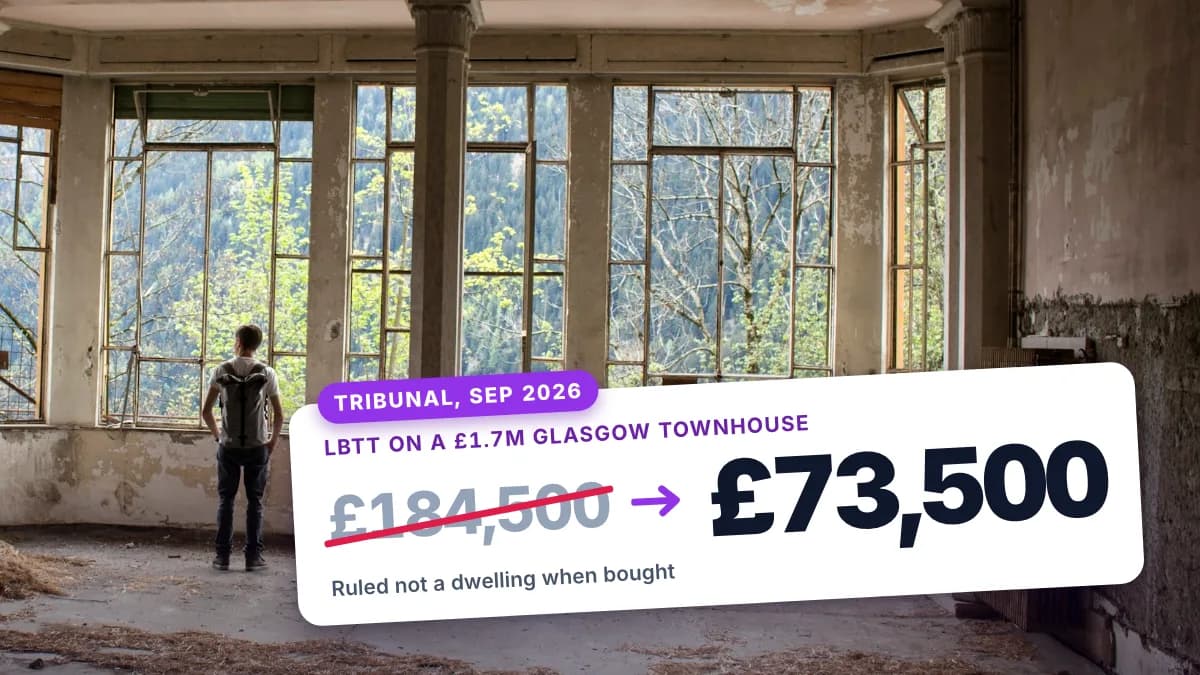
On 17 September 2026 Scotland's tax tribunal ruled that a Category A listed townhouse and mews in Glasgow's Park Circus, bought by a company for £1.7m in December 2020, were not suitable for use as a dwelling when they were bought. The buildings were built as homes, but since about 1920 had been a nursing home, church offices with a period as a clergy residence, a convent and charity offices, and were a stripped shell at the time of the sale. The tribunal allowed the company's claim to have its land and buildings transaction tax recalculated at non-residential rates, a repayment of £111,000. Revenue Scotland had argued that the buildings were still residential.
Bagshaw Limited v Revenue Scotland [2026] FTSTC 4, decided on the papers by Anne Scott (President) and Charlotte Barbour (Member), released 17 September 2026 (LBTT, Scotland).
Key Takeaways
- Bagshaw Limited v Revenue Scotland [2026] FTSTC 4, released 17 September 2026: Scotland's tax tribunal held that a Category A listed townhouse and mews in Glasgow, bought for £1.7m on 17 December 2020, were not suitable for use as a dwelling on that date
- The company's claim to recalculate the land and buildings transaction tax (LBTT) at non-residential rates was allowed: a repayment of £111,000. Revenue Scotland had refused it and upheld that refusal on review
- The buildings were built as homes, but from about 1920 had been a nursing home with an operating theatre, Archdiocese offices and an oratory with a period of mixed residential use, a convent and then charity offices. The tribunal found those changes deprived them of their identity as residential property
- At the purchase date there were no working utilities, plumbing and heating had been removed, and the only planning consent was for offices. The tribunal called the buildings "in effect a prospective construction site"
- The purchase had first been returned as residential, with a multiple dwellings relief claim later. The tribunal accepted the company's case that this was a mistake by its then solicitors and did not treat it as deciding the question
- The same two tribunal members decided LMT on 1 May 2026, where a Selkirk house empty since 2012 was still a dwelling. Previous use as a home is highly relevant, but it does not settle the question on its own
- Bagshaw binds no other tribunal. Revenue Scotland can apply for permission to appeal within 30 days of the decision being sent to it, and whether it has applied is not on the public record
What the Tribunal Decided
Land and buildings transaction tax (LBTT) is Scotland's equivalent of stamp duty, collected by Revenue Scotland. Residential property means “a building that is used or is suitable for use as a dwelling, or is in the process of being constructed or adapted for such use”, together with its garden or grounds. Anything else is non-residential (section 59 of the Land and Buildings Transaction Tax (Scotland) Act 2013). The tribunal noted that this wording is identical to the stamp duty land tax (SDLT) definition in section 116 of the Finance Act 2003 (paragraph 69).
Bagshaw Limited, a company registered in the Isle of Man, bought the townhouse and mews for £1,700,000 with an effective date of 17 December 2020. The return its solicitors filed that day treated the purchase as residential: LBTT of £160,250 plus the Additional Dwelling Supplement (ADS) of £68,000, a total of £228,250 (paragraphs 29 and 30). An amended return on 8 June 2021 claimed multiple dwellings relief, which was accepted, and £43,750 was repaid, leaving £184,500 (paragraph 33).
On 23 April 2024 the company claimed repayment of £111,000 under section 107 of the Revenue Scotland and Tax Powers Act 2014, on the basis that its former solicitors had made a mistake and the buildings were non-residential (paragraphs 4 and 35). Revenue Scotland opened an enquiry and refused the claim in a closure notice dated 20 December 2024, and a review upheld the refusal on 28 March 2025 (paragraphs 1, 59 and 65). The company appealed on 22 April 2025 (paragraph 66).
The parties agreed to have the appeal decided on the papers instead of at the hearing listed for 3 and 4 February 2026, and the tribunal described it in correspondence as “in many ways a test case” (paragraph 5). After a review, an earlier decision in the appeal, dated 20 May 2026, was set aside by an order of 16 September 2026 (paragraph 7). The published decision does not give the reason. The decision now published was released on 17 September 2026 and allows the appeal (paragraph 124).
A Century Out of Residential Use
The tribunal traced the buildings' history in detail, because whether a former home has kept its identity as a dwelling was central to the case. Its findings:
| Period | Use | Paragraph |
|---|---|---|
| On record from 1873 | A three-storey townhouse with a basement and a mews building behind, built as residential property | 10, 91 |
| From about 1920 | A nursing home, including an operating theatre | 13, 15, 91 |
| 1937 to 1979 | Owned by the Roman Catholic Archdiocese of Glasgow. The operating theatre became an oratory, and the buildings housed the Archdiocese's central offices from 1951 to 1964. A bishop lived there from 1962, and from 1965 to 1976 they were the Archbishop's residence. The tribunal found this was mixed use, with office use continuing | 14, 16 to 18, 99 |
| 1979 to 1999 | A convent. Both parties accepted this was not residential use for LBTT purposes. Planning permission for a change of use from convent to offices was granted in 1998 | 20 to 22, 99 |
| 1999 to 2019 | Offices of the Scottish Catholic International Aid Fund, with its name etched on the front windows | 23, 24 |
| November 2019 | Sold to two buyers, whose LBTT return classified the property as non-residential | 25, 26 |
| 17 December 2020 | Bought by Bagshaw Limited for £1.7m and returned as residential | 29, 30 |
| 16 December 2021 | First planning application to convert the buildings into five flats | 34 |
| 3 July 2024 | Sold on as non-residential property, with no conversion work done | 52, 108 |
On the condition at the purchase date, the contractor the company instructed before buying wrote that the property “was already in an uninhabitable condition. Previous owners had removed plumbing/heating and electrical systems, there were no usable toilet facilities” (paragraph 31). Water and electricity were connected, but were later disconnected at the insurers' insistence (paragraph 51). The energy performance certificates described the buildings as “Offices and Workshop businesses”, they were on the non-domestic valuation roll, and the Glasgow City Assessor confirmed in March 2021 that they would be valued as non-domestic until “significant work” to convert them was underway (paragraphs 28, 36 and 43).
What Each Side Argued
Revenue Scotland argued that the buildings were designed and built as residential property and that later uses had not changed that: “the fact that the building has been used for purposes other than a dwelling has at no point changed the building's fundamental characteristics” (paragraph 92). Its closure notice relied on the purchase having been returned as residential, the multiple dwellings relief claim made on the same basis, a large kitchen in the townhouse and a small one in the mews, a bath and shower, and toilets throughout. It accepted that a substantial amount of work was needed to make the buildings habitable, but argued that there were no irremediable structural defects and that services could be reconnected (paragraph 59). On review it added that the planning report referred to the conversion of a “townhouse” (paragraph 65).
The company argued that the buildings had not been used as dwellings since the 1920s or 1930s and had not been fit for residential use for decades (paragraph 61). At the purchase date they had no bathroom, no domestic kitchen and no accommodation for living or sleeping (paragraph 53), and the only lawful use under planning was as offices. It said the residential return had been a mistake by its former solicitors, and that every other sale of the buildings had been returned as non-residential (paragraphs 55 and 61). In its words, “This is not a case of a dwelling in disrepair” (paragraph 107).
Why the Tribunal Found It Was Not a Dwelling
The tribunal applied the Court of Appeal's decision in Mudan v HMRC [2025] EWCA Civ 799, which it called the most authoritative case law on the identical SDLT wording (paragraphs 69 to 71). It accepted that previous use as a home is highly relevant, but quoted the Upper Tribunal, endorsed by the Court of Appeal: “The fact of previous use as a dwelling does not mean that a building remains suitable for use as a dwelling regardless of what happens to the building and regardless of the effluxion of time” (paragraph 95). It said it had “considerable difficulty” with Revenue Scotland's position, which it summed up as “once a dwelling house, always a dwelling house” (paragraph 93).
- Identity. The works to turn the buildings into a nursing home with an operating theatre, and later into an oratory and offices, “would have been sufficiently extensive as to deprive the Properties of their identity as residential property” (paragraph 98). “The nexus was broken”, and since 1920 the buildings had not been “the sort of property that people live in” (paragraphs 100 and 101).
- Condition. There were no utilities at the effective date and the buildings “had been stripped back to the bare walls” (paragraph 106). They were “in effect a prospective construction site” (paragraph 107), and the works needed fell into the category of major works that can make a property unsuitable for use despite plans to carry them out (paragraphs 120 and 121).
- Planning. The buildings were Category A listed, had planning consent only for offices, and had no permission for a change of use at the purchase date, with no guarantee it would be granted. The purchase was not conditional on it. The tribunal found that the company had bought them as a commercial investment with development potential (paragraphs 107 and 116 to 118).
- The original return. The tribunal did not accept that filing the return as residential, and claiming multiple dwellings relief on that basis, meant the transaction could not be non-residential. Those were undisputed facts, but the company had consistently argued they were a mistake, “hence the repayment claim” (paragraph 110).
It concluded that “the Properties were not suitable for use as a dwelling at the effective date and accordingly the LBTT return should have been filed on the basis that it was a non-residential transaction” (paragraph 123). The appeal was allowed, Revenue Scotland's decision was cancelled and the repayment claim was allowed (paragraph 124).
The £111,000: How the Figures Work
The decision gives the totals (paragraphs 3, 30 and 33). Our working, at the Revenue Scotland rates in force on 17 December 2020:
- Residential LBTT, with the temporary nil-rate band of £250,000 that applied from 15 July 2020 to 31 March 2021: 0% on the first £250,000, 5% on the next £75,000 (£3,750), 10% on the next £425,000 (£42,500) and 12% on the remaining £950,000 (£114,000). Total £160,250.
- Additional Dwelling Supplement at the 4% rate then in force: £68,000. Total paid: £228,250.
- Multiple dwellings relief accepted in 2021: £43,750 repaid, leaving £184,500. The decision gives this figure but not its working.
- Non-residential LBTT: 0% on the first £150,000, 1% on the next £100,000 (£1,000) and 5% on the remaining £1,450,000 (£72,500). Total £73,500. ADS does not apply to non-residential property.
- Repayment allowed: £184,500 minus £73,500, which is £111,000.
ADS has since risen to 8%, from 5 December 2024, and the temporary nil-rate band has ended, so the gap between residential and non-residential treatment at the same price is wider today. The non-residential bands are unchanged since 25 January 2019. To see current figures on your price, use our LBTT calculator.
Bagshaw, LMT and Ball Compared
Bagshaw was decided by the same two members as LMT Property Investors Ltd v Revenue Scotland [2026] FTSTC 3, which went Revenue Scotland's way in May. The tribunal also distinguished Ball v Revenue Scotland [2024] FTSTC 6, which Revenue Scotland had relied on (paragraphs 102 to 106).
| Bagshaw (Glasgow) | LMT (Selkirk) | Ball | |
|---|---|---|---|
| Last used as a home | Not purely since about 1920. Mixed residential and office use from 1962 to 1976 | Last occupied in 2012 | A home for over 350 years, with a comparatively short period as offices |
| State when bought | Stripped to the bare walls, no working utilities | Furnished, with defects fixable by ordinary works | Functioning utilities. Repairs done within months |
| Result | Not a dwelling. Appeal allowed | Still a dwelling. Appeal dismissed | A dwelling |
We cover LMT, and the English decision in Oakwood Great Oak Ltd v HMRC where a £2.4m house with asbestos throughout was held not to be a dwelling, in the 2026 derelict house rulings.
What It Means for Buyers
- Previous use as a home does not settle the question on its own. The tribunal looked at what had happened to the buildings since, and at whether they had kept their identity as a dwelling.
- Planning status counts. Consent only for offices, with no permission for a change of use at the purchase date, weighed against residential treatment.
- How the return was filed does not decide it. A purchase first returned as residential was later held to be non-residential.
- The evidence came from the purchase date. The company relied on the planning history, energy performance certificates, non-domestic rates bills, the assessor's confirmation and a contractor's account of the condition before it bought.
For most buyers of a run-down former home, the position has not changed. A house that needs work, even serious work, is usually still a dwelling, as LMT and Ball show. For SDLT, HMRC said in July 2025 that “repayment claims based solely on a property's condition are not valid”. The rules and the cases so far are in our guide to the uninhabitable property stamp duty refund.
Bagshaw is a first-tier decision on its own facts. It binds no other tribunal and does not bind HMRC, although it applies the same Court of Appeal test that governs SDLT. Revenue Scotland can apply for permission to appeal on a point of law within 30 days of the decision being sent to it (paragraph 125). Whether it has applied is not on the public record.
If someone offers to reclaim LBTT or SDLT on a run-down property, ask what evidence from the purchase date supports the claim before you sign anything. Repayment claims can be enquired into, as this one was. For deadlines and the other routes, see Stamp Duty Refund: Can You Claim It Back?
Frequently Asked Questions
What did the tribunal decide in Bagshaw v Revenue Scotland?
It held that a Category A listed townhouse and mews in Park Circus, Glasgow, bought by Bagshaw Limited for £1.7m on 17 December 2020, were not suitable for use as a dwelling on that date. The purchase should have been returned as non-residential, so the company's £111,000 repayment claim was allowed. The decision, [2026] FTSTC 4, was released on 17 September 2026.
Why was a building that was built as a house not a dwelling?
Because it had lost its identity as residential property. The tribunal found that converting it to a nursing home with an operating theatre, and later to an oratory and offices, deprived it of that identity, and that it had not been "the sort of property that people live in" since about 1920. At the purchase date it had no working utilities, had been stripped to the bare walls, and had planning consent only for use as offices.
How much LBTT was at stake in the Bagshaw case?
£111,000. The company had paid £228,250 (LBTT of £160,250 plus the 4% Additional Dwelling Supplement of £68,000), reduced to £184,500 after a multiple dwellings relief claim was accepted in 2021. At non-residential rates the LBTT on £1.7m is £73,500, with no supplement. The difference is £111,000.
Why did Bagshaw succeed when the Selkirk house in LMT did not?
The facts were different. The same two tribunal members decided both cases. The Selkirk bungalow in LMT, decided on 1 May 2026, had been lived in until 2012, was furnished when bought and had defects that ordinary works could fix, so it was still a dwelling. The Glasgow buildings had not been used purely as a home since about 1920, had been offices for decades and were a stripped shell when bought.
Does the Bagshaw ruling apply to stamp duty in England?
Not directly. Bagshaw is a decision of the First-tier Tribunal for Scotland on LBTT and binds no other tribunal. The LBTT definition of residential property is identical to the SDLT definition in section 116 of the Finance Act 2003, and the tribunal applied the Court of Appeal's decision in Mudan v HMRC, which is the binding authority on SDLT.
Can Revenue Scotland appeal the Bagshaw decision?
It can apply for permission to appeal on a point of law. Under the decision, an application must reach the tribunal within 30 days of the decision being sent to the party. Whether Revenue Scotland has applied is not on the public record.
Calculate Your LBTT
Our calculator works out LBTT for Scotland, including the 8% Additional Dwelling Supplement, as well as SDLT for England and Northern Ireland and LTT for Wales. If you think a purchase may have been non-residential, take independent specialist advice before amending a return.
Use LBTT CalculatorSources
- Bagshaw Limited v Revenue Scotland [2026] FTSTC 4, First-tier Tribunal for Scotland Tax Chamber
- Land and Buildings Transaction Tax (Scotland) Act 2013, section 59: meaning of residential property, legislation.gov.uk
- Mudan v HMRC [2025] EWCA Civ 799, Find Case Law
- Residential property rates and bands, Revenue Scotland
- Non-residential property rates and bands, Revenue Scotland
- Additional Dwelling Supplement, Revenue Scotland
This article summarises a published tribunal decision and is not tax advice. It is not affiliated with Revenue Scotland, HMRC or GOV.UK.
Reviewed by

Julie White
ACAStamp duty specialist since 1999Stamp Duty Land Tax Specialist
ACA and Tax Adviser with a career spanning nearly four decades, specialising in stamp duty planning and advisory work since 1999.