
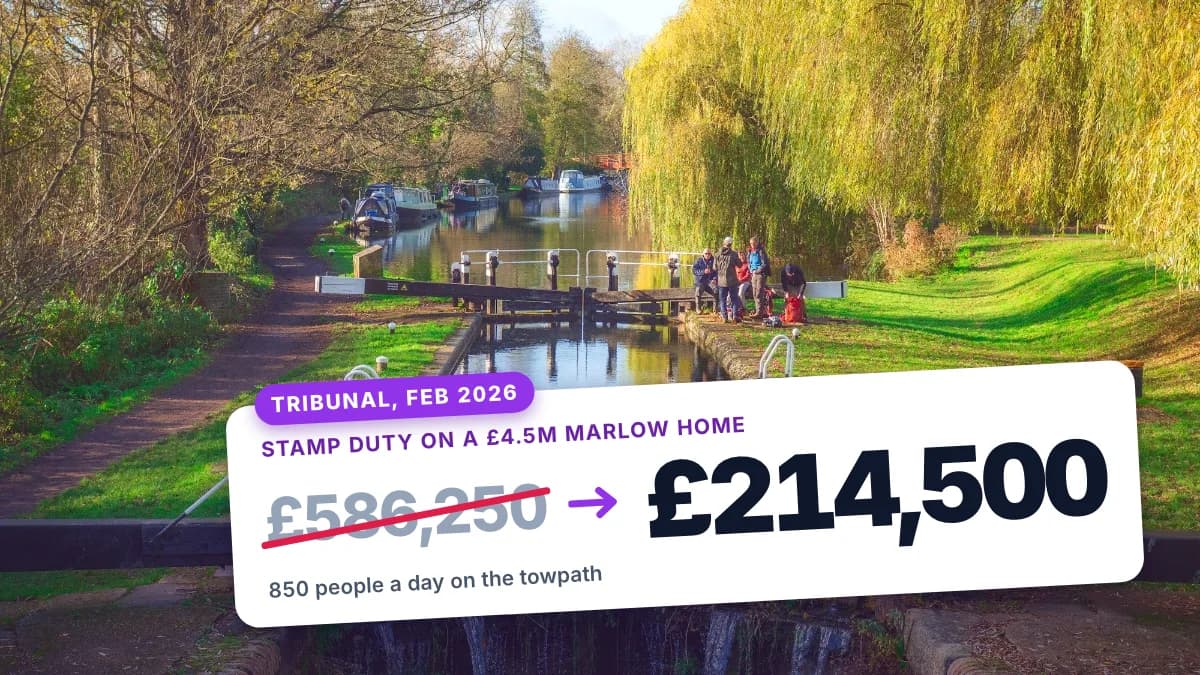
He Counted 850 People a Day on the Towpath. It Cut Stamp Duty on a £4.5m Home From £586,250 to £214,500
In a decision released on 20 February 2026, the First-tier Tribunal held that a busy stretch of the Thames Path running across a £4.5m Marlow home was not part of its grounds, so the purchase was mixed use. The buyers did not win on maps or plans. They won by filming the towpath and counting the people using it. Here is how they did it, what the tribunal did not decide, and why the case carries less weight in October 2026 than it did in February.
Key Takeaways
- Alan Wood & Anor v HMRC [2026] UKFTT 00265 (TC), decision TC09791, was released on 20 February 2026. It is not a new ruling. This is an in-depth look at how the buyers won, and where the case stands in October 2026
- The buyers paid £586,250 on a £4.5m Marlow home bought on 29 June 2023, then amended their return to mixed use, stating £214,500 was due and £371,750 should be refunded. HMRC refused, and the First-tier Tribunal allowed their appeal
- The deciding evidence was a count. Mr Wood filmed the Thames Path towpath from the first floor of the house from 6am to 9pm on five days in 2025, counted a random 15 minutes in every hour, and showed an average of 850 users a day. HMRC did not challenge it
- A public right of way alone was not enough, and the buyers' counsel accepted that. What carried the case was the level of intrusion, the lack of privacy and security, and a wall separating the towpath from the garden (paragraphs 34 and 35)
- The tribunal did not compute or order a refund. The £214,500 and £371,750 are the figures in the buyers' amendment, recorded at paragraph 17 of the decision
- HMRC's late argument that the land was a right benefiting the house under section 116(1)(c) failed, because a single freehold cannot subsist for the benefit of itself (paragraph 38)
- Wood binds no other tribunal. Every garden-and-grounds decision we have found released since has gone HMRC's way, including HMRC v Brzezicki in the Upper Tribunal on 18 March 2026, which binds the First-tier Tribunal
The House, the Towpath and the £371,750 Claim
Alan Wood & Anor v HMRC [2026] UKFTT 00265 (TC), decision TC09791, was released by the First-tier Tribunal on 20 February 2026. It is more than seven months old. We are returning to it because of how it was won, and because the decisions since have changed how much weight it can bear.
On 29 June 2023 Alan Wood and Elizabeth Veitch bought a freehold estate in Marlow for £4.5m. The tribunal described it in layers (paragraph 3): a seven-bedroom house; a patio and lawn about 7 metres deep, enclosed by a brick wall about 1.3 metres high with a single gate; beyond the gate, a towpath about 3 metres wide, part of the Thames Path National Trail, running the width of the property; a low chain fence with a small “private property” sign; and a strip of grass on the river bank.
They filed the next day as an additional residential property and paid £586,250 (paragraph 16). On 16 November 2023 their accountants amended the return on the basis that the towpath was non-residential, putting the liability at £214,500 and claiming a refund of £371,750 (paragraph 17). HMRC opened an enquiry and on 17 September 2024 issued closure notices refusing any change. The buyers appealed.
The gap comes from section 55 Finance Act 2003. Land that is entirely residential is charged under Table A, plus the surcharge for additional dwellings. If any of it is not residential, the whole price falls under Table B, which tops out at 5%. Our own arithmetic matches the figures in the decision:
| Basis on a £4.5m price | Working | SDLT |
|---|---|---|
| Residential, additional property, 29 June 2023 | 3% on the first £250,000 (£7,500), 8% on the next £675,000 (£54,000), 13% on the next £575,000 (£74,750), 15% on the remaining £3,000,000 (£450,000) | £586,250 |
| Mixed use, Table B (unchanged since) | 0% on the first £150,000, 2% on the next £100,000 (£2,000), 5% on the remaining £4,250,000 (£212,500) | £214,500 |
| Residential, additional property, completing today | 5% on the first £125,000 (£6,250), 7% on the next £125,000 (£8,750), 10% on the next £675,000 (£67,500), 15% on the next £575,000 (£86,250), 17% on the remaining £3,000,000 (£510,000) | £678,750 |
On identical facts today the gap would be £464,250, because the surcharge rose from 3% to 5% on 31 October 2024 and the nil-rate band fell back to £125,000 on 1 April 2025, while Table B is unchanged. That assumes UK-resident buyers in the same additional-property position. You can try both bases on your own price with our mixed-use stamp duty calculator.
What the tribunal actually ordered. It allowed the appeal against HMRC's closure notices. It did not compute or award a refund. The £214,500 and £371,750 are the figures from the accountants' amendment letter, recorded as findings of fact.
How They Won It: 75 Hours of Video and a Spreadsheet
Most mixed-use claims are argued from plans and brochures. This one was argued from a count.
To prepare for the appeal, Mr Wood set up a video camera on the first floor of the house, pointing at the towpath (paragraph 23). It recorded from 6am to 9pm on five days: Monday 26 May 2025, a bank holiday, then 28, 30 and 31 May and 1 June 2025. Rather than watch all 75 hours, he picked 15 minutes at random in each hour, a different 15 minutes each day, counted the users in it, and logged the counts in a spreadsheet (paragraph 24).
The average was 850 people a day: individuals, families, dog walkers, cyclists and joggers (paragraph 25). His evidence was that this was fairly representative of the year, busier at weekends and in summer. HMRC challenged neither point. The tribunal found him “a credible, straightforward and helpful witness” and, as his conclusions were not challenged, did not consider it necessary to watch the footage (paragraph 14).
The count underpinned the rest of the evidence. The owners could not sit on the towpath, leave anything on it or change its character, and did not let their grandchildren play there (paragraph 26). Mr Wood agreed that living beside it was comparable to living on a busy street (paragraph 27).
A caution if you plan to copy the method. Classification is judged at completion, here 29 June 2023, but the filming took place nearly two years later, and the decision does not say how the 15-minute samples were scaled up to a daily figure. The count was accepted because HMRC did not contest it.
What the Tribunal Decided, and the Limits It Set
Tribunal Judge Brooks and Tribunal Member Hunter heard the appeal on 28 January 2026. Both sides worked from the sixteen factors approved by the Upper Tribunal in HMRC v Suterwalla [2024] UKUT 00188 (TCC), which treat rights of way as “still generally grounds” and privacy and security as relevant (paragraph 32).
Several factors favoured HMRC. The house, towpath and riverside were connected, commonly owned and contiguous, and a public right of way does not in itself make land “any less the grounds of the House”. The buyers' counsel, Edward Hellier, accepted that, “as he must” (paragraph 34). His case was the level of intrusion, some 850 people a day, together with the lack of privacy and security. The tribunal agreed, “on balance”, noting that the towpath's use was “separate from and unconnected with the House and Garden from which it is separated by the Wall” (paragraph 35). The purchase was therefore not entirely residential, and the appeal was allowed (paragraphs 36 and 39).
The limits matter as much as the result:
- No threshold. The tribunal set no minimum number of users.
- The wall was part of the reasoning. A path crossing an open lawn is a different set of facts.
- The riverside view was obiter. The tribunal said it did not need to decide the point (paragraph 36), but “would have concluded” the riverside strip was grounds, because the owners could sit on it and change it (paragraph 37). That is not a finding.
- Other decisions help only so far. Earlier tribunal decisions gave “only limited assistance” because each case turns on its facts (paragraph 33). The same applies to Wood.
For the wider case law, see our page on landmark stamp duty cases.
HMRC's Late Argument That Failed
On 10 November 2025, under three months before the hearing, HMRC applied to add a second argument (paragraph 20): even if the towpath and riverside were not grounds, they were residential property under section 116(1)(c), as “an interest in or right over land that subsists for the benefit of” the house. Asked which interest it meant, HMRC said on 5 December 2025 that it “is the same interest/right that the Appellants have over the whole plot of land” (paragraph 22). In other words, the freehold itself.
The tribunal said it did not strictly need to decide this (paragraph 36), but rejected it briefly at paragraph 38: section 116(1)(c) could not apply “because there is a single freehold estate of the Property and that single estate is not an interest that can subsist for the benefit of itself”. The point is narrow. It does not affect separate rights held alongside a house, such as the fishing rights the Upper Tribunal held were residential property in Brzezicki (paragraph 84 of that decision).
Where Wood Stands in October 2026
Wood is still the only taxpayer win we have found among this year's decisions on what counts as the garden or grounds of a house. Every such decision released after it has gone HMRC's way:
- HMRC v Brzezicki [2026] UKUT 00125 (TCC), 18 March 2026: a carrier stream and two-acre island were “undoubtedly part of the grounds” (paragraph 83). It binds the First-tier Tribunal.
- Vereley Homes Limited v HMRC [2026] UKFTT 00695 (TC), 12 May 2026: a fenced-off plot where a neighbouring house had been demolished was still garden and grounds (paragraph 41).
- Sinclair & Anor v HMRC [2026] UKFTT 00798 (TC), 29 May 2026: a field grazed by a neighbour's sheep was still grounds.
Another HMRC win, Ferguson & Anor v HMRC [2026] UKFTT 00238 (TC), carries a 2026 citation but was released on 15 December 2025, before Wood. Wood's weight is limited for three reasons.
It binds nobody. As the tribunal in Sinclair put it at paragraph 82, “other FTT decisions do not bind us”, and “The authorities which bind us are those decided by the Upper Tribunal and higher courts.”
It was decided without Brzezicki, which came 26 days later. Brzezicki does not deal with a towpath, but at paragraph 57 it said land separated from a house by a public path belonging to someone else “may still fairly be described as grounds of the dwelling”, and at paragraph 70 it listed footpaths among the “natural or man-made divides” that many homes contain. Whether a busy path you own is itself grounds has not reached the Upper Tribunal.
It may not be final. The Negotiator reported on 4 March 2026 that HMRC said it was “considering the judgement” and may appeal. Each party had 56 days from when the decision was sent to apply for permission (paragraph 40). As at 3 October 2026 we found no Upper Tribunal decision in the case on Find Case Law or GOV.UK, but permission decisions are not routinely published, so that does not prove HMRC let it go.
For Ferguson, Sinclair and Brzezicki in detail, including the surcharge refund Mr Brzezicki appears to have lost by amending his return, read Garden and Grounds: Four SDLT Rulings, and Why Letting Land Out Will Not Make It Mixed Use.
If Your Home Has a Footpath or Towpath
Wood is sometimes summarised as deciding that a public footpath makes a house mixed use. Paragraph 34 says the opposite. These are the questions the case actually turned on:
- How heavy is the use? Around 850 people a day on a National Trail. No minimum figure exists, and a path used by a few neighbours is a different case.
- Is the path walled off from your garden? In Wood a 1.3-metre wall with a single gate divided them.
- Can you use the land at all? The Wood buyers could not sit on the towpath, leave anything on it or change it.
- Can you prove it? Wood was won on systematic, recorded evidence that HMRC did not contest.
A return can normally be amended within 12 months (paragraph 9 of the decision). An amendment can prompt an enquiry, and this case took more than two and a half years from completion to decision. If you file on a mixed-use basis at completion and lose, the shortfall is payable with interest, and penalties can arise for an inaccurate return. For the classification rules, see our mixed-use property stamp duty guide, and for time limits, stamp duty refund: can you claim it back?
Frequently Asked Questions
Does a public footpath across my land make my purchase mixed use?
Not by itself. In Wood the tribunal recorded at paragraph 34 that a public right of way does not of itself make land any less the grounds of a house, and the buyers' counsel accepted that. What carried the case was the level of intrusion, around 850 people a day on the Thames Path, with the lack of privacy and security and a wall separating the towpath from the garden.
How many people a day does a path need to make land non-residential?
There is no figure. The tribunal in Wood did not set a threshold. The 850 a day was Mr Wood's own count from sampled video, which HMRC did not challenge, and it was weighed with other factors rather than applied as a test.
Did the tribunal order HMRC to refund £371,750?
No. It allowed the appeal against HMRC's closure notices, which had refused the buyers' amendment. The £214,500 liability and £371,750 refund are the figures in the amendment letter, recorded at paragraph 17 of the decision. The tribunal did not compute them, although our working at the rates in force in June 2023 reproduces both.
Has HMRC appealed the Wood decision?
Nothing on the public record shows an appeal. The Negotiator reported on 4 March 2026 that HMRC was considering the judgement and may appeal. As at 3 October 2026 there is no Upper Tribunal decision in the case on Find Case Law or GOV.UK, but permission decisions are not routinely published, so that does not prove the case is final.
Is Wood still good law after Brzezicki?
No published decision has overturned it, but it binds no other tribunal. HMRC v Brzezicki, an Upper Tribunal decision released on 18 March 2026, binds the First-tier Tribunal and went HMRC's way, as did the later First-tier decisions in Vereley Homes and Sinclair. Brzezicki did not consider a towpath, so the Wood reasoning has not been tested at that level.
Would the same purchase cost the same today?
No. At residential rates with the additional-dwellings surcharge, a £4.5m purchase completing today costs £678,750, against £586,250 on 29 June 2023, because the surcharge rose from 3% to 5% on 31 October 2024 and the nil-rate band fell to £125,000 on 1 April 2025. The mixed-use figure is unchanged at £214,500.
Calculate Your Stamp Duty
Our calculator computes both residential and non-residential SDLT, so you can see what a mixed-use classification would actually be worth on your purchase price. If you think a claim may be arguable, take professional advice before amending a return.
Use Stamp Duty CalculatorSources
- Alan Wood & Anor v HMRC [2026] UKFTT 00265 (TC), TC09791, released 20 February 2026, Find Case Law
- HMRC v Brzezicki [2026] UKUT 00125 (TCC), released 18 March 2026, Find Case Law
- Ian Sinclair & Anor v HMRC [2026] UKFTT 00798 (TC), TC 09898, released 29 May 2026, Find Case Law
- Vereley Homes Limited v HMRC [2026] UKFTT 00695 (TC), TC 09881, released 12 May 2026, Find Case Law
- Andrew Charles Ferguson & Anor v HMRC [2026] UKFTT 00238 (TC), TC09782, released 15 December 2025, Find Case Law
- HMRC v Suterwalla [2024] UKUT 00188 (TCC), Find Case Law
- Section 116, Finance Act 2003, legislation.gov.uk
- Section 55, Finance Act 2003, legislation.gov.uk
- Stamp Duty Land Tax: residential property rates, GOV.UK
- Stamp Duty Land Tax: rates for non-residential and mixed land and property, GOV.UK
- Homeowner wins Stamp Duty loophole ruling, The Negotiator, 4 March 2026
This article summarises published tribunal decisions and is not tax advice. It is not affiliated with HMRC or GOV.UK.
Reviewed by

Julie White
ACAStamp duty specialist since 1999Stamp Duty Land Tax Specialist
ACA and Tax Adviser with a career spanning nearly four decades, specialising in stamp duty planning and advisory work since 1999.