HMRC Never Saw the House. 12 Acres of Woods Won a £225,250 Stamp Duty Appeal. Would It Win Now?
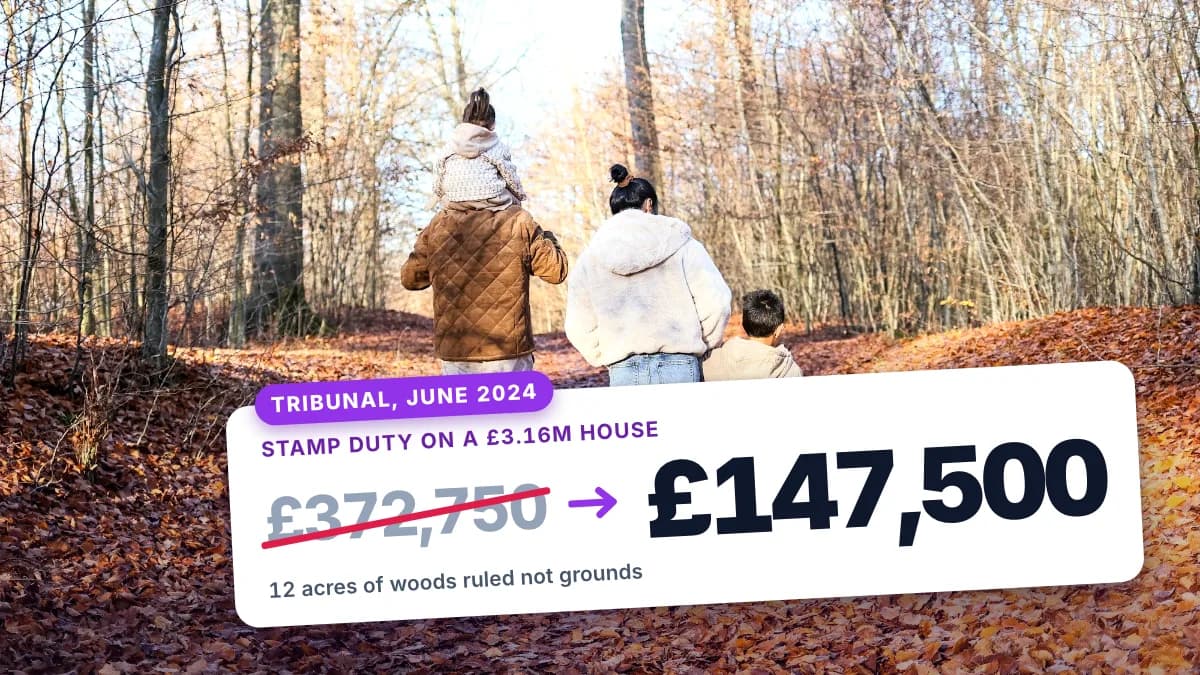
On 14 June 2024 the First-tier Tribunal decided that 12 acres of woods behind a £3.16 million house in the South Downs were not part of its grounds, because the public walked through them and they did nothing for the house. That made the purchase mixed use, and the buyer won her appeal over £225,250 of stamp duty. Since then, in our reading, the Upper Tribunal has narrowed part of the reasoning she relied on. Here is what was decided, and how much of it still stands.
Key Takeaways
- On 14 June 2024 the First-tier Tribunal allowed Marie Guerlain-Desai's appeal in [2024] UKFTT 00515 (TC), decision TC09203. It is a 2024 decision, not a new one, and it binds no other tribunal
- She bought a six-bedroom house with about 4 acres of formal gardens and about 12 acres of woods for £3,160,000 in January 2021, paid £372,750 at the higher residential rates, then amended her return to £147,500 at mixed-use rates and claimed back £225,250
- The tribunal held the woods were not the "garden or grounds" of the house. The public used them heavily, a mature privacy screen cut them off from the garden, and they had no "functional purpose for, or a use that supports, the dwelling" (para 160)
- No one from HMRC had visited the property. The tribunal found the buyer a credible witness and treated HMRC's submissions on views, privacy and separation "with caution" (paras 20, 21 and 138)
- There was no commercial use of the woods. The claim succeeded on public use and the lack of any link to the house, not on a business activity
- As at 3 October 2026, Find Case Law shows no appeal and no later decision citing the ruling. But HMRC v Brzezicki [2026] UKUT 00125 (TCC), released 18 March 2026 and binding on the First-tier Tribunal, held that land can be grounds even if the house's privacy, views and character do not depend on it
- Woods next to a house are often held to be grounds: the Upper Tribunal said so in How Development 1 Ltd in 2023, and the First-tier Tribunal did on 3.4 acres of woodland in Michael in April 2024
The House, the Woods and the £225,250
Marie Guerlain-Desai bought Durford House, on the private Durford Wood estate near Petersfield, on 15 January 2021 for £3,160,000. The decision describes a six-bedroom house set in 16.6 acres, with a triple garage, outbuildings, about 4 acres of private formal gardens and about 12 acres of mature woodland at the rear (paras 4, 6 and 7). The woods wrap around the garden on every side but the north, and run up to National Trust woodland to the east (paras 22 and 23).
The estate is unusual. It was conceived in 1923, when about 300 acres of woodland were laid out for 30 houses, and in 1959 residents bought about 30 acres of woodland, of which these 12 acres form part (paras 37, 38 and 146). Her property is subject to a charge in favour of the estate's management company, and she is obliged to maintain the woods (para 42).
Her return, filed on 18 January 2021, used the higher rates for additional dwellings and showed £372,750 (para 7). On 1 April 2021 her agent, Cornerstone Tax, amended it on the basis that the purchase included non-residential property, and asked for £225,250 back plus interest (para 8). HMRC opened an enquiry on 13 December 2021 and on 25 February 2022 issued a closure notice restoring the full £372,750 (paras 9 and 12).
| Higher residential rates, January 2021 | Tax | Mixed-use rates (Table B) | Tax |
|---|---|---|---|
| 3% on the first £500,000 | £15,000 | 0% on the first £150,000 | £0 |
| 8% on the next £425,000 | £34,000 | 2% on the next £100,000 | £2,000 |
| 13% on the next £575,000 | £74,750 | 5% on the remaining £2,910,000 | £145,500 |
| 15% on the remaining £1,660,000 | £249,000 | ||
| Total paid | £372,750 | Total on the amended return | £147,500 |
Our working reproduces both of the decision's figures. The residential column uses the temporary nil-rate band of £500,000 in force from 8 July 2020 to 30 June 2021, plus the 3% surcharge for additional dwellings. The difference is the £225,250 in dispute.
The stakes would be higher on the same price today. Under the residential bands in force since 1 April 2025, £3,160,000 attracts £292,950, or £450,950 with the 5% surcharge (5% on the first £125,000, 7% on the next £125,000, 10% on the next £675,000, 15% on the next £575,000 and 17% on the remaining £1,660,000). The mixed-use figure is unchanged at £147,500. See our stamp duty rates 2026 for the full tables.
Why the Woods Were Not Grounds
Under section 116(1)(b) of the Finance Act 2003, residential property includes land that “is or forms part of the garden or grounds” of a dwelling. If a purchase includes any land that is not, the whole price is taxed at the lower non-residential rates in Table B of section 55. HMRC accepted that the house was a dwelling and the 4 acres were its garden (paras 75 and 76). The only question was the woods (para 77).
The tribunal found four things against them being grounds:
- The public used them. They were not fenced or gated in a way that would deter anyone (para 147), and “the reality is that the woods are treated as public woodland with unrestricted access to the public, including dog walkers and cyclists” (para 150). The tribunal found “a considerable level of intrusion” (para 142).
- The garden was screened off from them. Over many years the owners had fenced the garden and grown a mature screen of trees and bushes. So the woods gave the house no privacy or security (paras 148 and 153), and there was “not a view, let alone a treasured view” of the house from the woods (para 149).
- They were not what the house was sold on. The tribunal was “not persuaded the woods were a key selling point nor essential to the dwelling house and private garden's character” (para 155).
- They did nothing for the house. Following Sloss v Revenue Scotland [2021] FTSTC 1, a Scottish LBTT case, the tribunal said there must be a link “beyond the fact that they were purchased together in a single transaction” and that the woods must have “a functional purpose for a house of the size of the dwelling house” (para 158). Its conclusion at para 160: “The tribunal did not consider that the woods have, in these terms, a functional purpose for, or a use that supports, the dwelling.”
Two points are easy to miss. There was no commercial use: the tribunal found no use of the woods separate from the house “other than the fact it had become a wooded area with public access” (para 140). And the panel distinguished the earlier decisions it was shown on facts it called exceptional, including the estate's 1923 origins, the 1959 purchase and “its untypical ownership and management arrangements” (para 162).
A Credible Witness and No Site Visit
The appeal was heard by video on 9 May 2024 by Tribunal Judge Ruthven Gemmell WS and Tribunal Member Jane Shillaker. Patrick Cannon of counsel, instructed by Cornerstone Tax, appeared for the buyer, and Maria Spalding of HMRC's Solicitor's Office for HMRC.
The buyer gave evidence and “was a credible witness” (para 20). On HMRC's side, “no one from HMRC had visited or had actually seen the Property” (para 21). HMRC's case described the woods as visible from the house, providing “a treasured view to the dwelling”, lacking “any features which would separate the land”, and giving privacy and security from users of nearby footpaths (para 137).
The tribunal said those statements “were in complete contradiction to the evidence” of the buyer, who lived there, and “treated HMRC's submissions on these matters with caution” (para 138). Her evidence went further than the photographs. She called the Knight Frank sales brochure “deceptive”: it advertised views to the South Downs that could not be seen from the house and needed a 10-minute walk to the boundary (paras 33 and 34).
The case nearly did not reach a hearing. Her appeal to the tribunal was 42 days late, after a staff member at her agent left without filing it. HMRC argued the case was very weak, and Judge Amanda Brown KC let it proceed anyway in April 2023, noting there were “cases on either side of the line, even in the case of woodland” (Guerlain-Desai v HMRC [2023] UKFTT 00374 (TC), paras 9, 28 and 38). HMRC then filed its own statement of case 64 days late, and was allowed to rely on it. Judge Natsai Manyarara called it “a case where both parties have defaulted in the past” ([2024] UKFTT 00117 (TC), paras 36 and 37).
Does the Ruling Still Hold in 2026?
As at 3 October 2026, Find Case Law holds no Upper Tribunal decision naming Ms Guerlain-Desai, and no later published decision cites the June 2024 ruling. The two later decisions that mention her name cite only the 2023 late-appeal decision. Applications for permission to appeal are not always published, so that is not proof that no appeal was sought. Either way, a First-tier decision binds no other tribunal.
| Decision | Tribunal and release date | Outcome | Bearing on the woodland ruling (our reading) |
|---|---|---|---|
| HMRC v Suterwalla [2024] UKUT 00188 (TCC) | Upper Tribunal, 1 July 2024 | Paddock not grounds. HMRC's appeal dismissed | Supportive. Upheld a finding that land which did not support the house was not grounds, and adopted a factor list that includes privacy, security and intrusion |
| Ferguson & Anor v HMRC [2026] UKFTT 00238 (TC) | First-tier Tribunal, 15 December 2025 | Paddock used by a livery yard was grounds. HMRC won | Third-party use that does not bind the buyer is not enough |
| Alan Wood & Anor v HMRC [2026] UKFTT 00265 (TC) | First-tier Tribunal, 20 February 2026 | Towpath not grounds. The buyers won | Closest in kind: about 850 users a day and the loss of privacy and security carried it |
| HMRC v Brzezicki [2026] UKUT 00125 (TCC) | Upper Tribunal, 18 March 2026 | Stream and island were grounds. Taxpayer win set aside | Undercuts it. Land need not serve the house's privacy, views or character. Binding on the First-tier Tribunal |
| Sinclair & Anor v HMRC [2026] UKFTT 00798 (TC) | First-tier Tribunal, 29 May 2026 | Field grazed by a neighbour's sheep was grounds. HMRC won | Agricultural classification for planning and council tax does not decide the SDLT test |
Brzezicki is the decision that matters most. The First-tier Tribunal below had found that the island was “not essential to the character of the house or its sense of space” and that the house's privacy and outlook did not depend on it. The Upper Tribunal held that “there is no requirement that all parts of grounds be necessary to the enjoyment of the dwelling”, so none of that helped the taxpayer (para 80). It treated the fact that the house's privacy and views did not depend on the land as “only one quite minor factor” (paras 81 and 83).
In our reading, that cuts against three of the four strands in the woodland ruling: no privacy, not essential to character, no functional purpose. What survives is the first strand, heavy public use, which is the same kind of reasoning that won Wood. Even there, Wood was decided before Brzezicki, and the Wood tribunal accepted that a public right of way on its own does not stop land being grounds (para 34). One detail shows how fact-driven these cases are: Jane Shillaker, the member who sat on the woodland appeal, also sat on Sinclair, which HMRC won.
For the facts and reasoning of the four 2026 decisions, see SDLT garden and grounds: the 2026 tribunal rulings.
Buying a House With Woodland or Large Grounds
Size alone will not make a purchase mixed use. In Hyman v HMRC [2022] EWCA Civ 185 the Court of Appeal was asked whether there is an “objective quantitative limit on the extent of the garden or grounds”, and Lewison LJ answered: “The suggested qualification is not there” (paras 1 and 33). Twelve acres did not decide this case on its own. Public use, physical separation and the estate's unusual history weighed with the tribunal, alongside the size of the woods relative to the house and garden (para 162).
Woodland next to a house has often been held to be grounds. In The How Development 1 Ltd v HMRC [2023] UKUT 00084 (TCC) the Upper Tribunal held that woodland, though hard to reach, was part of the grounds, pointing to the privacy and security it gave (paras 125 and 126). In Michael v HMRC [2024] UKFTT 00301 (TC), released on 2 April 2024, 3.4 acres of woodland behind a half-acre garden were held to be grounds, the tribunal finding among other things that they gave the house a degree of security and privacy (paras 16 and 52). The same counsel and agent acted in Michael, about ten weeks before the woodland decision, and lost.
If your purchase includes woods, these are the questions the tribunals have asked:
- Do the woods give the house privacy, security, a setting or a view? If yes, they are likely to be grounds.
- Are they used by other people in practice, and can you prove it with photographs, records or witnesses rather than assertion?
- Is there a physical break, such as a fence or established screen, between the garden and the woods?
- How were they marketed, and does the brochure match what is actually there?
Woodland bought on its own is a different matter: see Woodland & Forestry Stamp Duty. For how mixed-use classification works in general, see Mixed-Use Property SDLT, and before amending a return, read Stamp Duty Refund: Can You Claim It Back?
A failed claim has a cost. If HMRC has already refunded the tax, it is due again with late-payment interest, currently 7.75% a year (Bank of England base rate plus 4 percentage points), and penalties can arise where a return is found to be inaccurate.
Frequently Asked Questions
Is woodland bought with a house always mixed use for stamp duty?
No. Woodland next to a house is often part of its grounds, which makes the whole purchase residential. The Upper Tribunal held woodland was grounds in How Development 1 Ltd in 2023, and the First-tier Tribunal held the same for 3.4 acres of woodland in Michael in April 2024. Guerlain-Desai went the other way on unusual facts: heavy public use, a privacy screen between the garden and the woods, and an estate with its own history and management arrangements.
When was the Guerlain-Desai decision made?
The First-tier Tribunal heard the appeal by video on 9 May 2024 and released its decision on 14 June 2024. It is Marie Guerlain-Desai v HMRC [2024] UKFTT 00515 (TC), decision number TC09203.
Did HMRC appeal the woodland decision?
As at 3 October 2026, Find Case Law holds no Upper Tribunal decision in the case, and no later published decision cites it. Applications for permission to appeal are not always published, so that is not proof that no appeal was sought.
Is there a maximum size for the garden or grounds of a house?
No. In Hyman v HMRC [2022] EWCA Civ 185 the Court of Appeal refused to read a size limit into section 116 of the Finance Act 2003. Large grounds can still be wholly residential, so acreage alone does not make a purchase mixed use.
Would the same claim succeed today?
Not necessarily. HMRC v Brzezicki, released by the Upper Tribunal on 18 March 2026, held that land can be grounds even if the house's privacy, views and character do not depend on it, which, in our reading, undercuts much of the reasoning. The finding on heavy public use is closer to Wood, the towpath case the buyers won in February 2026. Each case turns on its own evidence.
How much stamp duty was at stake?
The buyer paid £372,750 at the higher residential rates on a £3,160,000 purchase in January 2021, then amended her return to £147,500 at mixed-use rates and claimed back £225,250. HMRC's closure notice reversed that amendment, and the tribunal allowed her appeal against it.
Compare Residential and Mixed-Use Rates
Our mixed-use calculator works out SDLT at non-residential rates and sets it against the residential figure, so you can see what a mixed-use classification would actually be worth on your price. If you think a claim may be arguable, take professional advice before amending a return.
Use the Mixed-Use Stamp Duty CalculatorSources
- Marie Guerlain-Desai v HMRC [2024] UKFTT 00515 (TC), TC09203, Find Case Law
- Decision, appeal reference TC/2022/13097, PDF published by Cannon Chambers
- Marie Guerlain-Desai v HMRC [2023] UKFTT 00374 (TC), late appeal, Find Case Law
- Marie Guerlain-Desai v HMRC [2024] UKFTT 00117 (TC), HMRC extension of time, Find Case Law
- HMRC v Suterwalla [2024] UKUT 00188 (TCC), Find Case Law
- HMRC v Brzezicki [2026] UKUT 00125 (TCC), Find Case Law
- Alan Wood & Anor v HMRC [2026] UKFTT 00265 (TC), Find Case Law
- Ferguson & Anor v HMRC [2026] UKFTT 00238 (TC), Find Case Law
- Sinclair & Anor v HMRC [2026] UKFTT 00798 (TC), Find Case Law
- The How Development 1 Ltd v HMRC [2023] UKUT 00084 (TCC), Find Case Law
- Michael v HMRC [2024] UKFTT 00301 (TC), Find Case Law
- Hyman & Anor v HMRC [2022] EWCA Civ 185, Find Case Law
- Section 116, Finance Act 2003, legislation.gov.uk
- Stamp Duty Land Tax: temporary reduced rates, GOV.UK
- HMRC interest rates for late and early payments, GOV.UK
This article summarises published tribunal decisions and is not tax advice. It is not affiliated with HMRC or GOV.UK.
Reviewed by

Julie White
ACAStamp duty specialist since 1999Stamp Duty Land Tax Specialist
ACA and Tax Adviser with a career spanning nearly four decades, specialising in stamp duty planning and advisory work since 1999.