Welsh LTT Statistics October 2026: Tax Due Level at £36.7m on 11% Fewer Transactions
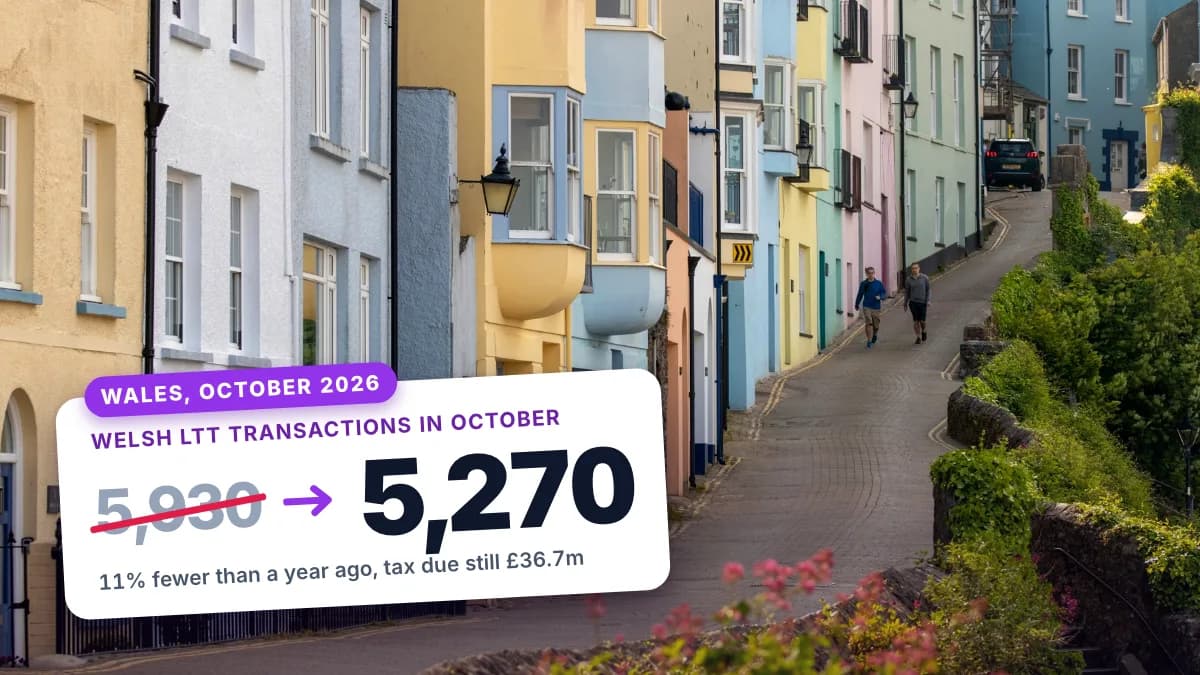
The Welsh Revenue Authority's 20 November release adds October 2026. Tax due on Welsh property transactions effective in October was £36.7m, against £36.4m a year earlier, on 5,270 transactions, 11% fewer. Residential tax due fell 5% and non-residential tax due rose to £7.1m. For April to October, tax due was £223.1m, 1.7% more than the same months of 2025 on the WRA's current figures and 0.7% less on first estimates, which treat both years the same way.
Key Takeaways
- The Welsh Revenue Authority (WRA) published Land Transaction Tax statistics for October 2026 on 20 November 2026. They cover Wales only and count transactions and tax due by effective date. The October figures are provisional
- Tax due on transactions effective in October 2026 was £36.7m, against £36.4m in October 2025. There were 5,270 transactions, 11% fewer than the 5,930 now recorded for October 2025
- The first estimate for October 2025, published a year ago, was 5,760 transactions and £37.1m. Against that, October 2026 had 8.5% fewer transactions and 1.1% less tax due. This is the closer like-for-like comparison, because October 2025 has since gained late returns and lost tax to higher rates refunds
- Residential tax due fell 5% to £29.6m. Of the 610 fewer residential transactions, 460 were at £225,000 or less, where a main-rates buyer pays no LTT
- Non-residential tax due rose to £7.1m from £5.2m. Transactions over £2 million accounted for £4.5m of it
- For April to October 2026, tax due was £223.1m against £219.4m in the same months of 2025, up 1.7%, on 34,550 transactions against 35,300, down 2.1%. Summing each month's first estimate, which treats both years the same way, tax due was 0.7% lower
- Higher rates figures for 2026 look stronger than 2025 because refunds are recorded against the original purchase month, and most claims on 2026 purchases have not been made yet. On first estimates, higher rates transactions were 3.9% fewer and the additional revenue from them 3.5% lower
- LTT paid to the WRA, a separate cash measure, was £29.6m in October 2026 against £34.1m in October 2025, and £205.7m for April to October against £218.9m
- Weekly submissions fell to 870 in the week beginning 7 November 2026, against 1,220 in the same week of 2025. The WRA's chart description notes the fall in the latest week
- Residential LTT rates did not change over the period. The Welsh Government's Draft Budget 2027-28 keeps LTT rates and thresholds unchanged for 2027-28. The next release, with November data, is due on 23 December 2026
Latest Month: October 2026
WRA release published 20 November 2026, covering returns received up to 16 November 2026. Next release: 23 December 2026.
The Welsh Revenue Authority publishes Land Transaction Tax statistics every month. LTT replaced stamp duty in Wales in April 2018, so these figures do not include England, Scotland or Northern Ireland. Transactions and tax due are counted by effective date, which is usually the completion date. The latest month is provisional, and the WRA revises earlier months as late returns arrive and higher rates refunds are claimed. The September column below is the revised figure from this release.
| Wales, LTT by effective date | Oct 2025 | Sep 2026 | Oct 2026 | v Sep 2026 | v Oct 2025 |
|---|---|---|---|---|---|
| Total transactions | 5,930 | 4,920 | 5,270 | +7% | -11% |
| Residential transactions | 5,370 | 4,420 | 4,760 | +8% | -11% |
| of which at higher rates | 1,020 | 920 | 930 | +1% | -9% |
| Non-residential transactions | 560 | 500 | 510 | +2% | -9% |
| Residential tax due | £31.2m | £26.5m | £29.6m | +12% | -5% |
| of which additional revenue from higher rates | £9.6m | £9.0m | £9.3m | +3% | -3% |
| Non-residential tax due | £5.2m | £5.0m | £7.1m | +42% | +37% |
| Property value taxed | £1,464m | £1,250m | £1,370m | +10% | -6% |
| Total tax due | £36.4m | £31.4m | £36.7m | +17% | +1% |
October was also busier than September in 2024 and 2025, so the comparison with October 2025 is the better guide. On that comparison, total tax due was £0.3m higher on 660 fewer transactions. Residential tax due was £1.6m lower and non-residential tax due £1.9m higher. Additional revenue from the higher rates was £9.3m, 31% of residential tax due.
October compared like for like
The October 2025 column above has had a year to change. Late returns have been added, and higher rates refunds claimed since then have been taken off its higher rates figures and its tax due. October 2026 has had neither. The WRA publishes the first estimate it made for each month in worksheets A1 and A2, and setting the two first estimates side by side removes most of that difference.
| October, first estimates | Oct 2025 | Oct 2026 | Change |
|---|---|---|---|
| Total transactions | 5,760 | 5,270 | -8.5% |
| Residential transactions | 5,240 | 4,760 | -9.2% |
| Higher rates transactions | 1,080 | 930 | -13.9% |
| Residential tax due | £32.1m | £29.6m | -7.8% |
| Additional revenue from higher rates | £11.1m | £9.3m | -16.2% |
| Non-residential tax due | £5.0m | £7.1m | +42.0% |
| Total tax due | £37.1m | £36.7m | -1.1% |
On this basis the fall in transactions is smaller, 8.5% against 11%, and the fall in higher rates purchases is larger, 13.9% against 9%. Total tax due is 1.1% lower. Both columns will be revised: October 2026 will gain late returns and lose tax to refunds over the coming months, as October 2025 did.
Residential transactions by price
| Price band, October | Transactions 2025 | Transactions 2026 | Change | Tax due 2025 | Tax due 2026 |
|---|---|---|---|---|---|
| Up to £180,000 | 2,250 | 1,880 | -16% | £3.0m | £2.6m |
| £180,001 to £225,000 | 790 | 700 | -11% | £0.9m | £0.9m |
| £225,001 to £250,000 | 420 | 390 | -7% | £0.9m | £1.1m |
| £250,001 to £400,000 | 1,300 | 1,190 | -8% | £8.9m | £8.1m |
| £400,001 to £750,000 | 530 | 540 | +2% | £12.3m | £12.1m |
| £750,001 to £1.5m | 70 | 60 | n/a | £4.2m | £4.4m |
| Over £1.5m | 10 | Suppressed | n/a | £0.9m | Suppressed |
| All residential | 5,370 | 4,760 | -11% | £31.2m | £29.6m |
There were 610 fewer residential transactions than in October 2025, and 460 of them were at £225,000 or less, where a buyer on main rates pays no LTT. Transactions between £400,001 and £750,000 were 540, slightly up, and that band produced £12.1m, 41% of residential tax due, from 11% of transactions. That is why residential tax due fell 5% while residential transactions fell 11%.
Tax due in each band includes the higher rates, which is why the bands up to £225,000 still show tax due. Counts are rounded to the nearest 10, so we do not show a change for the two smallest bands, and the WRA suppresses the over £1.5m band for October 2026 because too few transactions fall in it. The October 2025 column includes a year of late returns, and its tax due is net of refunds claimed since.
Non-residential
Non-residential tax due was £7.1m in October 2026, against £5.2m in October 2025 and £5.0m in September 2026. Transactions valued at more than £2 million, excluding rent, accounted for £4.5m of it, against £2.5m in October 2025. The WRA rounds counts to the nearest 10 and shows about 20 such transactions, against about 10 a year earlier. Non-residential transactions overall were 510, against 560.
A handful of large deals can move the monthly figure a long way. In the seven months of 2026-27 so far, non-residential tax due has ranged from £3.0m in June to £8.1m in July.
April to October: The Financial Year So Far
These are the first seven months of 2026-27 against the same months of 2025-26, on the WRA's current figures. The 2026 column is the WRA's own to-date row. The 2025 column is our sum of the monthly figures.
| April to October, by effective date | 2025 | 2026 | Change |
|---|---|---|---|
| Total transactions | 35,300 | 34,550 | -2.1% |
| Residential transactions | 31,750 | 31,070 | -2.1% |
| of which at higher rates | 5,980 | 6,150 | +2.8% |
| Non-residential transactions | 3,560 | 3,470 | -2.5% |
| Residential tax due | £170.6m | £181.5m | +6.4% |
| of which additional revenue from higher rates | £52.5m | £58.6m | +11.6% |
| Non-residential tax due | £48.6m | £41.6m | -14.4% |
| Total tax due | £219.4m | £223.1m | +1.7% |
Tax due is £3.7m higher than a year earlier on 750 fewer transactions. Residential tax due is £10.9m higher and non-residential tax due £7.0m lower. The residential and higher rates lines are flattered by refunds, because the 2025 months have had a year longer for them to be claimed and deducted. The next section puts both years on the same footing.
Most of the non-residential gap is April 2025, when non-residential tax due was £12.5m, £8.8m of it from transactions over £2 million. From May to October, summed from the monthly figures, non-residential tax due was £36.4m in 2026 against £36.1m in 2025.
55% of residential transactions from April to October 2026 (17,210 of 31,070) were at £225,000 or less, where a buyer on main rates pays no LTT.
Why the Higher Rates Figures Look Stronger Than They Are
A buyer who pays the higher rates while replacing a main home can claim back the higher rates element if the previous main residence is sold within 3 years. The WRA's refunds table counts each refund against the effective date of the original purchase, and its estimates tables show higher rates figures net of refunds claimed. So the higher rates figures for any recent month start high and fall as claims arrive. The cover sheet of the release gives refunds and late returns as the two reasons earlier months are revised.
So far, 730 refunds worth £13.2m have been made on April to October 2025 purchases, against 200 worth £4.1m on purchases from April 2026 onwards. For September 2026 purchases there have been 10 refunds worth £0.2m, against 90 worth £1.7m on September 2025 purchases. The October 2026 figure is suppressed because it is too small to publish.
Refund payments have not fallen. On a cash basis, the WRA paid 1,090 higher rates refunds worth £18.5m in April to October 2026, against 1,020 worth £16.0m in the same months of 2025. Most claims on 2026 purchases are still to come.
Summing the first estimate for each month treats both years the same way, because each first estimate was published about three weeks after the month ended, before most refunds and some late returns. These are our sums of the WRA's first estimates in worksheets A1 and A2.
| April to October | 2025 | 2026 | Change |
|---|---|---|---|
| Higher rates transactions, current figures | 5,980 | 6,150 | +2.8% |
| Higher rates transactions, first estimates | 6,460 | 6,210 | -3.9% |
| Additional revenue from higher rates, current figures | £52.5m | £58.6m | +11.6% |
| Additional revenue from higher rates, first estimates | £63.4m | £61.2m | -3.5% |
| Total tax due, current figures | £219.4m | £223.1m | +1.7% |
| Total tax due, first estimates | £225.2m | £223.7m | -0.7% |
On first estimates, higher rates purchases in Wales were 3.9% fewer than a year earlier and the additional revenue from them 3.5% lower. Total tax due was 0.7% lower, and transactions 0.8% fewer (34,070 against 34,340).
A comparison to avoid
Higher rates figures for recent months should not be set against older months on the WRA's current figures, because the older months have had longer for refunds to be deducted. Compare first estimates, or wait until both periods have had the same time for claims.
LTT Paid to the WRA
Worksheet 7 of the release records LTT paid to the Welsh Revenue Authority in each month. This is a cash measure. It counts payments when the WRA receives them, and a return and payment are due within 30 days of the effective date, so a month's payments mostly relate to transactions in the weeks before. It does not line up with tax due by effective date, so we compare it only with itself.
| LTT paid to the WRA, cash basis | 2025 | 2026 | Change |
|---|---|---|---|
| October | £34.1m | £29.6m | -13% |
| April to October | £218.9m | £205.7m | -6.0% |
The 2026 April to October figure is the WRA's to-date row and the 2025 figure is our sum of the monthly payments. For the whole of 2025-26, LTT paid to the WRA was £364.0m.
Weekly Returns Into November
Worksheet 8 counts transactions submitted to the WRA each week, whatever their effective date. It is the most recent data in the release, covering submissions up to 13 November 2026.
In the week beginning 7 November 2026, 870 transactions were submitted, against 1,220 in the week beginning 8 November 2025, a fall of 29%. In the five weeks beginning 3 October to 31 October 2026, submissions ranged from 1,110 to 1,250 a week.
The WRA's description of the chart in the release says: “The weekly numbers of transactions submitted since April 2025 were generally higher than or similar to the same week in the previous year, except for the fall seen in the latest week.” The release itself has no other commentary.
On our reading of the same table, the weeks beginning 17, 24 and 31 October 2026 were also 9% to 13% below the matching weeks of 2025. A single week is a small sample. The November figures, due on 23 December, will show whether the fall continued.
Scotland and England
Revenue Scotland publishes monthly LBTT figures on returns received each month, which we cover in our LBTT statistics article. HMRC publishes monthly cash receipts of Stamp Duty Land Tax for England and Northern Ireland, covered in our SDLT receipts article.
Each authority measures something different: tax due by effective date in Wales, tax declared on returns received in Scotland, and cash received by HMRC for England and Northern Ireland. The three cannot be added together into a single UK figure.
What This Means for Buyers in Wales
Nothing in this release changes what a buyer pays. Main residential rates have been the same since 10 October 2022, with nothing to pay on the first £225,000. The higher rates have been the same since 11 December 2024 and start at 5% on the first £180,000. Wales has no first-time buyer relief, so a first-time buyer pays main rates like any other main-rates buyer. The full bands are on our current LTT rates page.
The Welsh Government's Draft Budget 2027-28, published on 17 November 2026, said the residential and non-residential rates and thresholds for LTT will remain unchanged for 2027-28. The draft budget goes through Senedd scrutiny before it is final.
For a buyer paying the higher rates while replacing a main home, the refund matters more than these statistics. The WRA says the previous main residence must be sold within 3 years of buying the new property, and the refund is claimed from the WRA through an online form.
Annexe, land or an old home not sold yet?
These are the purchases where a standard calculator can get your stamp duty wrong. Get it checked before you exchange.
Frequently Asked Questions
How much Land Transaction Tax was due in October 2026?
The Welsh Revenue Authority's 20 November 2026 release shows £36.7m of LTT due on transactions effective in October 2026: £29.6m residential, including £9.3m of additional revenue from the higher rates, and £7.1m non-residential. The figures are provisional and will be revised.
How many property transactions were there in Wales in October 2026?
The WRA recorded 5,270 transactions effective in October 2026: 4,760 residential, of which 930 paid the higher rates, and 510 non-residential. That is 11% fewer than the 5,930 now recorded for October 2025, and 8.5% fewer than the first estimate for October 2025 (5,760).
Is Welsh LTT going up or down in 2026-27?
About level. Tax due for April to October 2026 was £223.1m against £219.4m in the same months of 2025, up 1.7% on the WRA's current figures. Summing the first estimates for each month, which treats both years the same way, it was £223.7m against £225.2m, down 0.7%. Transactions were 2.1% lower on current figures.
Why do the higher rates figures look higher in 2026 than in 2025?
Because higher rates refunds are recorded against the month of the original purchase, and a buyer has 3 years to sell a previous main home and claim. £13.2m has been refunded so far on April to October 2025 purchases, against £4.1m on purchases from April 2026. On first estimates, higher rates transactions for April to October were 3.9% fewer in 2026 and the additional revenue 3.5% lower.
How long do you have to claim a higher rates LTT refund in Wales?
The WRA says you must have sold your previous main residence within 3 years of buying the new property, and a longer period can apply in certain situations. The buyer, their solicitor or conveyancer if still acting, or someone authorised to act for them applies to the WRA through an online form.
Is tax due the same as LTT paid to the WRA?
No. Tax due is counted against the effective date of each transaction. LTT paid is cash received by the WRA in the month, which usually follows the effective date. The WRA publishes both, and they should not be compared with each other. LTT paid was £29.6m in October 2026 and £205.7m for April to October 2026.
Do these figures include England or Scotland?
No. LTT applies only in Wales and is collected by the Welsh Revenue Authority. Stamp Duty Land Tax in England and Northern Ireland is collected by HMRC, and Land and Buildings Transaction Tax in Scotland by Revenue Scotland. Each publishes its own figures on its own basis.
When is the next LTT statistics release?
The WRA's next release, with November 2026 data, is due at 9.30am on 23 December 2026. The October figures were published on 20 November 2026.
Calculate Your LTT
These statistics describe totals across Wales. For the LTT on a specific Welsh purchase at main or higher rates, use the calculator.
Use Wales LTT CalculatorSources
- Land Transaction Tax statistics: October 2026, Welsh Revenue Authority, published 20 November 2026
- Land Transaction Tax statistics tables, October 2026 (spreadsheet), Welsh Revenue Authority
- Written statement: Draft Budget 2027-28, devolved Welsh taxes, Welsh Government, 17 November 2026
- Claim a refund of Land Transaction Tax higher rates, Welsh Revenue Authority guidance
Figures are from the Welsh Revenue Authority's October 2026 release, covering returns and amendments received up to 16 November 2026 (weekly submissions to 13 November 2026). Transactions and tax due are by effective date. October 2026 is provisional, and earlier months are revised for late returns and higher rates refunds. The WRA rounds transactions to the nearest 10, tax to the nearest £0.1m and property values to the nearest £1m. The 2026-27 to-date figures are the WRA's own rows, calculated from unrounded values. April to October 2025 totals, May to October totals and first-estimate totals are our sums of the WRA's monthly figures, so they can differ from unrounded totals by a few tenths. Worksheet 1 excludes a small number of untypically large transactions and transactions with restricted detail. The WRA reports the tax on those separately by financial year, and records none for 2024-25 or 2025-26. LTT paid to the WRA is a cash measure and is not comparable with tax due. All figures cover Wales only. This article is not tax advice and is not affiliated with the Welsh Revenue Authority.
Reviewed by

Julie White
ACAStamp duty specialist since 1999Stamp Duty Land Tax Specialist
ACA and Tax Adviser with a career spanning nearly four decades, specialising in stamp duty planning and advisory work since 1999.