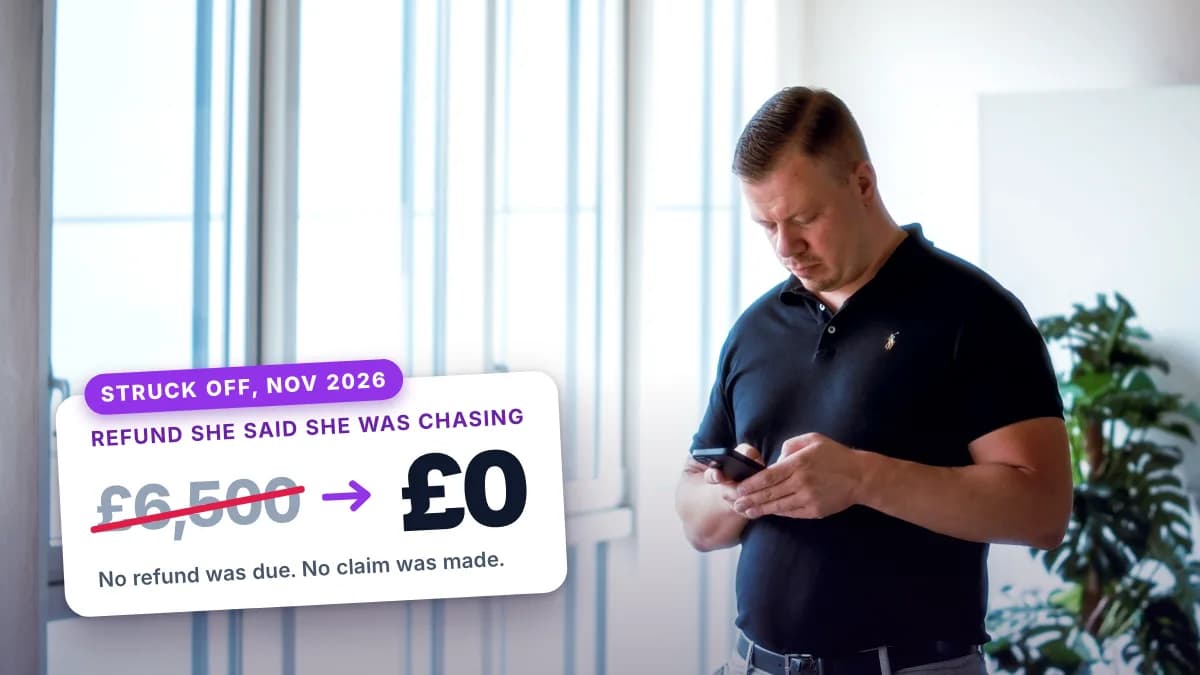
Solicitor Struck Off After Telling a Client for Most of 2023 That She Was Chasing a £6,500 Stamp Duty Refund. No Claim Was Made
In February 2023 a London solicitor told a client that he and his partner might be owed about £6,500 of stamp duty land tax. That advice was wrong. From then until December 2023 she told him over WhatsApp that she, a trainee and the firm's directors were chasing HMRC, and in November she sent him a screenshot of an email she had written herself. No claim was ever made. The Solicitors Disciplinary Tribunal has struck her off.
Solicitors Regulation Authority v Kimberley Clift, Solicitors Disciplinary Tribunal case 12886-2026, judgment on agreed outcome, dealt with on the papers on 4 November 2026, dated 10 November 2026.
Key Takeaways
- Solicitors Regulation Authority v Kimberley Clift, case 12886-2026: the Solicitors Disciplinary Tribunal approved an agreed outcome striking the solicitor off the roll, with £4,000 costs. It dealt with the case on the papers on 4 November 2026
- On 10 February 2023 she told a client by WhatsApp that he and his partner might be owed a stamp duty land tax refund of about £6,500. The agreed facts say that was not correct
- From 25 February to 11 December 2023 she repeatedly told him she was contacting HMRC by phone and in writing, and that a trainee and directors at the firm were chasing the refund. None of it was true, and no refund was ever requested
- On or around 28 November 2023 she sent him a screenshot made to look like an email from the firm's accounts department. She had written it herself
- She admitted both allegations, including dishonesty. The tribunal recorded no financial loss to the client, no gain for her, insight, remorse and cooperation, but found no exceptional circumstances
- A genuine SDLT refund claim includes every buyer, and a solicitor claiming for a client should send HMRC a letter of authority from all of them. HMRC pays the buyers, usually within 15 working days of receiving the claim
What the Tribunal Decided
The Solicitors Disciplinary Tribunal (SDT) has struck Kimberley Clift off the roll of solicitors in Solicitors Regulation Authority v Kimberley Clift (case 12886-2026). The tribunal, Mrs F Kyriacou (chair), Ms V Kaye and Ms K Wright, approved a statement of agreed facts and outcome signed by both parties on 28 October 2026. It dealt with the case on the papers on 4 November 2026, with no appearances, and the judgment is dated 10 November 2026.
Ms Clift admitted both allegations brought by the Solicitors Regulation Authority (SRA), including dishonesty. The tribunal found them proved, with breaches of Principles 2 (public trust and confidence), 4 (honesty) and 5 (integrity) of the SRA Principles 2019 and paragraph 1.4 of the SRA Code of Conduct for Solicitors (judgment, paragraphs 2 and 11). It also ordered her to pay £4,000 towards the SRA's costs, “not to be enforced without the leave of the Tribunal” (paragraph 17).
The £6,500 Refund: What the Agreed Facts Say
Ms Clift was admitted as a solicitor on 15 June 2016. At the time of the misconduct she was an associate solicitor in the real estate finance team at Lawrence Stephens Limited, a London firm. Client A was her client and was also known to her personally. In 2022 she advised him on buying a residential property, and the purchase completed in September 2022 (agreed statement, paragraphs 2, 4 and 5). The timeline after that:
- 10 February 2023: she told Client A by WhatsApp that he and his partner “had potentially overpaid on stamp duty and may be owed a refund of approximately £6500”. The agreed statement records that “this was not correct” (paragraph 6), and the tribunal found: “That advice was incorrect” (judgment, paragraph 5). Neither document says what the overpayment was thought to be.
- 25 February to 11 December 2023: she repeatedly told him over WhatsApp that she was contacting HMRC in writing and by phone to pursue the refund, and that a trainee and directors at the firm were chasing it up. On 23 June 2023 she wrote that “one of the Directors has a scheduled call with someone at HMRC at 1.30”. Each of these representations was untrue, and no trainee or director had contacted HMRC on his behalf (paragraphs 7 and 8).
- On or around 28 November 2023: she sent him a screenshot showing what appeared to be an email from the firm's accounts department asking for an update. She had created it, and the accounts department had sent no such email (paragraph 9).
- 13 March 2024: Client A complained to the firm. Asked where the screenshot came from, she replied by email on 22 April 2024: “I wrote the email out on my phone and took a screenshot. It was sent on 28th November. Nothing further was created by me, this was the only one.” (paragraph 10).
- 9 May 2024: at an investigatory meeting she said of the refund: “I had not done anything about it. I had understood it was a case of writing to HMRC with copies of documents and requesting a refund that way.” (paragraph 11.1).
- 28 May 2024: after a disciplinary meeting on 23 May 2024, at which she confirmed that each representation that she was chasing the refund was untrue, the firm summarily dismissed her for what it determined was a “serious regulatory matter” (paragraphs 12 and 13).
Representations made for her in July 2024 accepted that she “had not, in fact, requested any refund”, and offered a “genuine, and sincere, apology, regret and remorse for what occurred” (paragraph 14). So throughout the months in which Client A was told the refund was being chased, no claim had gone to HMRC, and the advice that started it was not correct.
Why the Tribunal Struck Her Off
The tribunal applied its Guidance Note on Sanctions (11th edition, February 2025), looking at culpability, harm, and the aggravating and mitigating features in the agreed outcome. On seriousness it said (judgment, paragraph 13):
“The misconduct was serious. The Respondent knowingly maintained a false account to Client A over a sustained period and created false material to support it. The conduct was repeated, involved concealment of an earlier error, and was liable to undermine public trust and confidence in solicitors and in the authenticity of communications put forward by them.”
It took account of the agreed mitigation (paragraph 14):
- she had no previous regulatory history
- she obtained no financial or personal gain, and Client A suffered no financial loss
- she had demonstrated insight and remorse, made admissions, and cooperated with the firm and the SRA
- she relied on positive character evidence
- she had taken steps to address the personal and psychological difficulties relied on in mitigation
In the agreed statement she accepted that Client A “was entitled to accurate information” and that, once she realised the matter had not been properly progressed, she should have addressed the position openly with him (paragraph 19).
The tribunal then said that “dishonesty is incompatible with continued membership of the solicitors' profession unless exceptional circumstances are established”. Having considered the nature, extent and duration of the misconduct and all the mitigation, it was not satisfied that exceptional circumstances existed, and concluded that striking off “was the only appropriate and proportionate sanction” (paragraph 15). The parties agreed the £4,000 costs contribution having regard to her means and the effect of the strike-off on her future earning capacity (agreed statement, paragraph 27).
If You Have Been Told an SDLT Refund Is Coming
The refund in this case was never due, and no claim for it was ever made. A buyer told that a refund is being pursued for them can check that against what a real claim involves. GOV.UK sets out these routes for England and Northern Ireland:
- Amending the return within 12 months of the filing date of the SDLT return, online or by letter. This covers, for example, a relief that was not claimed, residential rates paid where non-residential rates applied, or a mistake in the calculation.
- Overpayment relief, once more than a year has passed since the filing date: a written claim, made no more than 4 years after the effective date of the transaction (usually the completion date).
- The higher rates refund, if you paid the surcharge on a new main home and sold your previous main home within 3 years. HMRC must receive the claim by the later of 12 months after the sale and 12 months after the filing date of the new home's return. It is made online or on form SDLT16.
What a Real Claim Leaves on Paper
- Every buyer is on it. All purchasers must be included on a claim. A postal amendment needs the signatures of all the buyers, and an overpayment relief claim needs a signed declaration from each buyer.
- Your written authority. A solicitor or agent asking HMRC for a refund for a client should include a letter of authority from all the buyers on the return. For the higher rates refund, an agent needs a signed letter of consent from the main buyer.
- The UTRN. A postal amendment, an overpayment relief claim and a higher rates refund claim all quote the Unique Transaction Reference Number of the original return.
- A payment to the buyers. HMRC pays refunds to the purchasers unless they sign a letter telling it to pay someone else. It usually pays into the bank account within 15 working days of receiving the claim, and may write by post if it needs more information.
HMRC pays before checking eligibility and has up to 9 months to open a compliance check. GOV.UK also says that if you paid an agent to claim for you, you are still responsible for checking that the claim is correct.
Checking Your Own Position
If a refund has been in progress for months with no payment and no letter from HMRC, ask whoever is handling it for a copy of the amended return or claim, the date it was sent, and the authority you signed. The buyer is the taxpayer and can also contact HMRC directly, quoting the UTRN: our HMRC stamp duty contact guide lists the helpline.
Our stamp duty refund guide covers each route, its deadlines and its exclusions, and the second home stamp duty refund page covers the surcharge refund. Disputed claims can end at the First-tier Tribunal. In the towpath case, Wood v HMRC, and the woodland case, Guerlain-Desai v HMRC, the buyers amended their returns and won their appeals against HMRC.
Frequently Asked Questions
What did the Solicitors Disciplinary Tribunal decide about Kimberley Clift?
It struck her off the roll of solicitors and ordered her to pay £4,000 towards the Solicitors Regulation Authority's costs, not to be enforced without the tribunal's leave. The case, SRA v Kimberley Clift (12886-2026), was dealt with on the papers on 4 November 2026 as an agreed outcome, and the judgment is dated 10 November 2026. She admitted both allegations, including dishonesty.
Was the client actually owed a stamp duty refund?
No. On 10 February 2023 she told him by WhatsApp that he and his partner might be owed a stamp duty land tax refund of about £6,500. The agreed facts record that this was not correct, and the tribunal found that the advice was incorrect. Representations made for her in July 2024 accepted that she had not requested any refund from HMRC.
Did the client lose money?
The tribunal recorded that Client A suffered no financial loss and that she obtained no financial or personal gain. It took both into account as mitigation, together with her lack of any previous regulatory history, her insight, remorse, admissions and cooperation, and positive character evidence.
Why was she struck off despite the mitigation?
The tribunal said dishonesty is incompatible with continued membership of the solicitors' profession unless exceptional circumstances are established. Having considered the nature, extent and duration of the misconduct and all the mitigation, it found no exceptional circumstances. It described the misconduct as serious: a false account maintained over a sustained period, with false material created to support it.
What does a genuine SDLT refund claim involve?
An amended SDLT return within 12 months of the return's filing date, a written overpayment relief claim up to 4 years after the effective date of the transaction, or a higher rates refund claim after selling a previous main home. All buyers must be included, and a solicitor or agent claiming for a client should send HMRC a letter of authority from all the buyers. HMRC pays the refund to the buyers unless they sign a letter telling it to pay someone else, usually within 15 working days of receiving the claim.
Check What You Paid
Our refund calculator covers the higher rates refund after selling a previous home, the non-resident surcharge refund and a first-time buyer overpayment, and shows whether a claim is still in time. For the rates on the date you bought, use the historical stamp duty calculator.
Use the Stamp Duty Refund CalculatorSources
- SRA v Kimberley Clift, case 12886-2026: judgment on agreed outcome and statement of agreed facts and outcome, Solicitors Disciplinary Tribunal
- Case number 12886, Solicitors Disciplinary Tribunal
- Kimberley Clift, SRA ID 593128, Solicitors Regulation Authority solicitor check
- Strike-off for solicitor who sent fake screenshot to client, Legal Futures, 24 November 2026
- Apply for a refund of Stamp Duty Land Tax, GOV.UK
- Stamp Duty Land Tax: refunds of Stamp Duty Land Tax, GOV.UK
- Apply for a refund of the higher rates of Stamp Duty Land Tax, GOV.UK
This article summarises a published tribunal judgment and is not legal or tax advice. It is not affiliated with HMRC, GOV.UK, the SRA or the Solicitors Disciplinary Tribunal.
Reviewed by

Julie White
ACAStamp duty specialist since 1999Stamp Duty Land Tax Specialist
ACA and Tax Adviser with a career spanning nearly four decades, specialising in stamp duty planning and advisory work since 1999.